
Electric vehicle subsidy in India in 2026 comes from a mix of PM E-DRIVE (Central scheme), state subsidies, and tax benefits. Electric scooters get up to ₹2,500 per kWh (capped at ₹5,000), while electric cars benefit through GST reduction, road tax exemptions, and state incentives up to ₹1.5 lakh. To maximize savings, you need to combine Central + state + tax benefits properly.
What Is Electric Vehicle Subsidy in India?
Electric vehicle subsidy in India is not a single flat discount. It is a combination of multiple incentives that reduce your total cost at different stages, including purchase, registration, and taxes.
Under PM E-DRIVE, buyers receive an upfront discount at purchase, which is reimbursed to manufacturers by the government.
Here’s how it works:
- At purchase: A per-kWh subsidy is applied directly to your invoice under schemes like PM E-DRIVE, reducing the upfront price
- At registration: Many states offer full road tax exemption and waive registration fees
- At tax time: Buyers can claim up to ₹1.5 lakh deduction on EV loan interest under Section 80EEB
- Built into pricing: EVs are taxed at just 5% GST, compared to 28% for petrol or diesel vehicles
What actually determines your savings is a two-layer system:
- The Central government defines eligibility, subsidy rates, and vehicle categories
- State governments decide buyer-facing incentives like tax exemptions and additional subsidies
This means your total benefit depends heavily on where you register your vehicle.
In practice, subsidies are designed to be combined.
A buyer in Delhi or Maharashtra can combine Central incentives with state subsidies, road tax waivers, and registration exemptions on the same vehicle.
That’s how EV subsidy in India really works:
Not one discount, but multiple incentives running together to reduce your final cost.
Types of EV Subsidies in India
Central level: PM E-DRIVE (what replaced FAME II)
The Central government’s Electric veichle subsidy in India now flows through PM E-DRIVE – launched in October 2024, with a total outlay of ₹10,900 crore. It replaced the older FAME programme (FAME II officially ended in March 2024), which had clocked 22+ lakh EV sales before closing.
Where things stand in April 2026:
- Electric scooters / E-2Ws: ₹2,500 per kWh, capped at ₹5,000 per vehicle, and running till July 31, 2026. Ex-factory price must stay under ₹1.5 lakh
- E-rickshaws and e-carts: eligible until March 2028, with a ₹12,500 per vehicle cap
- L5 three-wheelers: closed December 2025 – the allocation ran out early
- Electric cars (e-4Ws): no direct purchase subsidy from the Centre, but the 5% GST rate (vs 28%+ on ICE vehicles) does real work on pricing
- E-buses: 14,000+ targeted across nine cities
- Charging infra: 22,100 fast chargers for four-wheelers and 48,400 for two/three-wheelers are being targeted
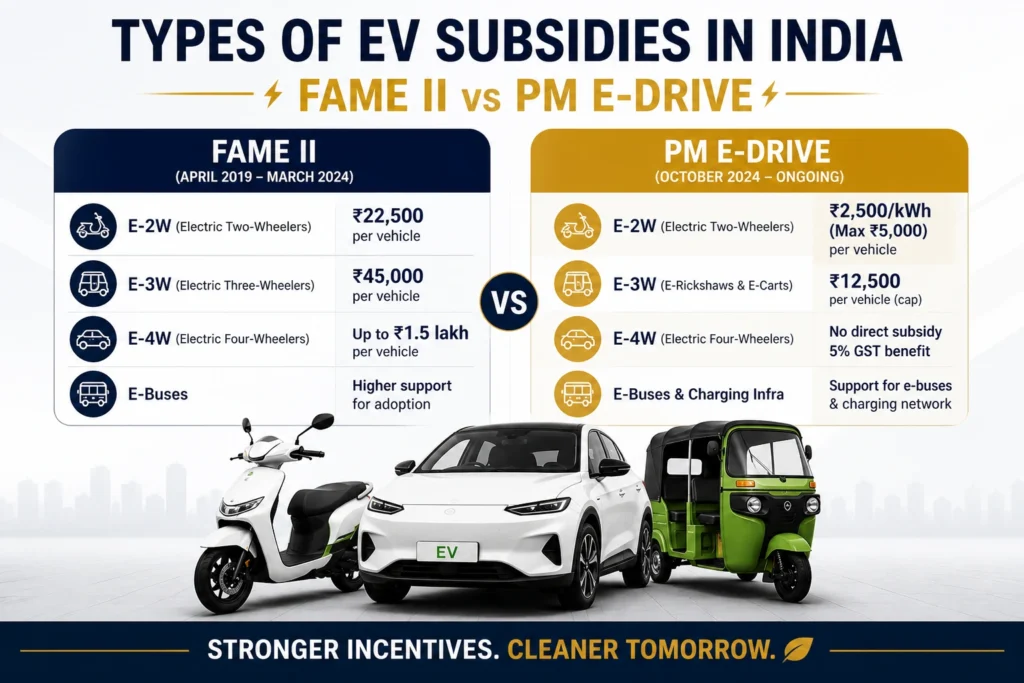
FAME II vs PM E-DRIVE – what actually changed
Under FAME II, the electric scooter subsidy ran as high as ₹22,500 per vehicle. PM E-DRIVE cut that to ₹10,000 in Year 1, then ₹5,000 from April 2025. The signal is deliberate – the government is nudging the market toward self-sustainability rather than keeping it on subsidy indefinitely.
State government EV subsidies
State incentives layer on top of PM E-DRIVE, and this is often where the bigger savings actually live — especially for electric car buyers, who get nothing directly from the Centre.
The most generous states for individual buyers right now: Delhi, Maharashtra, Gujarat, and Rajasthan.
For EV manufacturers and companies building charging infrastructure, the quantum is a different order of magnitude altogether – PLI schemes, SGST refunds, capital subsidies. Bizastra’s government subsidy schemes services cover that full details.
State-by-State EV Subsidy in India – 2026 Breakdown
Your registration state matters more than most buyers realise. The EV subsidy in Delhi is a completely different story from what you’d get in Karnataka or Tamil Nadu. Here’s where each major state stands:
| State | E-2W Subsidy | E-4W Subsidy | Road Tax | Registration |
|---|---|---|---|---|
| Delhi | Up to ₹30,000 | Up to ₹1.5 lakh | 100% exempt | Waived |
| Maharashtra | Up to ₹25,000 | Up to ₹2.5 lakh | 100% exempt | Waived |
| Gujarat | Up to ₹20,000 | Up to ₹1.5 lakh | 50% reduced | Waived |
| Rajasthan | Up to ₹10,000 | Up to ₹1 lakh | 100% exempt | Waived |
| Karnataka | No direct subsidy | 10–15% of ex-factory | 5–10% tiered (from Apr 2026) | Exempt (under ₹25L) |
| Tamil Nadu | — | — | 100% waiver | Waived |
| Telangana | — | — | 100% exempt (until Dec 2026) | Waived |
| Madhya Pradesh | Varies | Varies | Exempt | Waived |
State subsidies come with expiry dates – and registration caps
Maharashtra’s early-bird subsidy covered the first 1,00,000 EVs registered. Once a state hits its cap, the subsidy closes – even if the scheme is still “active” on paper. Always check your state’s EV portal before assuming you’ll get it.
Electric Vehicle Tax Benefits – the Money People Often Miss
Beyond what happens at the dealership, electric car tax benefits in India can add another ₹1.5–4 lakh in savings – most of it through income tax deductions and the GST differential. Most buyers don’t bother to look, which is a significant amount to leave behind.
Section 80EEB – deduction on EV loan interest
Up to ₹1,50,000 per year can be deducted on the interest you pay on an EV loan.
There’s a hard constraint though – and it trips a lot of people up:
- Only loans sanctioned between April 1, 2019 and March 31, 2023 are eligible
- It works only under the old tax regime – switch to the new regime and you lose it
- Available only to individual taxpayers – companies, HUFs, and partnership firms can’t claim it
- Continues year on year until the loan is fully repaid
Loan sanctioned after March 2023? This deduction doesn’t exist for you – Parliament didn’t extend it.
The GST angle
- EVs: 5% GST – petrol and diesel cars attract 28%, plus a cess that pushes the effective rate even higher
- EV chargers: also 5% GST – vs the standard 18%
- On a ₹15 lakh EV, the GST saving alone works out to roughly ₹3.5 lakh – that’s before any other incentive
Who Actually Qualifies for EV Subsidy in India?
Eligibility shifts based on which scheme you’re looking at, what kind of vehicle you’re buying, and where you’re registering it. These are the conditions worth checking before you assume the subsidy is yours:
- Battery type: has to be lithium-ion or an approved equivalent and lead-acid battery vehicles won’t qualify for it.
- OEM registration: the vehicle’s manufacturer must be registered under PM E-DRIVE; not every brand on the road is listed
- Price ceiling: for e-2Ws, the ex-factory price must stay at or below ₹1.5 lakh; state caps on e-4Ws vary
- Aadhaar KYC: Central subsidy gets triggered through FACE authentication on the PM E-DRIVE portal – done at the dealership itself.
- Registration state: a state subsidy only applies if you register the vehicle in that state – buying in one state and registering in another costs you the incentive
- One per category: individual buyers can claim for one vehicle per eligible category
Different rules entirely for manufacturers and charging infra companies
The buyer incentives above are a fraction of what’s available at the business level. PLI Auto (₹25,938 Cr), PLI ACC Battery (₹18,100 Cr), Maharashtra’s 50–60% charging infra reimbursement, state SGST refunds, stamp duty exemptions – the stacking here runs into crores. Missing an eligibility window at that scale is costly. Government subsidy consulting services cover the full manufacturer-side picture.
How to Claim Your EV Subsidy – Step by Step
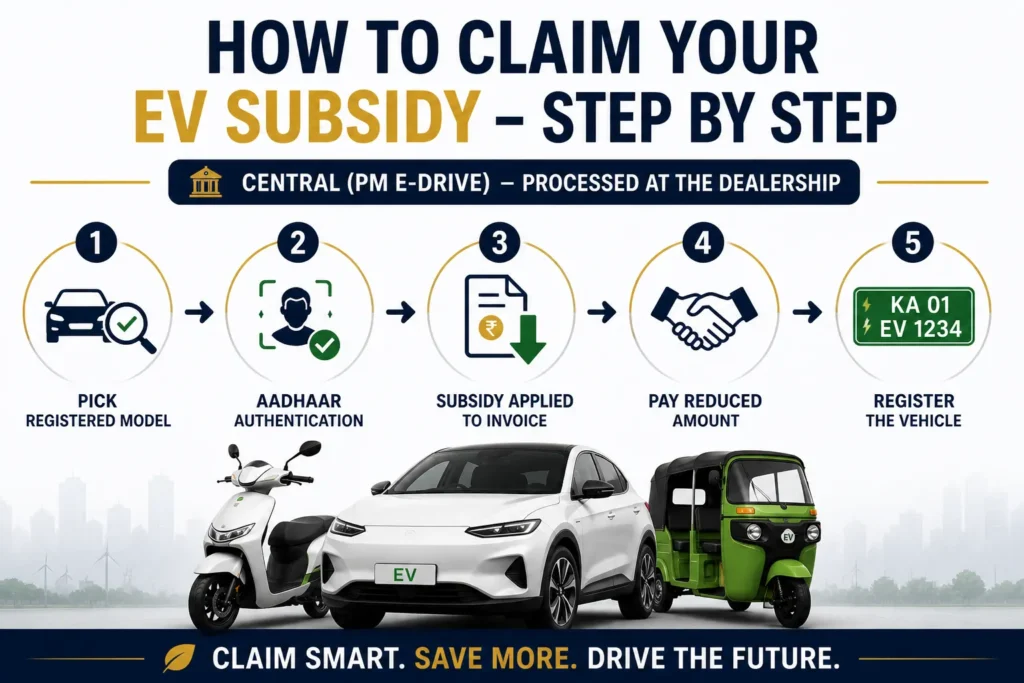
A lot of buyers assume the dealer handles everything. For the Central subsidy, they largely do. For state subsidies, you might need to file something yourself — and that’s where claims get rejected.
Central (PM E-DRIVE) – processed at the dealership
No separate application, no government portal to navigate on your own. Here’s what the process looks like:
Pick a PM E-DRIVE registered model
Ask the dealer directly – they’ll know whether their vehicles are listed. If they’re not sure about it, that’s a red flag.
Do the Aadhaar FACE authentication at the dealership
This generates your e-Voucher on the PM E-DRIVE portal. Takes a few minutes and the dealer walks you through it.
The subsidy comes off your invoice directly
You pay the reduced amount. The OEM then claims reimbursement from the government on the back end and not your problem.
Register the vehicle
EVs get green number plates. They’re also exempt from commercial permit requirements under most categories.
State subsidies – each state have different process
- Start with your state’s official EV portal and don’t rely on second-hand information about what they need
- Standard documents required: RC copy, invoice (with VIN/chassis number), Aadhaar, and bank account details
- Some states deduct the benefit at purchase; others pay it back to your bank account within 30–90 days
- Make absolutely sure the state you register in matches the state whose subsidy you’re claiming
- Keep physical originals of everything and incomplete documentation could be a reason for common rejection.
EV Subsidy Savings in India: Real Cost Breakdown Example
Here’s a worked example of how Central and state incentives combine on a single purchase – using Maharashtra, where the stack is particularly deep:
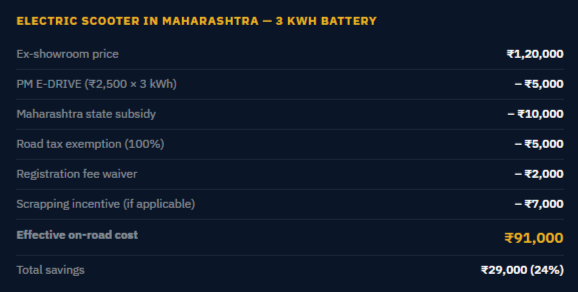
Scale that up to an electric car in Delhi: ₹1.5 lakh in state subsidy, plus a road tax waiver, plus registration exemption – that’s over ₹2 lakh off the on-road price before you even account for the GST differential. Against a comparable petrol car at 28%+ GST, the gap closes faster than most people expect.
Mistakes That Cost Buyers the Subsidy
Assuming the vehicle automatically qualifies. Imported EVs and lead-acid battery models are excluded from PM E-DRIVE. Confirm with the dealer before signing anything
Registering in the wrong state. Buy in Maharashtra, register in Karnataka – you’ve just lost the Maharashtra state subsidy. This catches people who move shortly after purchase
Waiting too long. PM E-DRIVE for e-2Ws ends July 31, 2026. The fund can close earlier if allocations run out – it’s happened before
Forgetting Section 80EEB. Buyers with loans sanctioned before March 2023 leave up to ₹1.5 lakh per year on the table. It’s a deduction — it requires nothing from the dealer, just your ITR filing
Paperwork gaps. An invoice without the VIN, a bank name that doesn’t match Aadhaar, an unsigned RC – any of these can kill a claim at the state level
Assuming the dealer filed the state claim for you. Several states require a separate buyer-side portal submission. If you don’t ask, it doesn’t happen
Businesses treating EV incentives as a single scheme. Companies setting up EV production routinely qualify for three or four overlapping schemes but apply for one. Central PLI, state EV policy, charging infra incentives – they stack. This is precisely where government scheme advisory for businesses pays for itself
Where EV Subsidies Are Headed After 2026
Buyer subsidies are contracting. The PM E-DRIVE rate already dropped from ₹10,000 to ₹5,000 per e-2W. After July 2026, it’s unlikely two-wheeler incentives survive in their current form – if they continue at all.
Commercial vehicles get a longer runway. E-buses, e-trucks, and e-ambulances have support running through 2028. Government thinking has shifted toward fleet electrification as a better use of subsidy money than individual consumer incentives.
Manufacturer incentives aren’t going anywhere. PLI Auto (running until 2028), PLI ACC Battery, and state manufacturing policies are building domestic supply chains. These are decade-horizon programmes, not short-term pumps.
States pick up the buyer incentive baton. As Central purchase subsidies wind down, what your state offers starts to matter even more. Maharashtra, Gujarat, and Tamil Nadu are competing for EV investment – expect buyer incentives to expand there even as the Centre pulls back.
Charging infra subsidies are still early. PM E-DRIVE guidelines for public charging infrastructure were only published in early 2026. With 72,000+ chargers in the pipeline, this is the next major subsidy category – and largely untapped for businesses entering the space now.
Setting Up EV Manufacturing or Charging Infrastructure?
PLI + state policies + EV-specific schemes can cover 30–50% of project cost. Bizastra’s CA-led team maps every scheme, files before deadlines, manages compliance for the full eligibility period. Free assessment in 3 business days.
₹1,000+ Cr secured · 450+ clients · CA-led · D-U-N-S® Registered · No advance
Frequently Asked Questions – Electric Vehicle Subsidy India
Is there still a subsidy on electric vehicles in India in 2026?
Yes, EV subsidy is still available in 2026 under the PM E-DRIVE scheme. Electric scooters (e-2Ws) get ₹2,500 per kWh, capped at ₹5,000, valid until July 2026. E-rickshaws are covered until March 2028. Electric cars do not get a direct Central subsidy, but they benefit from 5% GST instead of 28%+. States like Delhi, Maharashtra, and Gujarat add extra incentives.
How much can I actually save through EV subsidies in India?
Savings depend on the vehicle type and state. At the Central level, you can get up to ₹5,000 for electric scooters and ₹12,500 for e-rickshaws. State subsidies increase this significantly. Delhi offers up to ₹1.5 lakh for electric cars, while Maharashtra goes up to ₹2.5 lakh. When combined, total savings can reach ₹1.5–3+ lakh on an electric car.
Which state offers the highest EV subsidy?
Delhi and Maharashtra offer the highest EV subsidies. Delhi provides up to ₹1.5 lakh for electric cars, along with full road tax and registration exemption. Maharashtra offers up to ₹2.5 lakh, plus a scrapping incentive. Gujarat also stands out with the highest per-kWh subsidy rate for electric scooters at ₹10,000 per kWh.
Is FAME II still active?
No, FAME II ended on March 31, 2024. The EMPS scheme covered the transition from April to September 2024. After that, PM E-DRIVE replaced it starting October 2024. FAME II is no longer active.
Does the EV subsidy also reduce road tax and registration charges?
Yes, in many states it does. Delhi, Maharashtra, Tamil Nadu, and Rajasthan offer 100% exemption on road tax and registration. Gujarat provides a 50% reduction. Karnataka changed its policy in April 2026 and now applies a 5–10% tiered road tax. These policies can change, so checking the latest state notification is important.
Can I stack Central and state subsidies on the same vehicle?
Yes, you can combine both. The Central subsidy under PM E-DRIVE is applied at the dealership through an e-Voucher. The state subsidy depends on where you register the vehicle. As long as both conditions are met, you receive both benefits.
Is Section 80EEB still available for EV buyers?
Section 80EEB is available only if your EV loan was sanctioned between April 2019 and March 2023. If eligible, you can claim up to ₹1.5 lakh per year on interest payments. This applies only under the old tax regime. Loans taken after March 2023 do not qualify.
Sources & Official References
- PM E-DRIVE Official Portal — Ministry of Heavy Industries. Gazette S.O. 4259(E), Sep 29, 2024. pmedrive.heavyindustries.gov.in
- PM E-DRIVE Extension — e-2W to July 31, 2026; e-3W to March 2028; L5 closed Dec 2025. Autocar India
- FAME II Status — 22.12 lakh EVs sold, ₹1,703 Cr disbursed (Jan 2026). PIB Official
- PM E-DRIVE Subsidy Rates — ₹5,000/kWh (FY24-25), ₹2,500/kWh (FY25-26), cap ₹5,000. PIB Official
- e-3W cap at ₹12,500. MHI Gazette March 2026. Elctrik
- GST 5% for EVs/chargers; PLI Auto ₹25,938 Cr; PLI ACC ₹18,100 Cr. PIB Official
- Charging targets: 22,100 + 1,800 + 48,400 chargers. EV Mechanica
- Section 80EEB — ₹1.5L deduction, old regime, individuals only. ClearTax
- 80EEB loan window: April 2019 – March 2023. Not extended. Bajaj Finserv
- Maharashtra EV Policy — 50–60% charging infra reimbursement. E-Vehicle Info
- State-wise EV subsidy data. Tata Capital
- FAME → EMPS → PM E-DRIVE transition. India Briefing
- Karnataka EV road tax: 5–10% tiered from April 2026. EVINDIA
- Delhi EV Policy 2026 — extended, 3,535 e-buses operational. Bolt.Earth
- Karnataka Clean Mobility Policy 2025–30 — ₹50,000 Cr investment target. Mercom India