
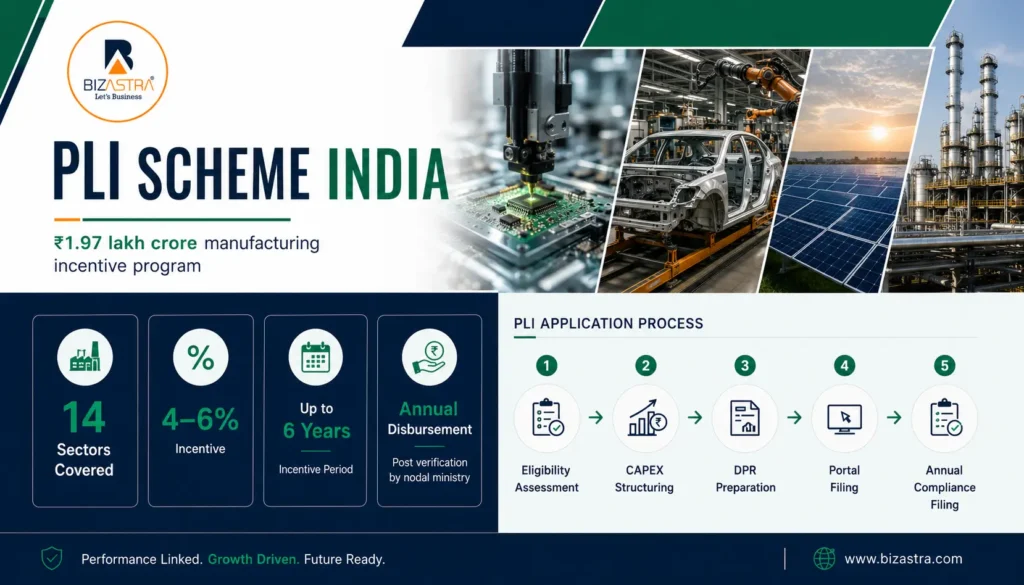
India’s Production Linked Incentive scheme is not a grant. It does not subsidise land or give upfront money.
It pays you a percentage of what you actually manufacture above a benchmark – every year, for up to six years.
That is its strength. And its complication. Read this guide before committing a single rupee of CAPEX.
What Is the Production Linked Incentive (PLI) Scheme?
PLI pays manufacturers 4–6% on incremental domestic sales above a base year (FY 2019-20), for 4–6 years, across 14 sectors. Total outlay: ₹1.97 lakh crore. Payment is verified and disbursed annually by the nodal ministry – not upfront.
PLI full form: Production Linked Incentive. Launched by the Government of India to boost domestic manufacturing and reduce import dependency.
Unlike grants, PLI rewards performance – not participation. Every year, your nodal ministry measures your incremental domestic sales against the FY 2019-20 base year and multiplies the difference by your incentive rate.
Which Sectors Qualify for PLI Scheme 2026?
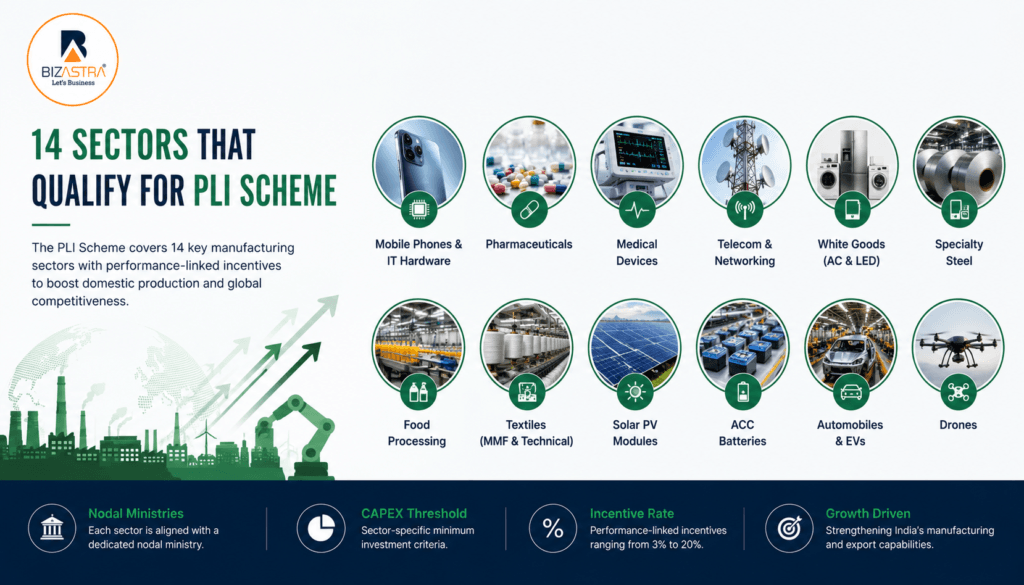
14 PLI sectors: mobile phones, IT hardware, pharmaceuticals, medical devices, telecom, white goods, specialty steel, food processing, textiles (MMF and technical), solar PV, ACC batteries, automobiles and EVs, and drones. Each has its own nodal ministry, CAPEX threshold, and incentive rate.
| Sector | Ministry | Outlay | Rate |
|---|---|---|---|
| Mobile Phones & IT Hardware | MeitY | ₹40,951 Cr | 4–6% |
| Pharmaceuticals | Chemicals | ₹15,000 Cr | 3–10% |
| Medical Devices | Chemicals | ₹3,420 Cr | 5% |
| Telecom & Networking | DoT | ₹12,195 Cr | 6% |
| White Goods (AC & LED) | DPIIT | ₹6,238 Cr | 4–6% |
| Specialty Steel | Steel | ₹6,322 Cr | 4–12% |
| Food Processing | MoFPI | ₹10,900 Cr | 4–10% |
| Textiles | Textiles | ₹10,683 Cr | 3–15% |
| Solar PV Modules | MNRE | ₹4,500 Cr | 4–5% |
| ACC Batteries | NITI/MNRE | ₹18,100 Cr | GWh |
| Automobiles & EVs | Heavy Industries | ₹26,000 Cr | 13–18% |
| Drones | Civil Aviation | ₹120 Cr | Up to 20% |
Source: PLI Scheme Dashboard
Who Is Eligible for PLI Scheme?
Any company incorporated in India that meets the sector-specific minimum CAPEX threshold and applies before committing investment. FDI companies qualify through Indian manufacturing subsidiaries. Post-investment applications are automatically rejected – no exceptions.
Minimum Investment Thresholds (Key Sectors)
- Mobile phones — global companies: ₹1,000 Cr over 4 years
- Mobile phones — domestic companies: ₹200 Cr over 4 years
- Telecom products — SMEs: ₹10 Cr over 4 years
- Textiles — large units: ₹100 Cr over 5 years
- Drones: ₹2–4 Cr (lowest threshold across all PLI sectors)
Source: PLI India Portal | Individual sector scheme notifications, DPIIT
Core Eligibility Checklist
- Company incorporated in India (Private Ltd, LLP, or subsidiary of foreign entity)
- Correct product category mapping to the relevant PLI sector
- Udyam Registration completed (prerequisite for most sectors)
- Application submitted before any CAPEX is committed
- CA-certified base year (FY 2019-20) domestic sales documentation
How to Apply for PLI Scheme in India?
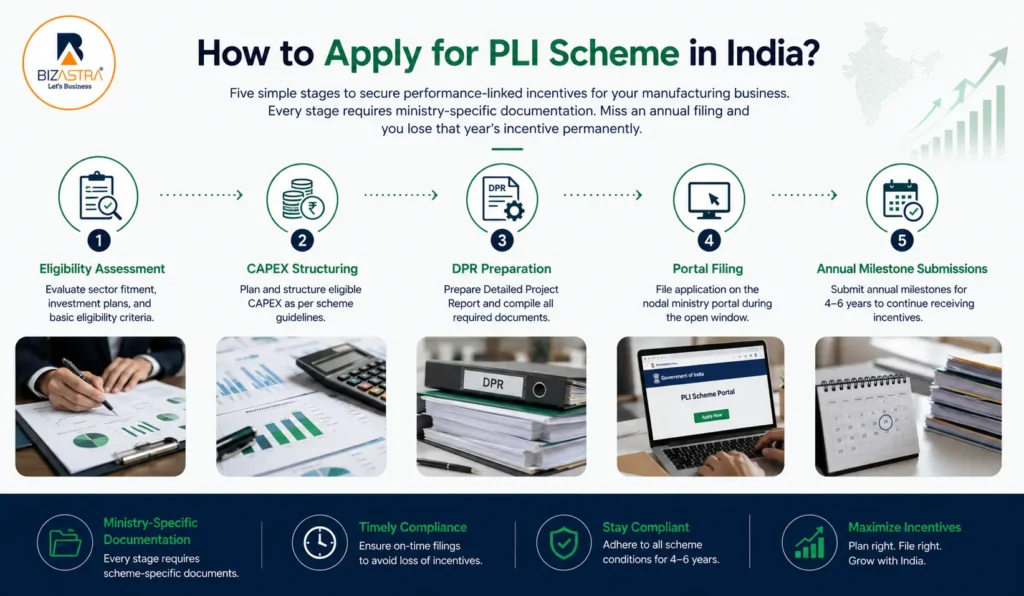
Five stages: eligibility assessment → CAPEX structuring → DPR preparation → portal filing during the open window → annual milestone submissions for 4–6 years. Every stage requires ministry-specific documentation. Miss an annual filing and you lose that year’s incentive permanently.
- Eligibility Assessment
- CAPEX Structuring
- DPR Preparation
- Portal Filing
- Annual Milestone Submissions
Why Do PLI Applications Get Rejected?
4 Common Reasons for Rejection or Delayed Disbursement
- CAPEX committed before approval
- Wrong CAPEX category
- Annual milestone missed or filed late
- Incorrect product category at application
Why Manufacturers Use a PLI Specialist
PLI is not a one-time form. Most manufacturers are experts in production – not in PLI compliance. A specialist handles the parallel process so you focus on manufacturing.
What Bizastra Handles for PLI Clients
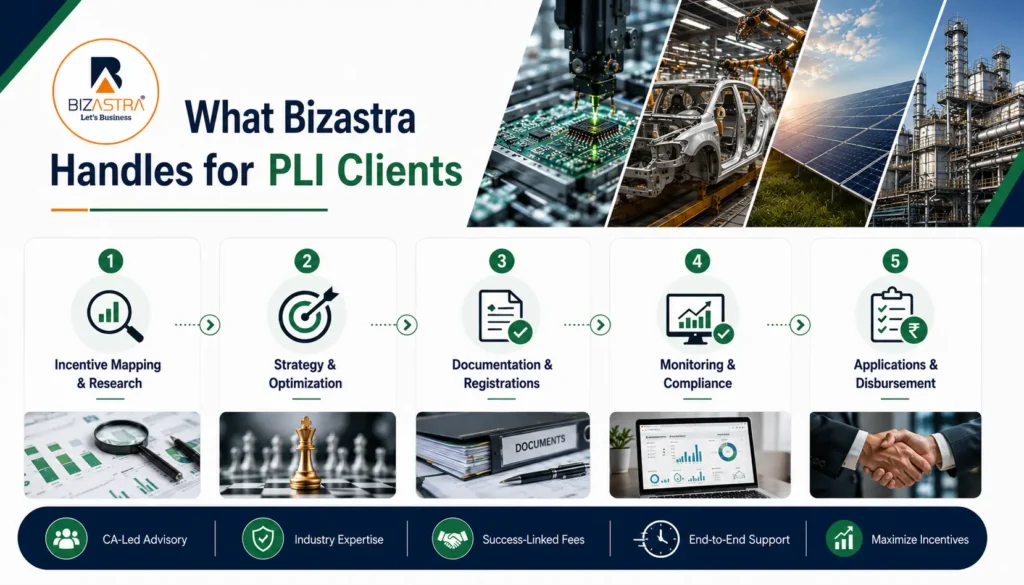
1. Incentive Mapping & Research
Identification of eligible Central and State incentive schemes.
2. Strategy & Optimization
Investment structuring and incentive optimization support.
3. Documentation & Registrations
DPR preparation, registrations, and documentation assistance.
4. Monitoring & Compliance
Annual filings, compliance tracking, and reporting support.
5. Applications & Disbursement
Application filing, follow-ups, and incentive claim management.
Bizastra’s advisory is CA-led, with experience across electronics, food processing, pharma, and EV sectors. Success-linked fees only – no retainer, no advance.
Start with a PLI eligibility assessment. Delivered in 3 business days. Free.
Conclusion
The Production Linked Incentive scheme offers ₹1.97 lakh crore in manufacturing incentives across 14 sectors – one of the largest such programs globally.
Three things decide whether you get paid:
- Apply before committing CAPEX
- Structure your investment correctly against eligible definitions
- File every annual milestone on time
Miss any one of these and the entitlement is permanently lost. Know your eligibility before you invest.
Frequently Asked Questions
What is the production linked incentive scheme?
PLI pays manufacturers 4–6% on incremental domestic sales above the FY 2019-20 base year, for 4–6 years, across 14 sectors.
- Total outlay: ₹1.97 lakh crore
- Payment is verified and disbursed annually by the nodal ministry
- It rewards production growth – not just establishment
What are the 14 sectors of PLI scheme?
The 14 PLI sectors are:
- Mobile phones and IT hardware
- Pharmaceuticals, Medical devices
- Telecom products, White goods (AC and LED)
- Specialty steel, Food processing
- Textiles – MMF and technical
- Solar PV modules, ACC batteries
- Automobiles and EVs, Drones
Who is eligible for PLI scheme?
Core eligibility criteria:
- Company incorporated in India
- Meets the sector-specific minimum CAPEX threshold
- Applies before committing any investment
- FDI companies eligible via Indian manufacturing subsidiary
- Udyam Registration completed as prerequisite
Is the PLI scheme successful?
Yes. Key outcomes as of FY 2024-25:
- ₹1.28 lakh crore in investments attracted
- ₹10.8 lakh crore+ in production output
- Mobile phone exports: ₹1.28 lakh crore in FY 2023-24
- 8.5 lakh+ jobs created directly and indirectly
Source: PIB Press Release, Ministry of Commerce, 2025
Which is better, PLI or PPF?
They serve completely different purposes and cannot be compared directly:
- PLI: Company-level manufacturing incentive – 4–6% on incremental sales
- PPF: Personal savings scheme – 7.1% annual interest, 15-year lock-in, fully tax-exempt
If you are a manufacturer, both are relevant – in entirely separate contexts. They are not alternatives to each other.
Sources Referenced
- India Post — PPF interest rate FY 2026
- Individual sector scheme notifications via DPIIT, MeitY, Ministry of Chemicals, Ministry of Textiles, MoFPI (2021–2026)