
Most articles on this topic quote 40% as if it is the ceiling. It is not, it is your starting point. This guide shows how that starting rate gets built up, customised, and applied across a small unit, a large unit, and a mega unit, using the government’s own calculation method.
Before the numbers make sense, it helps to see exactly how this customisation works.
1. What Decides Your Capital Subsidy: Scale, Sector, District
Three things shape your final subsidy, and each one is a lever you can actually influence.
How much you invest sets your baseline. Up to Rs 85 crore, your starting rate is 40%. Above that, the percentage adjusts gradually as your investment grows, not as a penalty, but because the policy is designed to give smaller businesses the highest percentage, while still offering very large projects a substantial, capped amount.
Your sector matters too, but mostly by exclusion. A short list of sectors, certain mining activities, oil refining, sawmills, aerated drinks, and a few others, sit outside eligibility. Almost every other manufacturing sector qualifies fully.
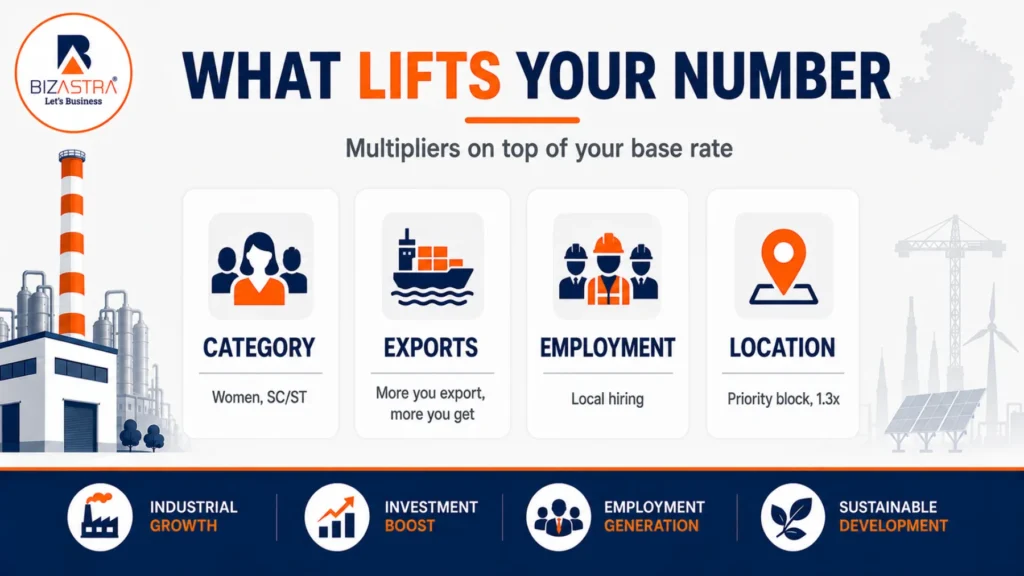
Where you set up, and who you are, add real customisation on top of your base rate:
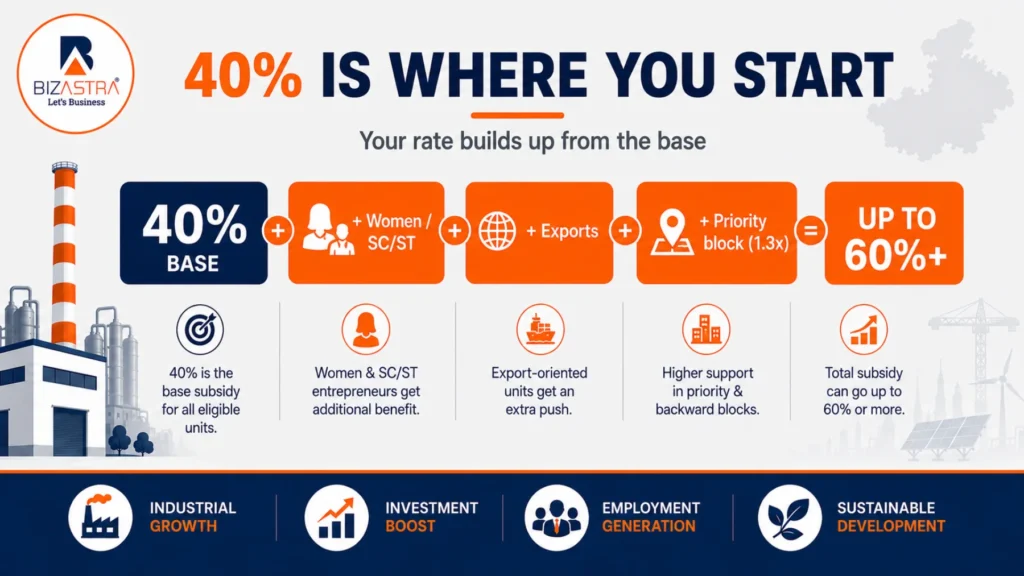
| Your Profile | What It Adds to Your Base Rate |
|---|---|
| General category | Base rate only (starts at 40%) |
| Woman entrepreneur | +2% per year for 4 years |
| SC/ST entrepreneur | +2% per year for 4 years |
| SC/ST woman entrepreneur | +2.5% per year for 4 years |
| Exports 25-50% of sales | +2% per year for 4 years |
| Exports more than 50% of sales | +3% per year for 4 years |
| Located in a priority block | Additional 1.3x multiplier on total assistance |
Figures above are indicative and subject to the policy’s eligibility conditions.
In other words, 40% is where you begin, not where you end. Now let us see this customised rate applied to a real factory, starting with the smallest scale.
2. Example 1: MSME Unit Subsidy (Starting at 40%, Built Up from There)
Say you invest Rs 5 crore, well inside the Rs 85 crore range where the base 40% rate applies in full.
| Scenario | Rate Applied | Subsidy on Rs 5 Crore |
|---|---|---|
| General category | 40% | Rs 2 crore |
| Woman or SC/ST entrepreneur | Up to 48% | Rs 2.4 crore |
| SC/ST woman entrepreneur | Up to 50% | Rs 2.5 crore |
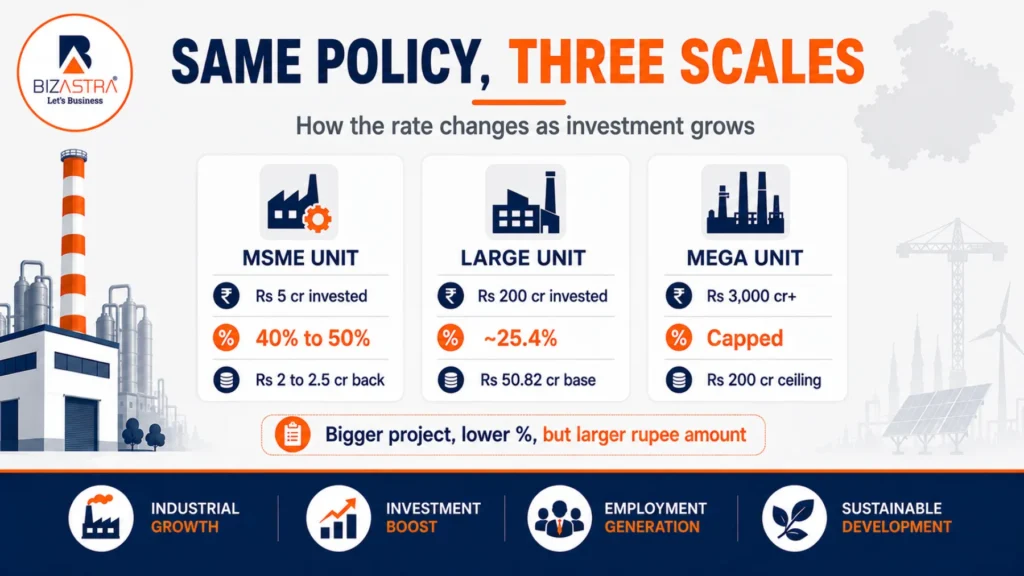
As the table shows, the same Rs 5 crore investment can return anywhere from Rs 2 crore to Rs 2.5 crore, depending entirely on who is applying, a meaningful difference that comes purely from knowing which category you qualify under.
This amount is paid through the Industrial Development Subsidy route, released across 4 equal yearly instalments rather than all at once, worth building into your cash flow planning.
That is how customisation works at smaller scale. Once your investment crosses Rs 85 crore, the base rate itself starts adjusting, and this is where most explanations online stop making sense.
3. Example 2: Large Unit (The Base Rate Adjusts With Scale)
Now say you invest Rs 200 crore, well past the threshold where the flat 40% applies.
| Investment (Eligible) | Base Assistance | Effective Rate |
|---|---|---|
| Rs 100 crore | Rs 35.9 crore | 35.9% |
| Rs 200 crore | Rs 50.82 crore | 25.4% |
| Rs 500 crore | Rs 91.44 crore | 18.3% |
At Rs 200 crore, this works out to base assistance of roughly Rs 50.82 crore, around 25.4% of your investment. The rate is lower than the small-unit rate, but the actual rupee amount is far larger, and the same customisation options still apply: this base figure gets adjusted further for exports, employment generated, location, and foreign investment. A unit in a priority block, for instance, would see this number multiplied by a further 1.3.
At even bigger scale, the base rate settles into its final form.
4. Example 3: Mega Unit (The Rs 200 Crore Ceiling)
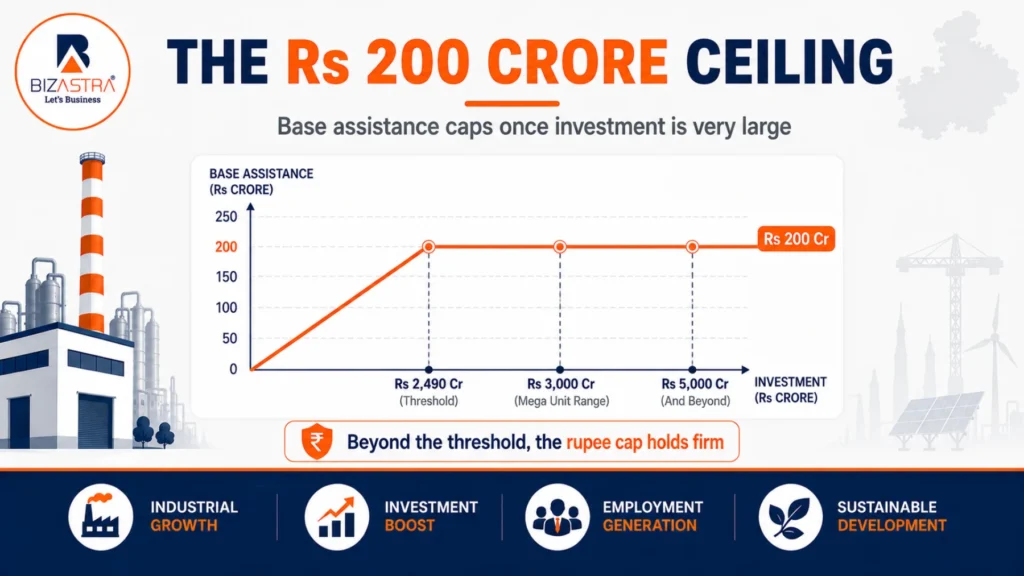
At the highest tier, the base assistance reaches a fixed ceiling. Once your investment crosses about Rs 2,490 crore, the base amount holds steady at Rs 200 crore, regardless of how much larger your investment grows beyond that.
A Rs 3,000 crore project and a Rs 5,000 crore project both receive the same Rs 200 crore base amount before multipliers, as per the guidelines. The percentage of investment covered keeps shrinking as the project grows, but the rupee ceiling holds firm by design. At this scale, the real opportunity to increase your total return sits in the multipliers, exports, employment, and location, and the Customised Package, since the base figure is already fixed and known upfront.
No matter where your project falls on this scale, one thing stays consistent: how the money is actually paid to you.
5. How the Money Reaches You: Disbursement
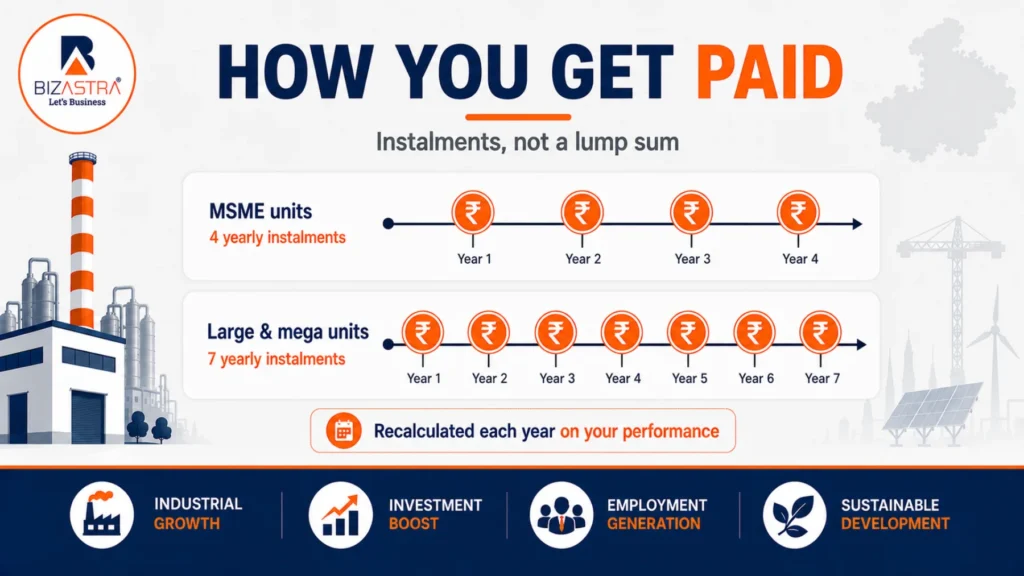
The MP MSME subsidy at MSME tier, calculated on your base 40% (or customised higher) rate, is released in 4 equal yearly instalments once your investment and eligibility are verified.
For larger units under the tapering and capped formula, the payout stretches across 7 equal yearly instalments instead. Each year, you receive one-seventh of your total base assistance, adjusted by that year’s numbers for exports, employment, location, and foreign investment, so your yearly figure can shift slightly depending on how your unit performs against these metrics.
Either way, this is capital paid out over several years, not handed over in a single sum, worth building into your financial planning from the very start.
6. Frequently Asked Questions
Is 40% the maximum capital subsidy I can get in MP?
No, 40% is your starting rate, not a ceiling. Women, SC/ST, and export-oriented entrepreneurs can customise their rate upward to 60%, and location-based multipliers can add further value on top.
What counts as “eligible investment”?
Money spent on plant and machinery, buildings, and investments related to production and manufacturing activities. Land and working capital are not included.
Does my location make a difference?
Yes. Units in priority blocks get an extra 1.3x multiplier on their subsidy amount, on top of the base rate.
Can exports or hiring more people increase my subsidy?
Yes. Both come with their own multipliers that raise your total assistance above the base amount.
How is the money actually paid out?
Smaller units receive it over 4 yearly instalments. Large and mega units receive it over 7 yearly instalments, recalculated each year.
Is there an absolute maximum, no matter how big my project is?
Yes. The base assistance caps at Rs 200 crore once your investment crosses the threshold limit, regardless of how much bigger the project gets after that.
7. Key Takeaways
Think of the capital subsidy in Madhya Pradesh as a starting point you can build on, not a fixed number. Every manufacturer begins at 40%, and from there, your category, your exports, your workforce, and your location can each push that number higher. Larger projects see the base percentage adjust with scale, and mega projects settle into a firm Rs 200 crore ceiling, but even there, the multipliers keep working in your favour.
Knowing exactly which of these levers apply to your project is what turns 40% from a headline number into the real figure you can plan your investment around.
Want to know your customised subsidy rate? See the full Madhya Pradesh industrial subsidy schemes or get a calculation based on your actual investment size, category, and location.