
1. First, What Are We Even Multiplying?
Before we get into multipliers, let’s talk about the number they multiply, because that’s the first question anyone exploring this policy wants answered.
Every large manufacturing unit setting up in Madhya Pradesh under the Industrial Promotion Policy (IPP) 2025 is entitled to a base subsidy called Basic Investment Promotion Assistance, or BIPA for short. Think of it as cash-back on what you spend building your factory, mainly your building and your main plant and machinery. Land doesn’t count, and neither does old machinery or your pollution-control equipment.
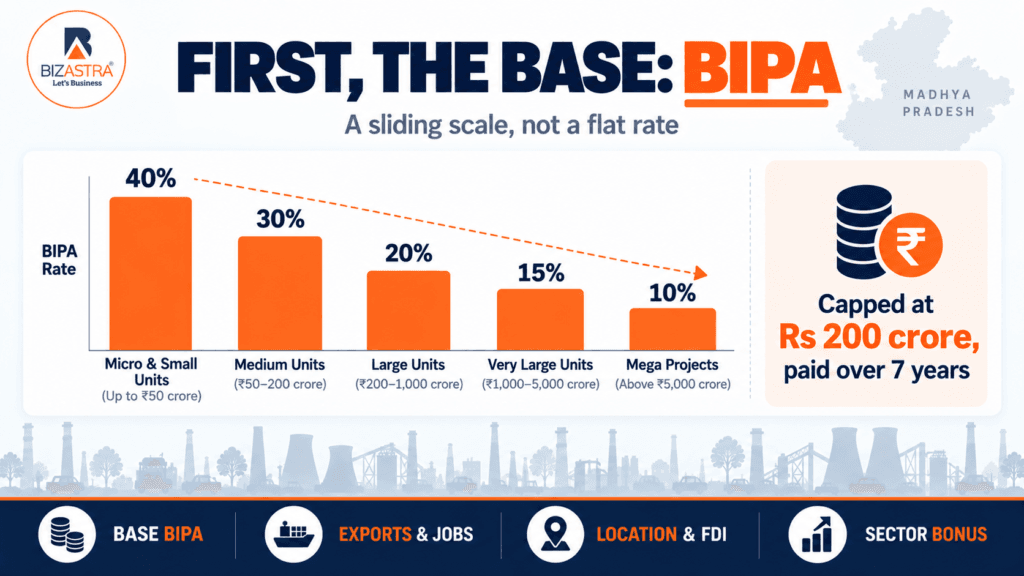
Here’s the part most people get wrong: BIPA is not a flat percentage. It’s a sliding scale. Smaller large units, say a ₹85 crore investment, get the highest rate: 40% of what they spend. As your project gets bigger, that percentage actually falls, all the way down to 10% for genuinely massive projects. And no matter how big you go, the total payout is capped at ₹200 crore, paid out over 7 years in equal yearly instalments.
That’s easier to see in numbers than in words. In short, the rate steps down in bands as the investment rises, from 40% at the smaller end toward 10% for the largest projects, with the ₹200 crore ceiling always applying.
2. So, What Exactly Is a “Multiplier”?
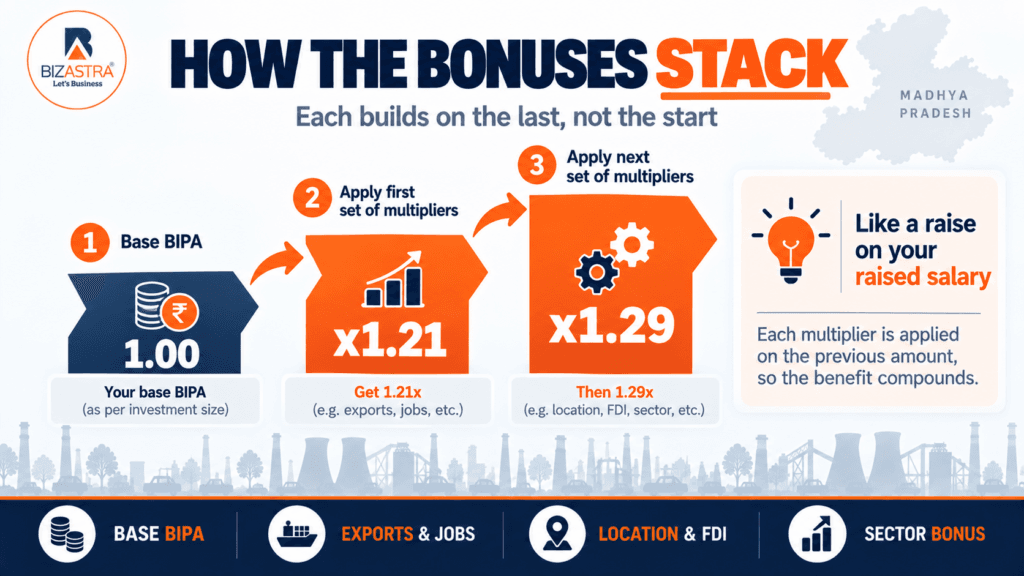
In plain terms: a multiplier is a bonus the government adds on top of your BIPA, for doing something the state wants more of, such as exporting, creating jobs, choosing the right location, bringing in foreign money, or working in a sector Madhya Pradesh is trying to grow.
Here’s a simple way to picture how these bonuses combine. Imagine your salary is ₹50,000 a month and you get a 10% raise, so you’re now on ₹55,000. Then you get another 10% raise. That second raise isn’t calculated on your original ₹50,000, it’s calculated on your new ₹55,000, giving you ₹60,500, not ₹60,000. Each bonus builds on the number the last one produced, not on the starting figure.
That’s exactly how these multipliers work. Each one is a number between 1.0 and 1.5. A multiplier of 1.0 means no bonus. A multiplier of 1.3 means a 30% bump. And since more than one multiplier can apply to the same factory at the same time, they stack one on top of the other, which is where the real jump in the final number comes from.
This is the part most people underestimate. Most calculations stop at the base BIPA percentage, and the real number, once the multipliers are added in, often turns out to be a genuinely pleasant surprise. So let’s look at exactly which ones are available.
3. The 10 Multipliers Under IPP 2025
| # | Multiplier | Range | Description |
|---|---|---|---|
| 1 | Gross Supply Multiple (GSM) | 0 to 1.0 | Rewards actually running your factory, not just building it. Hit 40% capacity in Year 1, and 50% to 75% after that, and you get the full 1.0. Fall short, and this shrinks. |
| 2 | Export Multiple (EM) | 1.0 to 1.3 | Rewards exporting. The more you export, from 25% up to 75% or more of production, the higher this climbs, up to 1.3. Units inside an SEZ are locked at 1.0 no matter what. |
| 3 | Employment Multiple (EYM) | 1.0 to 1.5 | Rewards jobs. 100 employees or fewer gets you 1.0; 2,500 or more gets you the full 1.5. Bigger workforce, bigger bonus. |
| 4 | Geographical Multiple (GM) | 1.0 or 1.3 | Rewards location. Set up inside a government-notified Priority Block, an area the state especially wants industrialised, and you get a flat 1.3, no matter what else you do. |
| 5 | FDI Multiple | 1.0 / 1.1 to 1.2 | Rewards foreign investment. The more foreign equity in your company, from under 26% up to 51% or more, the higher this goes, up to 1.2. |
| 6 | Food Processing Multiple | 1.5 (flat) | A flat 50% bonus for Agri, Dairy and Food Processing units. |
| 7 | API / Bulk Drug Multiple | 1.3 (flat) | A flat 30% bonus for pharma units making Active Pharmaceutical Ingredients or Bulk Drugs, provided you hold a valid API licence. |
| 8 | Medical Device Multiple | 1.3 (flat) | A flat 30% bonus for medical device manufacturers. |
| 9 | EV Manufacturing Multiple | 1.3 (flat) | A flat 30% bonus for electric vehicle manufacturers. |
| 10 | High Value-Add (HVA) Multiple | 1.3 (flat) | A flat 30% bonus for high-value, high-tech, innovation-driven manufacturing. |
Reading a list of multipliers is one thing. Watching what they actually do to a real subsidy number is another. So let’s make it concrete.
4. A Worked Example: What Multipliers Actually Do to Your Payout
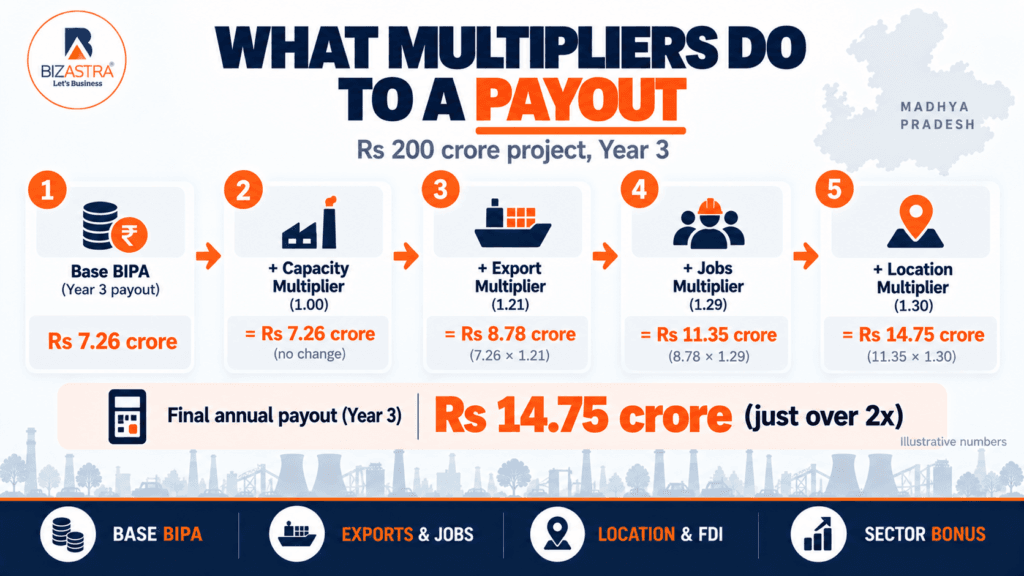
Picture a factory being built inside a notified Priority Block, with an eligible investment of ₹200 crore. As per the policy guidelines, the base subsidy works out to about ₹50.8 crore over 7 years, roughly ₹7.26 crore a year.
Now say business is going well, and in Year 3 this factory:
- Runs well above the minimum required production level, so its capacity bonus is full marks, 1.0
- Exports 60% of what it makes. The more you export, the bigger this bonus climbs; 60% takes it to about 1.21
- Employs 1,500 people on average that year. More jobs created means a bigger bonus here too, about 1.29
- Is located inside its Priority Block, the less-developed area bonus the government especially wants to encourage, a flat 1.3
- Has no foreign investors, so this bonus stays neutral at 1.0
Just like the salary example, each bonus applies on top of the number the last one produced. Here’s what happens to that ₹7.26 crore, step by step:
| Step | What’s Happening | Value | Running Yearly Amount |
|---|---|---|---|
| Base (Year 3) | ₹7.26 crore | ||
| + Capacity bonus | Production target cleared | 1.00 | ₹7.26 crore |
| + Export bonus | 60% of production exported | 1.21 | ₹8.78 crore |
| + Jobs bonus | 1,500 average employees | 1.29 | ₹11.35 crore |
| + Location bonus | Priority Block | 1.30 | ₹14.75 crore |
| + Foreign investment bonus | No foreign equity | 1.00 | ₹14.75 crore |
Same factory. Same investment. But the combined effect works out to just over 2 times, turning a ₹7.26 crore base subsidy into a ₹14.75 crore actual payout for that one year, almost doubling it without a single extra rupee going into the investment itself.
This is exactly the kind of gap that catches most people by surprise before they finalise a project, because decisions made at the drawing-board stage, like where you locate or how export-focused you plan to be, quietly decide which of these bonuses you’ll actually end up qualifying for.
5. The Fine Print: Caps, Resets, and Rules
Before building a subsidy plan around these multipliers, here’s what’s worth knowing upfront:

- Your subsidy can never exceed what you actually invested. Across every incentive claimed under IPP 2025, total assistance is capped at 100% of your eligible investment.
- You usually can’t combine two government schemes. If a project qualifies under more than one Madhya Pradesh scheme, one has to be chosen, unless that scheme specifically says its benefits apply over and above IPP 2025.
- Multipliers can move. The capacity, export, and foreign-investment bonuses are checked every single year based on real performance; go up or down, and the bonus moves with it. Location and sector bonuses generally stay fixed.
6. Where People Usually Get Confused
“Do I automatically get this?” No. Nothing here is handed over just because a project qualifies on paper. Every multiplier, capacity, exports, headcount and foreign investment, needs a Chartered Accountant’s certificate, filed every year with the State Level Empowered Committee. Miss the filing, and the payout is just the base BIPA, with no bonus on top.
“A 2 times multiplier means my subsidy doubles, right?” The subsidy doubles, not the investment. A 2 times multiplier applies to the BIPA amount, not to what was spent building the factory. If the base BIPA is small, doubling it is still a small number; multipliers matter most when the base subsidy is already healthy.
7. Frequently Asked Questions
Can all ten multipliers be stacked at once?
Realistically, no. Five of them, capacity, exports, employment, location and FDI, are open to any eligible unit and can, in principle, apply together. The other five are sector-specific (Food Processing, API/Bulk Drugs, Medical Devices, EV, and High Value-Add manufacturing), and since a unit is usually registered under one sector, only one of these five would typically apply.
Does location work on a multi-tier zone system, like some other states use?
No. Madhya Pradesh keeps it simple: the location bonus is a flat, binary switch, 1.3 inside a notified Priority Block and 1.0 everywhere else. There’s no ladder of percentages by district the way some other states structure their location-based incentives.
What if foreign investment goes up after production starts?
Based on how the policy is worded, the foreign equity share recorded on the date commercial production begins is what counts going forward. The text only mentions revising the bonus downward if that share later falls, not upward if it rises. Worth confirming this reading with MPIDC before assuming a later capital infusion helps.
Is the multiplier bonus paid separately from BIPA?
No, it’s applied to the yearly BIPA and paid out together, as one sanctioned amount, based on the annual claim filed through the INVEST MP portal.
8. Want to Know What a Factory Actually Qualifies For?
Reading about multipliers is useful. Knowing the exact number for a specific project is more useful. If a factory is being planned in Madhya Pradesh, the investment size, export plans, hiring targets, sector and location together decide the real payout, multipliers included.
Contact Us for a Free Calculation
Disclaimer: The multiplier rates, the BIPA formula, and the rules quoted in this article are taken directly from the Madhya Pradesh Industrial Promotion Policy 2025 (notified 24 February 2025) and the Madhya Pradesh Investment Promotion Scheme 2025 that implements it, so these figures are accurate as per the policy itself. What’s indicative is the worked example in Section 4: it uses rounded, illustrative numbers purely to show how the formulas interact. Actual EFCI, export share, headcount and eligibility will differ project to project, so treat it as a demonstration, not a quote. As always, get specific numbers verified with a qualified consultant before making any investment decisions.
Author: CA, BizAstra. Figures reflect the Madhya Pradesh Industrial Promotion Policy 2025 (notified 24 February 2025) and the Madhya Pradesh Investment Promotion Scheme 2025, cross-referenced against publicly available policy summaries. The scheme’s Annexure-A (Priority Blocks list) and the exact floor value of the FDI Multiple have not been independently re-verified against the latest gazette notification, please confirm both before publishing customer-facing numbers.