
Quick Answer
If you are turning part of a working farm into a homestay, cottages, or a farm-tourism unit in Maharashtra, the Tourism Policy 2024 gives you a capital subsidy of 15% of what you spend (capped at ₹15 crore), plus a recurring package of GST refunds, electricity concessions, interest support, and stamp duty exemptions that runs for 3 to 5 years depending on where your land is. On top of that, agri-tourism gets a few benefits no other tourism category gets: domestic electricity rates and no non-agricultural land permission needed. The numbers below are taken directly from the policy; the worked example further down uses illustrative figures.
What Counts as an “Agro Tourism Unit”?
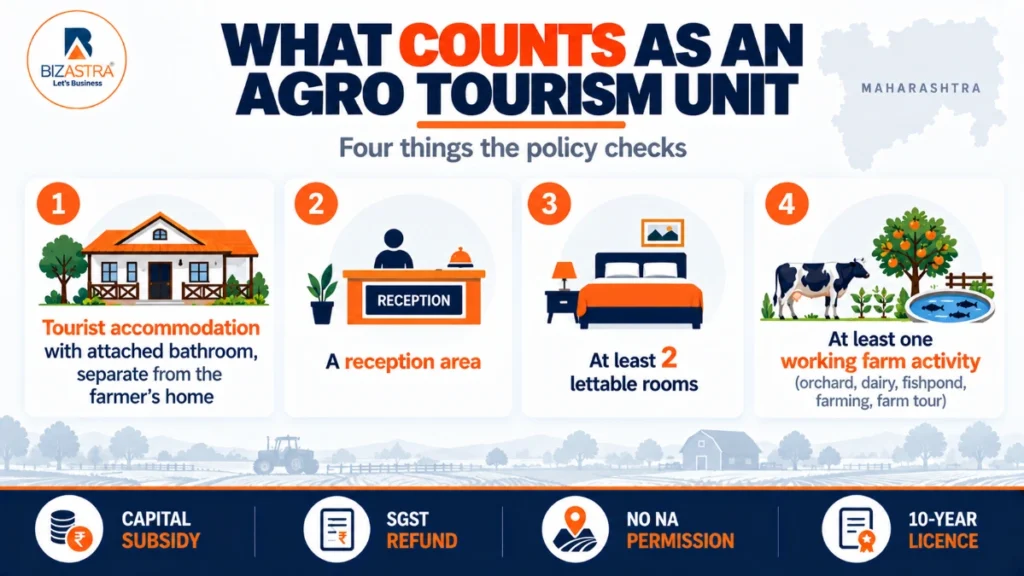
Not every farm with a guest room qualifies. The policy is specific about what it means by an Agro Tourism Unit:
- Accommodation with an attached bathroom, built specifically for tourists, separate from the farmer’s own house
- A reception area to welcome guests
- At least 2 lettable rooms
- At least one of the following working farm activities on site: (1) Agriculture farming, (2) Horticulture orchard or garden, (3) Fishpond, (4) Dairy Farm, (5) Animal Husbandry unit, (6) Farm Tours, (7) Farm Store, (8) Other activities as decided by the DoT
If your setup fits this, say a mango orchard with two cottages and a small farm tour, you are in. If you are just renting out a spare room with no farm activity attached, that is a different category, and the eligibility rules differ slightly.
Which Zone Are You In? This Decides Your Numbers
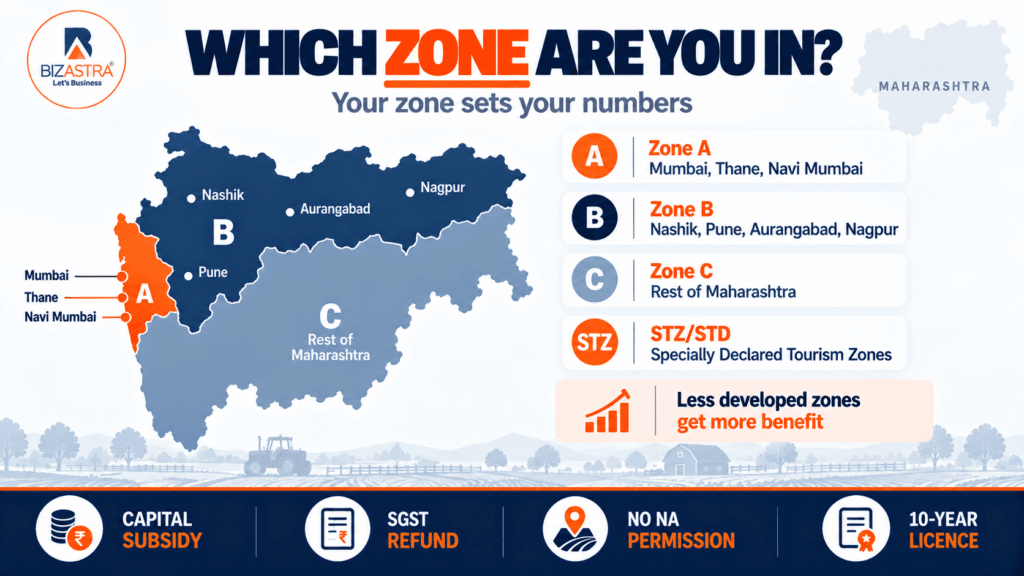
Before anything else, it helps to know your zone, because almost every incentive below is set by it.
| Zone | Area |
|---|---|
| A | Mumbai, Thane, Navi Mumbai Municipal Area |
| B | Nashik, Pune, Aurangabad, Nagpur Municipal Corporation |
| C | Rest of Maharashtra |
| STZ / STD | Specially Declared Tourism Zones or Destinations |
What You Actually Get: The Full Incentive List
A. Capital Investment Incentive
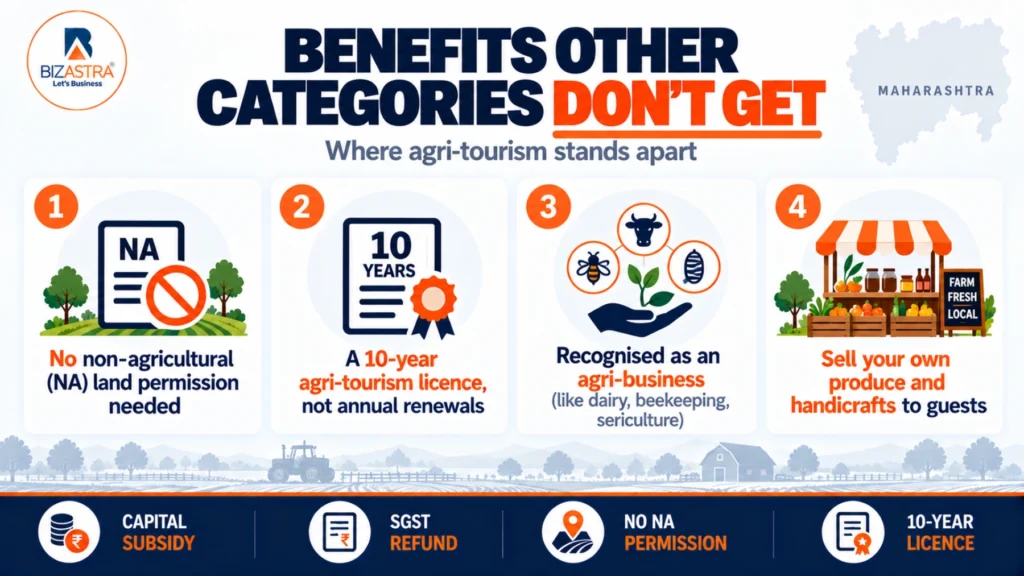
Every eligible agro tourism unit gets 15% of its eligible capital investment, or ₹15 crore, whichever is lower. This is paid out in 5 equal yearly instalments starting from the date you begin commercial operations. Note: land cost does not count toward this. The 15% applies to what you spend on buildings, furniture, fixtures, equipment, and similar assets, not the land itself.
B. The Recurring Package (for most agro tourism units)
| Benefit | Rate | Eligibility Period |
|---|---|---|
| Capital Subsidy | 15% of eligible capital investment | 5 years |
| SGST reimbursement | Up to 100% of net SGST paid | Up to 5 years |
| Electricity duty exemption | Up to 100% | Up to 5 years |
| Electricity tariff refund (commercial vs industrial gap) | Up to 100% | Up to 5 years |
| Interest subvention | Up to 5% on loans up to ₹2 crore, capped at ₹10 lakh total | Up to 5 years |
| Stamp duty and registration exemption | Up to 100% | On qualifying transactions |
C. Benefits Agro Tourism Gets That Other Categories Don’t
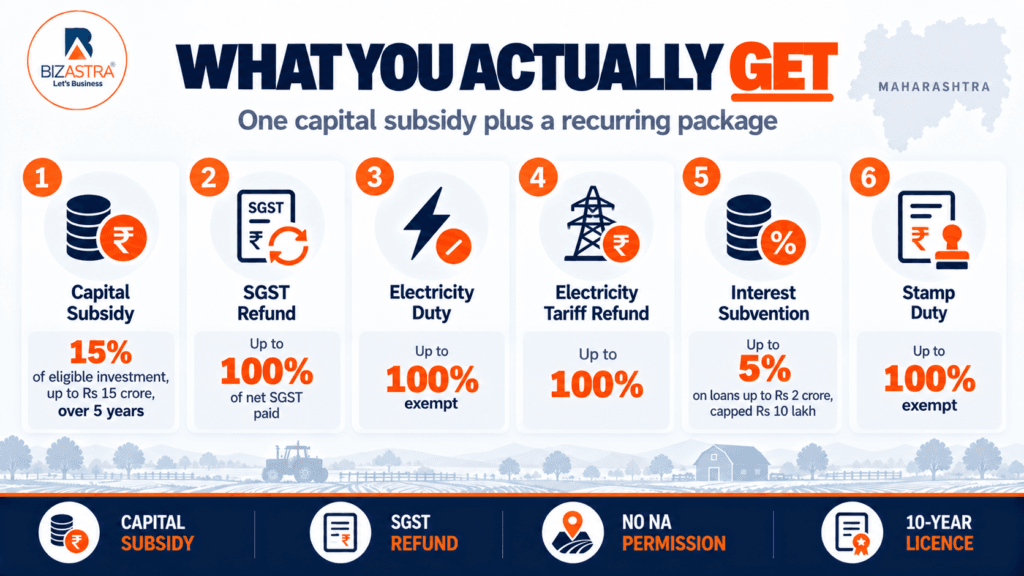
This is where agri-tourism stands apart from a regular hotel or resort:
- No non-agricultural (NA) land permission needed. Converting farmland for most commercial uses in India usually means applying for NA conversion, a slow and often expensive process. Agri-tourism is specifically exempted from this. You do still need to inform your local revenue department about the activity, but you are not waiting on a conversion order.
- A 10-year agri-tourism licence, instead of the usual annual renewals most hospitality permits require.
- Recognition as an agri-business. Agri-tourism now sits in the same bracket as dairying, beekeeping, and sericulture, a formal classification that can matter for how your business is treated elsewhere.
- You can sell your own produce and local handicrafts to visiting tourists as part of the same registered unit.
D. Extra Boost for Women, SC/ST, and Differently-Abled Entrepreneurs
If your unit is a new tourism project owned and managed by a woman entrepreneur, an SC/ST entrepreneur, or a differently-abled entrepreneur, with at least 51% ownership in the business, you get an additional 5% on top of the Capital Investment Incentive.
Agro, Rural, or Eco Tourism: Which One Are You?
The policy groups Agro, Rural, and Eco Tourism together for most of these incentives, but they are defined differently on paper, and it is worth knowing which one actually describes your project:
- Agro Tourism Unit: built around a working farm activity (orchard, dairy, fishpond, farming itself).
- Rural Tourism Unit: built around showcasing rural life, art, culture, craft, or cuisine, with a souvenir shop, rather than farm activity specifically.
- Eco Tourism Unit: built around a natural setting like a forest, dam site, or water body, focused on flora and fauna.
All three qualify for the same 15% capital incentive and the same zone-based recurring package described above. Where they differ is in the specific site conditions you will need to prove. So a mango farm with cottages should apply under Agro Tourism, not Rural Tourism, even though both eventually land in the same incentive table.
A Worked Example: Turning a Farm Into a Subsidised Homestay
Picture a farmer in rural Maharashtra (Zone C) building four cottages with attached bathrooms and a reception area next to an existing dairy operation, spending ₹75 lakh on construction, furniture, and fittings (excluding land).
- Capital Investment Incentive: 15% of ₹75 lakh = ₹11.25 lakh, paid as ₹2.25 lakh a year for 5 years
- If a woman entrepreneur owns 51% or more of the unit: that rises to 20% = ₹15 lakh total, an extra ₹3.75 lakh
- Interest subvention: on a ₹40 lakh loan taken to build it, 5% works out to ₹2 lakh a year, right up to the ₹10 lakh Zone C ceiling over the 5-year period
- SGST reimbursement: say the homestay’s rooms, meals, and farm-tour packages generate roughly ₹2 lakh a year in net SGST paid, 100% of that comes back each year in Zone C, an illustrative ₹10 lakh over 5 years
- Electricity duty exemption and domestic tariff billing: ongoing savings on every power bill for the life of the eligibility period
- Stamp duty exemption: if any adjoining land is purchased or leased for the project, the registration and stamp duty on that transaction is fully waived, but if it is already paid then it is not reimbursed
Add it up, and a ₹75 lakh investment could realistically see well over ₹25 to 30 lakh flow back over five years, on top of ongoing electricity and land-permission relief that never shows up as a lump sum but adds up every single month.
The Fine Print: Rules Worth Knowing Before You Apply
- Timing matters. Only investment from 18 July 2024 onward counts, and only within 4 years of your commercial operation date.
- Incentives are capped at 100% of your investment, across all benefits combined.
- Register first. DoT and Ministry of Tourism registration, plus an eligibility certificate, must come before any claim.
- Land cost is excluded from the 15% capital incentive, though there is a possible SGST-refund exception worth confirming with DoT.
- Domestic tariff versus duty exemption is not clearly reconciled in the policy text. Confirm with your electricity provider and DoT how the two apply together for your bill.
Frequently Asked Questions
Do I need to reclassify my farmland as non-agricultural to start agri-tourism?
No. Agri-tourism is specifically exempted from needing non-agricultural permission, though you do need to inform your local revenue department.
What electricity rate will I actually be charged?
Homestays under agri-tourism are billed at domestic rates, and the broader incentive package also offers up to 100% electricity duty exemption for units.
Can I sell farm produce or handicrafts to my guests?
Yes, this is explicitly permitted for agri-tourism units.
How long is the agri-tourism licence valid for?
10 years, verified by the relevant local authorities.
Is there extra support for women or SC/ST entrepreneurs?
Yes, an additional 5% on the capital incentive, if the entrepreneur owns and manages at least 51% of the unit.
Does my existing, older farm-stay setup qualify?
Only if the investment was made on or after 18 July 2024, and only for capital spent within 4 years of your commercial operation date. Older investment is not eligible.
Is Agro Tourism treated as an MSME or a Large project?
Neither. It has its own dedicated incentive track (the zone-based table above), separate from the general MSME and Large or Mega project classifications.
Knowing the Rate Isn’t the Same as Getting the Money
15% sounds simple until you are the one proving your eligible capital investment to DoT, filing the eligibility certificate before you pour a single foundation, and keeping five years of SGST, interest, and tariff claims on schedule without missing a deadline. This is usually where farmers either under-claim or lose eligibility on a technicality, not because the policy is stingy, but because the paperwork is unforgiving. We handle this end-to-end: registration, eligibility certificate, and the annual claims that follow.
Contact Us for a Free Calculation
Disclaimer: The incentive rates, eligibility rules, and definitions quoted in this article are taken directly from the Tourism Policy of Maharashtra 2024 (Government Resolution No. TDS-2022/09/CR No. 542/Tourism-4, dated 18 July 2024), so these figures are accurate as per the policy itself. The worked example in Section 5 uses rounded, illustrative numbers purely to show how the incentives interact; your own investment, turnover, and zone will produce different figures. Please get your specific numbers verified with a qualified consultant before making any investment decisions.