
Quick Answer
The scheme you choose depends on what your factory makes. ECMS (Electronics Component Manufacturing Scheme) rewards factories that make components, sub-assemblies and electronics manufacturing equipment, through a turnover-linked incentive of 1% to 10%, a 25% capex incentive, or a hybrid of both. PLI-type schemes reward large volumes of finished devices, mainly mobile phones and IT hardware. As of September 2026, ECMS Segment D (supply chain and capital equipment, minimum Rs 10 crore investment) is the window still open to new component and equipment makers, until 30 April 2027.
1. What Each Scheme Rewards
ECMS pays you for building what goes inside the device. The Electronics Component Manufacturing Scheme (ECMS) was notified on 8 April 2025 with an outlay of about Rs 22,919 crore, raised to Rs 40,000 crore in Budget 2026. It runs for six years and covers display and camera module sub-assemblies, passive components, electro-mechanicals, multi-layer PCBs, Li-ion cells for digital applications, mobile and IT enclosures, HDI and flexible PCBs, SMD passives, and (in Segment D) the supply chain and capital equipment behind all of them.
PLI pays you for finished-product scale. The original PLI for large-scale electronics manufacturing, launched in 2020, paid 4% to 6% on incremental sales of mobile phones and specified components over a FY 2019-20 base. That scheme ended on 31 March 2026, with 32 approved companies. Its successor, the Rs 62,500 crore Mobile Phone Manufacturing Scheme (MPMS), was approved on 15 July 2026 for FY 2026-27 to FY 2030-31. It pays 2.25% to 5% on eligible sales, plus up to 1.5% for domestic sourcing of key components and sub-assemblies. PLI 2.0 for IT hardware (Rs 17,000 crore) covers laptops, tablets, all-in-one PCs and servers, with 27 approved manufacturers.
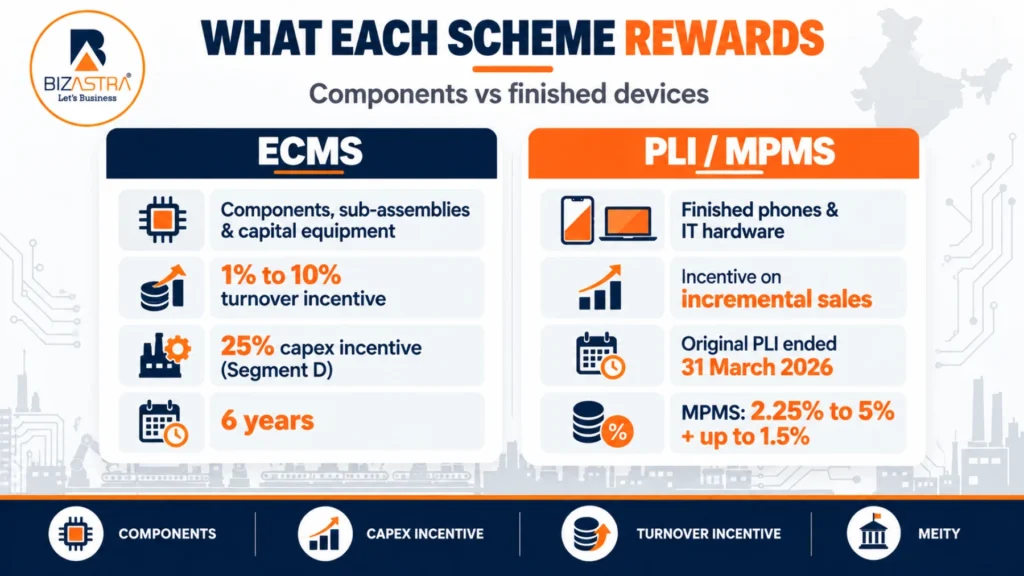
Here is how they compare in one view.
| Category | ECMS | PLI (large-scale electronics) | PLI 2.0 (IT hardware) | MPMS (mobile phones) |
|---|---|---|---|---|
| Who it is for | Component, sub-assembly, supply-chain and capital-equipment makers | Mobile phone and specified component makers | Laptop, tablet, AIO PC and server makers | Mobile phone makers in India, including EMS providers |
| Incentive type | Turnover-linked, capex, or hybrid | Turnover-linked | Turnover-linked | Turnover-linked plus domestic-sourcing add-on |
| Typical rate | 1% to 10% of incremental sales, or 25% of capex (Segment D) | 4% to 6% of incremental sales | Around 5% of net incremental sales | 2.25% to 5%, plus up to 1.5% |
| Tenure | 6 years (FY 2025-26 to FY 2031-32) | Ended 31 March 2026 | Six-year scheme approved 2023 | FY 2026-27 to FY 2030-31 |
| Open to new applicants (Sept 2026) | Segment D only, till 30 April 2027. Segments A to C closed 30 Sept 2025 | No | No | Applications expected from 15 October 2026, subject to official notification |
2. Eligibility Side by Side
ECMS eligibility depends on the segment. For Segments A to C (now closed to new applicants), the applicant, its group companies and JVs had to show consolidated global ESDM or manufacturing revenue for FY 2023-24: Rs 50 crore or Rs 150 crore for passives, electro-mechanicals and multi-layer PCBs; Rs 250 crore or Rs 750 crore for display, camera, Li-ion, enclosures and SMD passives; and Rs 500 crore or Rs 1,500 crore for HDI and flexible PCBs.
Segment D has no revenue test. You need a proposed investment of at least Rs 10 crore and net worth of at least 50% of that investment. If your net worth is lower, a board resolution committing the investment and naming the funding source is accepted instead.
Rules that apply across ECMS:
- You must manufacture yourself. Contract manufacturing is not eligible, and job work cannot form a significant part of your process.
- Land and building do not count. Eligible investment covers plant, machinery, equipment, tools, dies, moulds, jigs and associated utilities. Consumables and raw material are excluded.
- Separate books. You need a separate fixed asset register for the project, a statutory auditor certificate, and a Chartered Engineer certificate for cost reasonableness.
PLI schemes work differently: you are selected once, during an application window, and thresholds are set for large investors. That is why the legacy schemes were dominated by big multinationals and groups, and why an approval list, not a fresh application, decides who can claim today.
3. Capex vs Turnover Incentive
Turnover-linked incentive: the government pays a percentage of your net incremental sales over a base year (FY 2024-25 for ECMS). The rate tapers over the years. For example, non-SMD passives and electro-mechanicals get 8/7/7/6/5/4% across six years, and multi-layer PCBs with 8 or more layers get 10/8/7/6/5/5%. One percentage point of the rate is held back if you miss the employment threshold.
Capex incentive: the government pays 25% of your eligible capital expenditure. Of that 25%, five percentage points are released only if you meet the cumulative employment threshold.
Worked example (Segment D). Suppose you invest Rs 40 crore in eligible machinery to make electronics-manufacturing equipment. At 25%, your maximum incentive is Rs 10 crore. If you miss the employment threshold, the rate drops to 20% and you receive Rs 8 crore. The guideline indicates about 2 jobs per crore of investment for capital goods (about 80 jobs here) and about 1 job per crore for supply-chain products.
PLI is turnover-only. It never funds machinery directly. You spend first and earn only when incremental sales cross the thresholds. That suits established, high-volume players. A capex incentive suits a newer plant that must fund equipment before sales arrive.
4. Component Makers vs Assemblers
- You make components or sub-assemblies (passives, connectors, PCBs, camera or display modules, enclosures): ECMS is your scheme. Segments A to C are closed, so check whether your product qualifies under Segment D (supply chain) or wait for any reopening. The guidelines allow the window to be extended or reopened.
- You make machinery, tooling, moulds or capital goods for electronics factories: ECMS Segment D, with a 25% capex incentive and a Rs 10 crore minimum.
- You make or assemble finished mobile phones (brand or EMS): MPMS is the relevant scheme. Its domestic-sourcing add-on requires components to be localised for at least 25% of your phone units in a year.
- You make laptops, tablets or servers: PLI 2.0 for IT hardware applies only to already-approved manufacturers.
There is a useful link between the two. MPMS rewards phone makers for buying locally, so it creates demand for component makers. ECMS builds the supply. As of August 2026, 106 ECMS applications covering about 30 products across 15 states had been approved, with a projected investment of Rs 69,548 crore, well beyond the original Rs 59,350 crore target.
5. How to Decide: A Five-Question Checklist
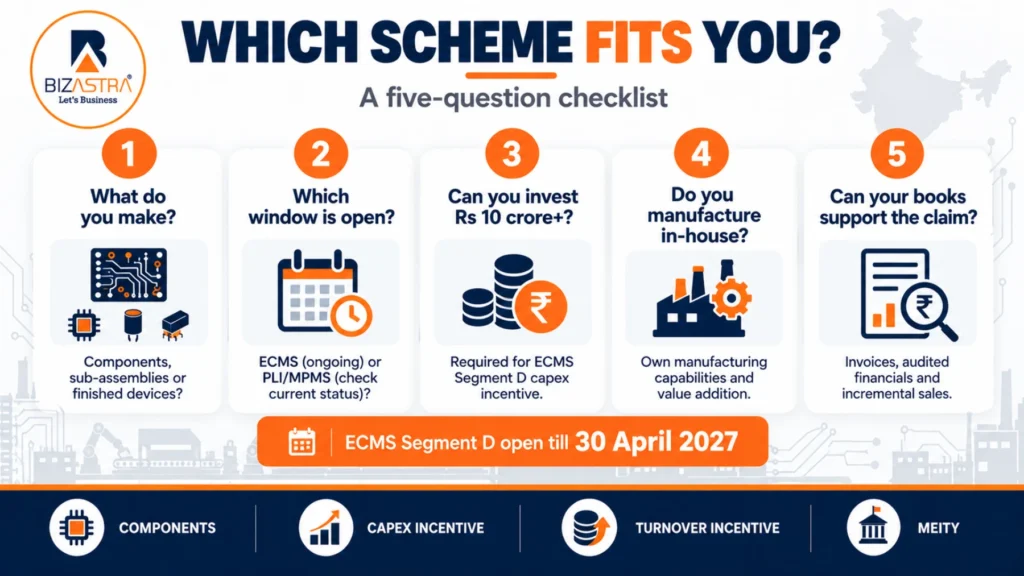
- What do you actually make? Components, sub-assemblies or equipment point to ECMS. Finished phones point to MPMS. Laptops and servers point to IT hardware PLI 2.0.
- Which window is open today? ECMS Segment D is open now, until 30 April 2027. MPMS applications are expected to open from 15 October 2026, subject to official notification.
- Can you clear the entry ticket? For Segment D: at least Rs 10 crore of eligible investment and net worth of 50% of it.
- Do you manufacture in-house? Contract manufacturing is not eligible.
- Can your books support the claim? Every claim needs auditor and Chartered Engineer certificates, GST and e-way bill reconciliation, and a fixed asset register. Claims must be filed within 9 months of the financial year end.
One caution on timing: disbursement is first come, first served, and an approval letter is not a guarantee of payment. It depends on verification after you file your claim.
6. Frequently Asked Questions
Is ECMS the same as PLI?
No. ECMS targets components, sub-assemblies and capital equipment, and offers turnover-linked, capex and hybrid incentives. PLI rewards incremental sales of finished devices such as mobile phones and IT hardware.
Is the PLI scheme still open for electronics in 2026?
No. The original PLI for large-scale electronics manufacturing ended on 31 March 2026. Its successor, the Mobile Phone Manufacturing Scheme (MPMS), is aimed at mobile phone makers. If you make components, ECMS is the relevant route.
Is the ECMS application window still open?
Partly. Segments A to C closed on 30 September 2025 after an extension. Segment D (supply chain and capital equipment) is open until 30 April 2027. The guidelines allow the window to be extended or reopened, so check the ECMS portal for updates.
Can a small manufacturer apply for ECMS?
Segment D has no revenue threshold, but it needs at least Rs 10 crore of eligible investment. The earlier segments carried revenue and investment thresholds starting at Rs 50 crore.
How much is the ECMS capex incentive?
25% of eligible capital expenditure for Segment D, and it is also part of the hybrid incentive for HDI/MSAP/flexible PCBs and SMD passives. Five percentage points depend on meeting the employment threshold.
Is an ECMS acknowledgement the same as approval?
No. The project management agency aims to issue an acknowledgement within 15 working days of a complete application. Approval comes later through the Governing Council and the competent authority, and even approval is not a guarantee of disbursement.
Can I use contract manufacturers?
Not for the core of your process. ECMS does not accept manufacturing through contract manufacturers. You may outsource a few parts of the process on a job-work basis, but not a significant part.
Does ECMS pay for land and buildings?
No. Land, factory building and construction are not eligible investment. Plant, machinery, equipment, tools, dies, moulds, jigs and associated utilities are.
7. Not Sure Which Scheme Fits Your Factory?
Get a free scheme-fit assessment based on your product, planned investment, net worth and current application windows, before you commit to machinery orders. See our ECMS advisory page for how we handle eligibility, filing and claims.
Get a Free Scheme-Fit Assessment
Disclaimer: Figures are indicative and based on the ECMS Scheme Guidelines (MeitY, April 2025), the MPMS Cabinet approval (15 July 2026) and public announcements as of September 2026. Actual benefits depend on your product, investment and approval conditions. Please confirm with a qualified consultant before making investment decisions.