
Quick Answer
ECMS Segment D is the part of the ECMS (Electronics Component Manufacturing Scheme) for supply-chain products (materials and parts that feed component makers) and capital goods used to build electronics. It pays a capex incentive of up to 25% on eligible investment, with a minimum investment of Rs 10 crore. Segments A to C closed on 30 September 2025. Segment D remains open until 30 April 2027, and applications are appraised on an ongoing basis.
1. What Segment D Covers
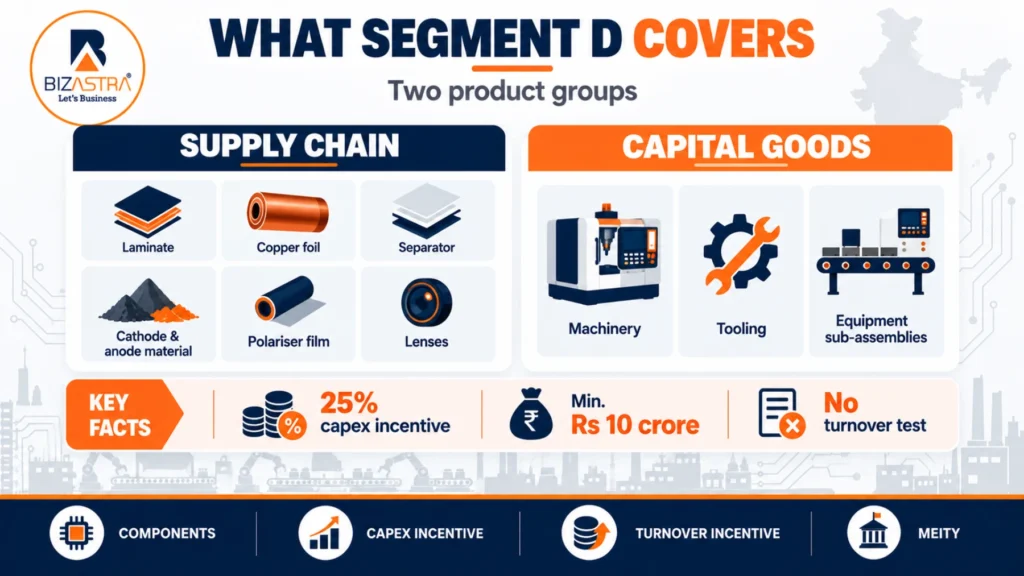
Segment D has two product groups under the scheme guidelines:
- Supply chain of sub-assemblies and bare components: the parts and components used to manufacture display and camera sub-assemblies, and the bare components in Segments B and C.
- Capital goods used in electronics manufacturing, including their sub-assemblies and components. This means the machinery, tooling and equipment that electronics factories run on.
The guidelines give an illustrative, non-exhaustive list of supply-chain items: laminate, pre-preg, copper foil, separator, cathode and anode material, electrolyte, polypropylene film, spray wire, lenses, protective film, glass cover, back light, contrast film and polariser film. Recent approval tranches have included laminates, metallised films for capacitors, rare-earth permanent magnets, and capital goods and their parts.
The government has openly steered industry towards this segment. Segments A to C drew far more applications than expected, while Segment D is where India still depends heavily on imported machinery and materials.
| Segment D at a glance | Details |
|---|---|
| Incentive | Capex incentive of 25% of eligible investment (no turnover-linked incentive) |
| Minimum investment | Rs 10 crore |
| Application window | 1 May 2025 to 30 April 2027, appraised on an ongoing basis |
| Investment period | 5 years from the date of acknowledgement, or as set in the approval letter |
| Employment threshold | Indicative: about 1 person per Rs 1 crore for supply-chain products, about 2 per Rs 1 crore for capital goods |
| Segment D outlay | Rs 1,712 crore in the original guidelines (the Governing Council may reallocate between segments) |
2. The 25% Capex Incentive
The incentive is 25% of your eligible incremental capital expenditure. Commencement of commercial production and meeting the investment threshold are mandatory.
What counts as eligible investment:
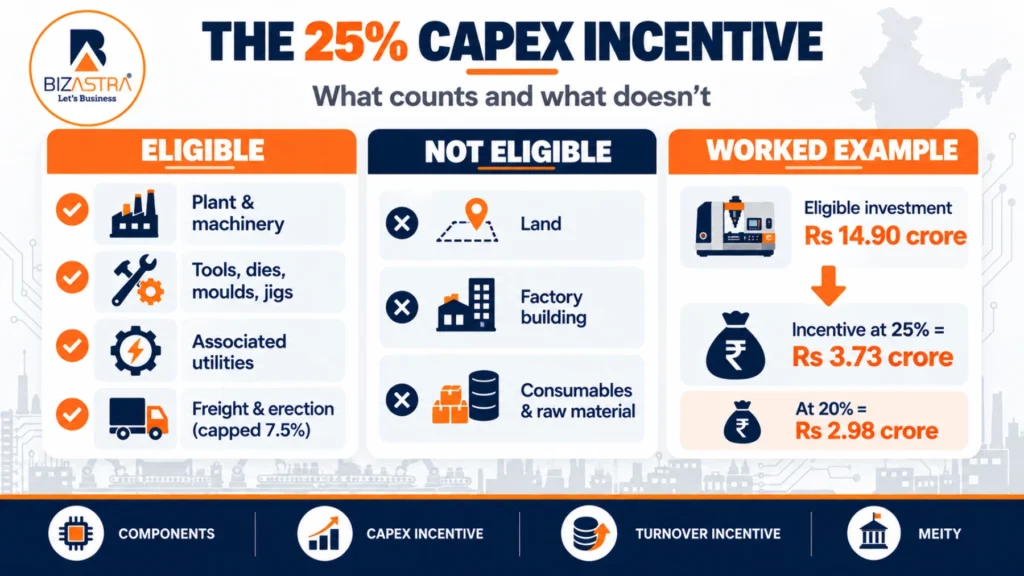
- Plant, machinery, equipment, tools, dies, moulds, jigs and fixtures, including parts, accessories and spares.
- Associated utilities such as captive power, effluent treatment, clean rooms, compressed air, control systems, and IT infrastructure used in manufacturing. Utilities are capped at CPWD schedule rates where available, and need a statutory auditor certificate.
- Packaging, freight, insurance, and erection and commissioning.
- In-house R&D and product development capex, with an auditor certificate and purchase agreements for any IPR.
What does not count: land, factory building and construction, and consumables or raw material. Non-creditable taxes, technology transfer fees and royalties can help you reach the investment threshold, but they are not themselves incentivised.
Worked example. Say you set up a plant making assembly-line equipment. You buy Rs 12 crore of machinery and spend Rs 2 crore on associated utilities. Freight and erection cost Rs 1.2 crore, but the cap is 7.5% of Rs 12 crore, or Rs 0.9 crore. You also spend Rs 5 crore on the factory building.
| Item | Eligible amount |
|---|---|
| Machinery | Rs 12.00 crore |
| Associated utilities | Rs 2.00 crore |
| Freight and erection (capped at 7.5%) | Rs 0.90 crore |
| Factory building | Rs 0 (not eligible) |
| Total eligible investment | Rs 14.90 crore |
| Incentive at 25% | Rs 3.73 crore |
| Incentive at 20% (employment threshold missed) | Rs 2.98 crore |
3. Who Should Apply
Segment D suits you if you are:
- An engineering, precision-machining or automation company that can make machines, tooling or handling equipment for electronics lines.
- A maker of parts and sub-assemblies for that equipment.
- A materials manufacturer supplying inputs to PCB, capacitor, battery or display makers.
- An existing manufacturer diversifying into these products, or a new entrant. Both greenfield and brownfield projects qualify.
4. The Deadline and What Happens After You Apply
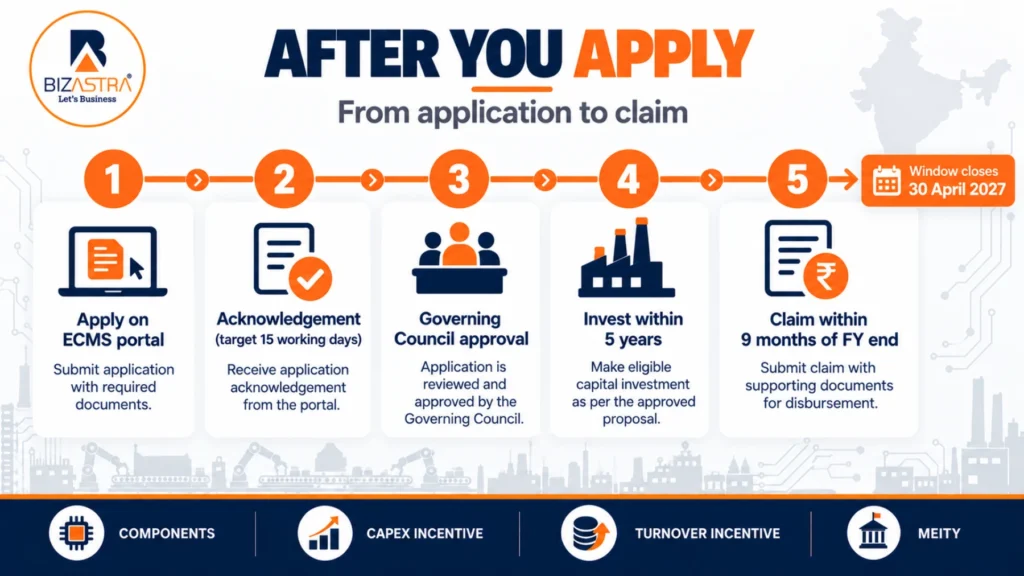
The window closes on 30 April 2027. The guidelines say no application is accepted after the window ends. They also allow the window to be extended or reopened, but you should not plan around that.
Timing matters for reasons beyond the deadline:
- Acknowledgement: the project management agency aims to issue it within 15 working days of a complete application. Acknowledgement is not approval.
- Approval: the Governing Council reviews and recommends. For projects with an incentive up to Rs 100 crore, the Secretary, MeitY approves; above Rs 100 crore, the Cabinet does.
- Investment clock: for Segment D, investment made within 5 years of acknowledgement counts, or as the approval letter states. The Governing Council reviews your investment timeline, and you must stick to it.
- Progress checks: if you make no investment in year one, or your cumulative investment falls below 50% of the projected amount, the Council may revoke your approval.
- Claims: file within 9 months of the end of the financial year in which commercial production is achieved. Disbursement is first come, first served, so a clean file matters.
5. Documents You Need
At application (on the ECMS portal, ecms.meity.gov.in):
- A detailed project report: business plan, investment, sales and employment projections, localisation plan and expected domestic value addition.
- Manufacturing process flowchart, indicative investment timeline and a tentative list of capital equipment.
- Net worth certificate, a board resolution, and other declarations.
- Management undertaking that no investment or sales are being incentivised under another scheme, and the Integrity Pact undertaking signed by your CEO, MD or Director.
At claim stage:
- Statutory auditor certificate for eligible investment, capitalisation of assets in your books and commencement of commercial production.
- Chartered Engineer certificate on reasonableness of cost, installation, installed capacity and, for used equipment, valuation and residual life.
- A separate fixed asset register for the project with proper tagging of assets.
- Pre-disbursal documents: management undertaking, indemnity bond and board resolution. If a claim is later found excessive or false, you refund it with interest at the 3-year SBI MCLR, compounded annually.
- Quarterly review reports within 30 days of each quarter end, once approved.
6. How BizAstra Files It
Most Segment D problems start with a weak application, not a weak project. Our process runs in four steps:
- Fit check: we test your product against the Segment D scope, your Rs 10 crore investment and net worth position, and whether your capital plan is eligible.
- Application file: we prepare the project report, process flowchart, equipment list and undertakings so they match one another.
- Portal filing and follow-up: we submit on the portal and respond to queries within the 15-working-day windows.
- Claim readiness: we set up the fixed asset register, capitalisation trail and certificate schedule from day one, so your first claim is not delayed.
Read more on our ECMS advisory page.
7. Frequently Asked Questions
Is ECMS Segment D still open in 2026?
Yes. Segment D (supply chain and capital equipment) accepts applications until 30 April 2027. Segments A to C closed on 30 September 2025.
What is the minimum investment for Segment D?
Rs 10 crore of eligible investment. There is no minimum turnover or revenue qualification for this segment.
Does Segment D offer a turnover-linked incentive?
No. Segment D offers a capex incentive of 25%. Turnover-linked incentives apply to the other target segments.
Can I claim the incentive on land and building?
No. Land, factory building and construction are not eligible investment.
Can I buy machinery before applying?
Be careful. For Segment D, investment within 5 years of the date of acknowledgement is considered eligible, or as the approval letter says. Confirm the timing before placing orders.
Can I apply for more than one product?
Yes, but each target product needs a separate application and fee. You cannot combine products in one application.
Can I use second-hand machinery?
Yes, if it has at least 5 years of residual life, with a valuation and residual-life certificate from a Chartered Engineer.
What if I miss the employment threshold?
You still receive the capex incentive, but at 20% instead of 25%. The five percentage points depend on meeting the cumulative employment threshold.
8. Check Your Segment D Eligibility
Get a free assessment of whether your product, investment plan and net worth fit Segment D, before you place machinery orders or lose time against the 30 April 2027 deadline.
Disclaimer: The figures above are indicative and for general understanding only, based on the Electronics Component Manufacturing Scheme guidelines (MeitY, April 2025) and public announcements as of September 2026. Actual benefits depend on your project, product, investment size, approval conditions and the scheme rules at the time of your application. Please consult a qualified consultant before making any investment or financial decisions.