
1. What Does the Government Offer Electronics Manufacturers?
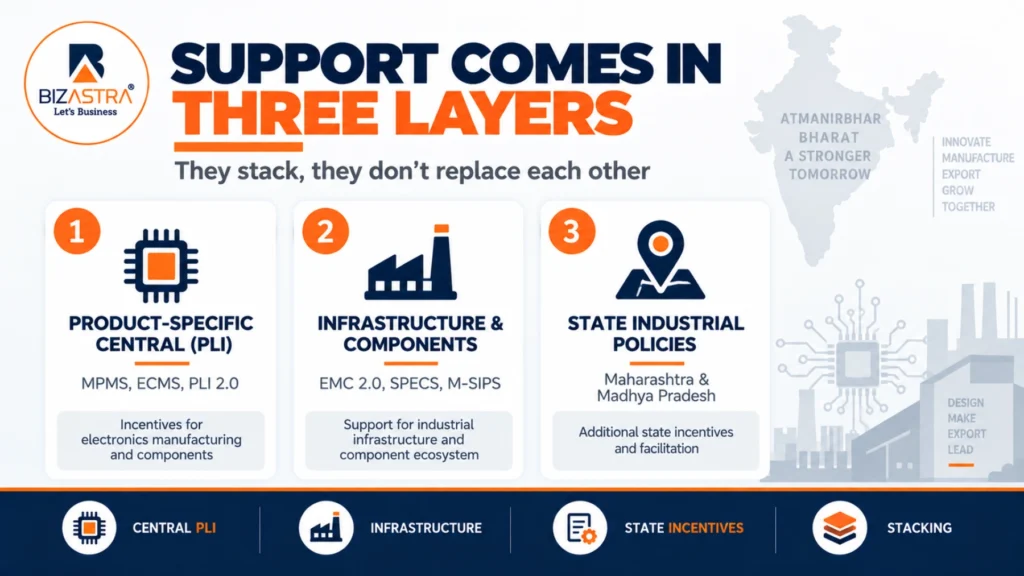
Support comes in three layers, and they are not mutually exclusive.
Product-specific central incentives. The PLI family: MPMS for mobile phones, ECMS for components, and PLI 2.0 for IT hardware. These pay cash incentives linked to incremental sales or capital investment.
Infrastructure and component-ecosystem schemes. EMC 2.0 funds shared industrial infrastructure for electronics clusters. SPECS gives a flat capital subsidy for components, and its predecessor M-SIPS still has legacy relevance for older projects.
State industrial policies. Maharashtra and Madhya Pradesh, among others, run their own incentive packages, including electronics-specific ones, that sit on top of central schemes rather than replacing them.
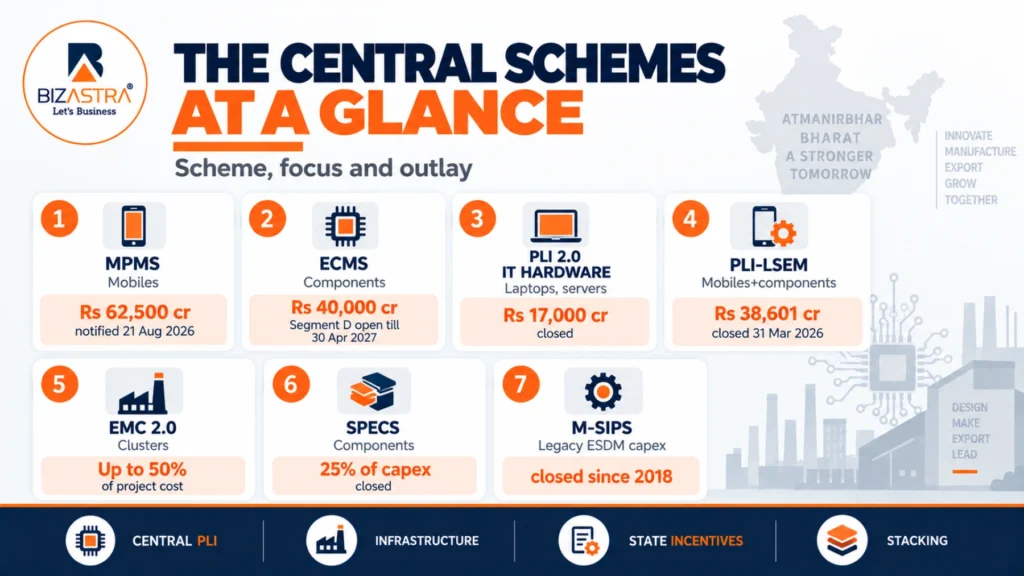
Here is the full central-scheme list at a glance:
| Scheme | Type | Covers | Outlay | Status (Aug 2026) |
|---|---|---|---|---|
| MPMS | Central PLI | Mobile phone manufacturing + Indian brands | Rs 62,500 crore | Notified 21 Aug 2026; guidelines awaited |
| ECMS | Central PLI | Components, sub-assemblies, capital equipment | Rs 40,000 crore | Segment D open till 30 Apr 2027 |
| PLI 2.0 IT Hardware | Central PLI | Laptops, tablets, all-in-one PCs, servers | Rs 17,000 crore | Applications closed Aug 2023; 27 companies running |
| PLI-LSEM (original) | Central PLI | Mobile phones + components (predecessor to MPMS) | Rs 38,601 crore | Closed 31 Mar 2026 |
| EMC 2.0 | Infrastructure | Industrial clusters and common facility centres | Up to 50% of project cost, capped per acre | Ongoing; 13+ clusters approved |
| SPECS | Capital subsidy | Components, e-waste recycling, SPV polysilicon and more | 25% of capital expenditure | Closed to new applications |
| M-SIPS | Capital subsidy (legacy) | ESDM investment, capex subsidy for electronics units | Up to Rs 10,000 crore per company | Closed to new applications since 2018; superseded by SPECS |
Disclaimer: Figures reflect official MeitY notifications and press releases available as of August 2026.
2. ECMS 2025: The Big One for Components
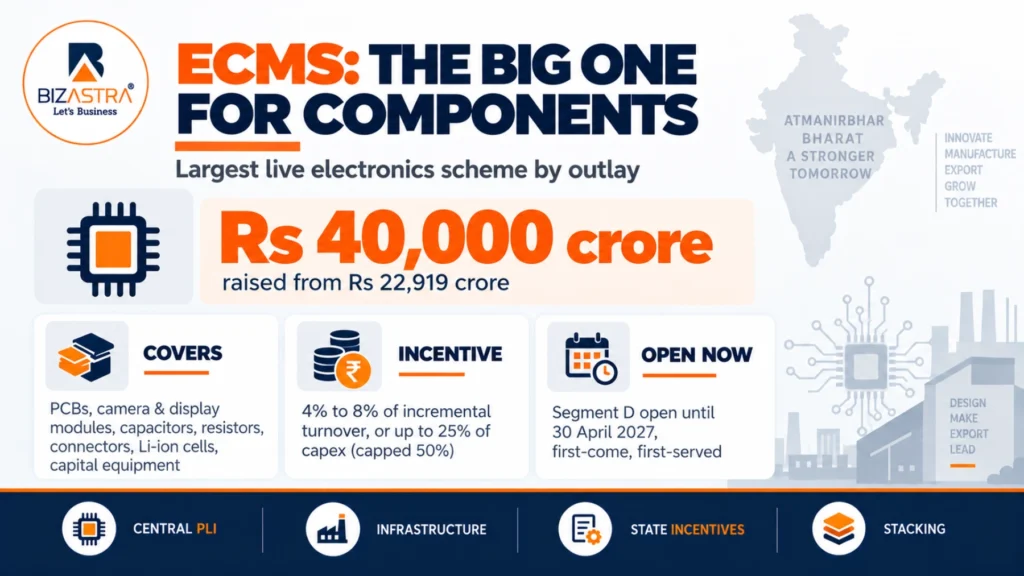
ECMS is currently the largest dedicated electronics scheme by outlay. It was approved by the Union Cabinet on 28 March 2025 and notified on 8 April 2025, with an original outlay of Rs 22,919 crore. The scheme drew far more interest than expected, receiving applications well beyond its original investment target by the September 2025 deadline. The Union Budget 2026-27 responded by raising the outlay to Rs 40,000 crore, a nearly 75% increase.
ECMS covers electronic components and sub-assemblies: multi-layer PCBs, camera and display modules, capacitors, resistors, connectors, magnetics, lithium-ion cells and the capital equipment used to manufacture these items. Incentives are turnover-linked or capex-linked (reported at 4% to 8% of incremental turnover, or up to 25% of eligible capital investment, capped overall at 50% of eligible investment), with a first-come, first-served allocation and some incentives tied to design and quality benchmarks. Applicants must meet consolidated global ESDM or manufacturing revenue thresholds based on FY2023-24.
Segments A, B, C and E closed on 30 September 2025. Segment D, covering supply chain ecosystem and capital equipment, stays open until 30 April 2027. As of mid-2026, a large number of projects have already been approved under the scheme, spanning multiple product categories and states across the country.
3. PLI for Electronics: MPMS, IT Hardware and the Scheme That Closed
MPMS, notified 21 August 2026, is the newest scheme in the family. It covers mobile phone manufacturing and, through a dedicated segment, gives extra support to Indian-owned mobile brands investing in design and R&D. Outlay: Rs 62,500 crore over five years, FY2026-27 to FY2030-31. Guidelines and an application portal are still awaited.
PLI 2.0 for IT Hardware, approved May 2023, covers laptops, tablets, all-in-one PCs and servers. Its outlay is Rs 17,000 crore. Applications closed in August 2023, and 27 companies, including Dell, HP, Lenovo, Acer and Asus, continue claiming under it.
PLI-LSEM, the original scheme, closed 31 March 2026. Notified in April 2020, it covered mobile phones and components together and is what MPMS has effectively replaced for mobile phones.
All three sit within India’s broader PLI programme, which spans 14 sectors of the economy (specialty steel, textiles, automobiles, pharmaceuticals, white goods and more) with a combined original outlay of about Rs 1.97 lakh crore.
4. EMC 2.0, SPECS and the M-SIPS Legacy
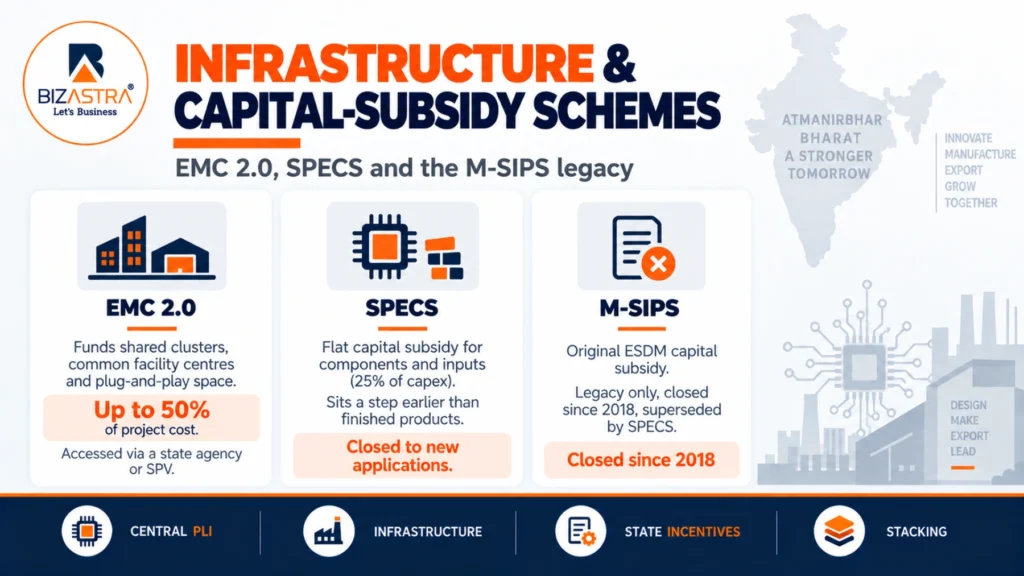
EMC 2.0 (Modified Electronics Manufacturing Clusters) was approved alongside the original PLI-LSEM. It doesn’t fund a company’s manufacturing directly. Instead, it funds the shared infrastructure, common facility centres and plug-and-play industrial space that let electronics manufacturers set up faster inside a dedicated cluster, testing labs, tool rooms, effluent treatment and utilities included. These clusters typically host a mix of mobile phone assembly, consumer electronics, telecom equipment and component manufacturing units under one roof, since sharing infrastructure across several manufacturers is the whole point of the scheme. This scheme is usually accessed through a state industrial development agency or cluster developer (an SPV), rather than applied for directly by an individual manufacturer. Several such clusters have already been approved across multiple states, and more continue to be added as demand for shared electronics infrastructure grows.
SPECS (Scheme for Promotion of Manufacturing of Electronic Components and Semiconductors) was notified the same day as PLI-LSEM. Where ECMS and MPMS reward finished products, SPECS sits a step earlier in the chain. It supports manufacture of the parts and materials that feed into those finished products: electronic components, e-waste recycling, mechanics such as enclosures and connectors, micro and nano-electronic components, and solar PV polysilicon. The idea is to build domestic capacity for inputs that Indian electronics assembly still largely imports, rather than to subsidise assembly itself.
M-SIPS (Modified Special Incentive Package Scheme) was the original capital subsidy scheme for the ESDM sector, before SPECS existed. It offered a capital subsidy on new investment plus reimbursement of certain duties on capital equipment, covering everything from consumer electronics to IT hardware and medical electronics. A later amendment raised its incentive ceiling and shortened the disbursement window. M-SIPS stopped taking new applications some years ago, and SPECS has since taken over its role. Worth checking for older projects, since the terms differ from SPECS.
5. State Incentives: Maharashtra and Madhya Pradesh
Central schemes and state incentives generally stack, since they sit at different levels of government with their own eligibility criteria.
Maharashtra runs three layers of its own. General industrial policies, MIISP 2025 and PSI 2019, treat Electronics and ESDM as a thrust sector, which unlocks a capital subsidy (20% of eligible fixed capital investment under MIISP 2025, capped at Rs 25 crore per unit) on top of standard benefits like SGST refund. Separately, the state has run a dedicated Maharashtra State Electronic Policy, 2016. A dedicated incentive package just for electronics manufacturers, separate from the general MIISP 2025 / PSI 2019 route. It covers your core setup costs: land, building, plant and machinery, and related development expenses. In return, you get an SGST refund on your first sales within the state, an interest subsidy on your term loans, relief on electricity duty and power tariffs for new units, and a stamp duty waiver during the investment period. Electronics also qualifies as a thrust sector under the general MIISP 2025 route, so it’s worth checking both.
Madhya Pradesh IT, ITeS & ESDM Investment Promotion Policy 2023. Covers IT/ITeS companies, ESDM manufacturing, and data centres, with bigger benefits for larger, mega-scale projects. The core support is a capital subsidy on your investment in plant, machinery and infrastructure, paid out over a few years. On top of that, the policy adds a power tariff rebate, support for green infrastructure like effluent treatment, help building infrastructure up to your factory gate, reimbursement for patent and trademark filings, incentives for hiring differently-abled employees, and an export freight subsidy.
Disclaimer: State incentive rates and eligibility change by government resolution or notification. Confirm current terms for a specific project before relying on the figures in this section.
6. How Do You Choose and Stack These Schemes?
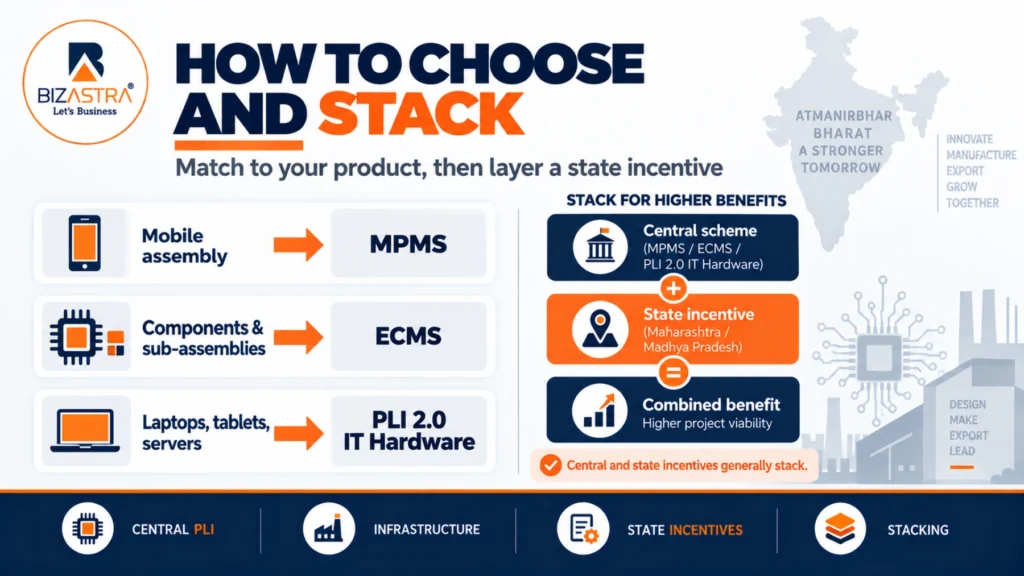
Match the scheme to your product line first. Mobile assembly points to MPMS. Components and sub-assemblies point to ECMS. Laptops, tablets and servers point to PLI 2.0 for IT Hardware.
Layer a state incentive on top. Being approved under a central scheme does not disqualify you from Maharashtra or Madhya Pradesh’s own incentive packages, including Maharashtra’s dedicated Electronics Policy for R&D and innovation infrastructure.
Track application windows separately. Central schemes open and close on their own calendars. ECMS Segment D closes 30 April 2027. MPMS has no open window yet. State schemes usually run on rolling windows tied to your project’s commissioning date.
Check if you already have infrastructure access. If you’re setting up inside an EMC 2.0 cluster, plug-and-play infrastructure may already be in place through the developer, without a separate company-level application.
Do the eligibility math before committing capital. Thresholds like MPMS’s Rs 10,000 crore turnover cutoff or ECMS’s revenue benchmarks rule out most MSMEs from the flagship schemes. Smaller manufacturers often get more practical value from SPECS, EMC 2.0 infrastructure access, and state MSME-specific incentives.
7. Frequently Asked Questions
Is there one single “electronics manufacturing scheme” in India?
No. It’s a stack of schemes: MPMS for mobiles, ECMS for components, PLI 2.0 for IT hardware, plus EMC 2.0 for infrastructure, SPECS and M-SIPS for capital subsidy, and state incentives on top.
What is the difference between ECMS and PLI for electronics?
ECMS is itself one of the PLI-linked schemes, focused specifically on electronic components and sub-assemblies. MPMS and PLI 2.0 for IT Hardware are the other two current PLI programmes covering mobiles and IT hardware respectively.
Can a manufacturer claim both a central scheme and a state subsidy?
Generally yes. Central and state incentives are administered independently and are usually designed to stack, though each has its own eligibility conditions to satisfy separately.
Does Maharashtra have anything specific to electronics, or just general industrial incentives?
Both. MIISP 2025 and PSI 2019 treat electronics and ESDM as a thrust sector with extra capital subsidy, and the state also runs a separate Electronics Policy, in place since 2016, focused on R&D, design and innovation infrastructure.
8. What’s Next: How Much Can You Actually Claim?
Knowing which scheme applies to you is only half the job. The number that actually matters is how much MPMS, ECMS or PLI 2.0 pays out for your specific product and investment size, and that’s where most manufacturers either overestimate or leave money on the table.
Contact Us for a Free Assessment
This guide sits within our broader coverage of Government Schemes for manufacturers investing in India.
Disclaimer: The figures above are indicative and for general understanding only, based on official government notifications and press releases available as of Aug 2026. Actual eligibility, incentive rates, outlays and application windows depend on the specific scheme guidelines in force when you apply. Please consult a qualified consultant before making any investment or financial decisions.
Author: CA, BizAstra. Figures reflect official MeitY and government press releases for MPMS, ECMS, PLI 2.0 for IT Hardware, PLI-LSEM, EMC 2.0, SPECS, M-SIPS and Maharashtra’s Electronics Policy, current as of August 2026.