
The Question Nobody Answers Honestly
You have decided to set up a factory in Maharashtra. You have heard the word “subsidy” thrown around, in brochures, in meetings, maybe from a friend who set up a plant near Pune. But nobody has told you the one thing you actually need to know: how much subsidy for a factory in Maharashtra will actually land in your account, and when.
Not a percentage. Not a policy name. Real rupees. In your bank account.
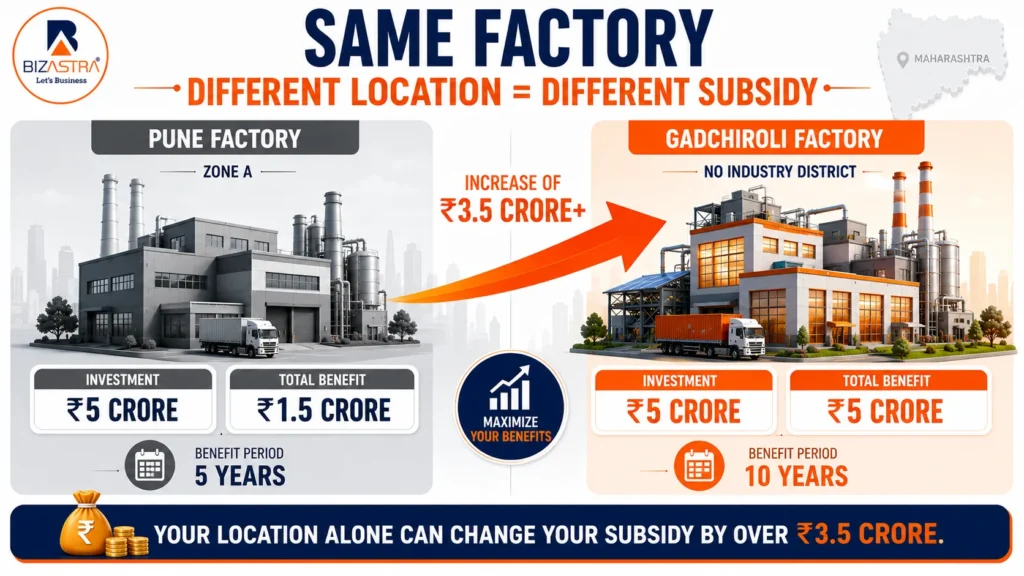
Here is the honest, current answer. Many older guides still quote the previous scheme, so their numbers can be out of date: a factory investing Rs 5 crore in an aspirational or no-industry district can get its entire Rs 5 crore back over 10 years, that is 100% of its investment.
The exact same factory near Pune gets roughly Rs 1.5 crore back over 5 years. Both numbers are real and in force today. The gap between them is not luck, or connections. It’s one location decision and planning.
The difference comes down to three things you need to know before you sign anything. This blog walks through exactly what those three things are, using the Maharashtra subsidy figures that apply under the current policy. Confirm the exact figures for your project, as the detailed implementing rules are still being finalized.
The First Thing That Decides Your Money: Where Your Factory Is
Maharashtra’s industrial incentive framework divides the state into zones based on how industrially developed each area already is. The less developed the area, the more the government gives back to bring investment there. Think of this zone table as a built-in Maharashtra subsidy calculator: find your taluka’s zone, and you already know your ceiling.
Here is the current zone-wise picture:
| Zone | Example Cities / Districts | Max Incentive (% of FCI) | Benefit Period | Approx. Return on ₹5 Cr FCI |
|---|---|---|---|---|
| A | Mumbai, Pune, PCMC | 30% of FCI | 5 Years | ₹1.50 Crore |
| B | Nashik, Kolhapur | 40% of FCI | 7 Years | ₹2 Crore |
| C | Satara, Sangli | 50% of FCI | 7 Years | ₹2.5 Crore |
| D | Jalna, Latur | 60% of FCI | 10 Years | ₹3 Crore |
| D+ | Interior Vidarbha / Marathwada Talukas | 70% of FCI | 10 Years | ₹3.5 Crore |
| Special Belt | Vidarbha, Marathwada, Ratnagiri, Sindhudurg, Jalgaon, Dhule (Nagpur Region), Chhatrapati Sambhajinagar Region, Konkan Interior | 80% of FCI | 10 Years | ₹4 Crore |
| No-Industry Districts, Naxalism-Affected & Aspirational Districts | Gadchiroli, Washim, Osmanabad (Dharashiv), Nandurbar | 100% of FCI | 10 Years | ₹5 Crore |
Disclaimer: The figures above are indicative and for general understanding only. Actual benefits depend on your specific project, location, sector, investment size, and scheme rules at the time of your application. Please consult a qualified consultant before making any investment or location decisions.
Notice something important: Zone A is no longer a zero. Under the older scheme most consultants, and most other blogs, are still quoting, a factory in Pune or PCMC got nothing at all. That changed on 31 December 2025, when Maharashtra’s newest industrial policy, MIISP 2025, was notified (see our full MIISP 2025 guide for the complete picture). Under the current rules, even a Group A location earns a real, if modest, subsidy amount. It just doesn’t come close to what interior Vidarbha or Marathwada pays out.
Your zone is locked in the moment you pick your land. Shift the location by even 50 to 100 kilometres and you could double your total benefit. That decision must happen before you buy the plot, not after. For the full list of MIDC industrial areas mapped to each zone, see our MIDC list guide.
The Second Thing: What the Government Counts as Your Investment
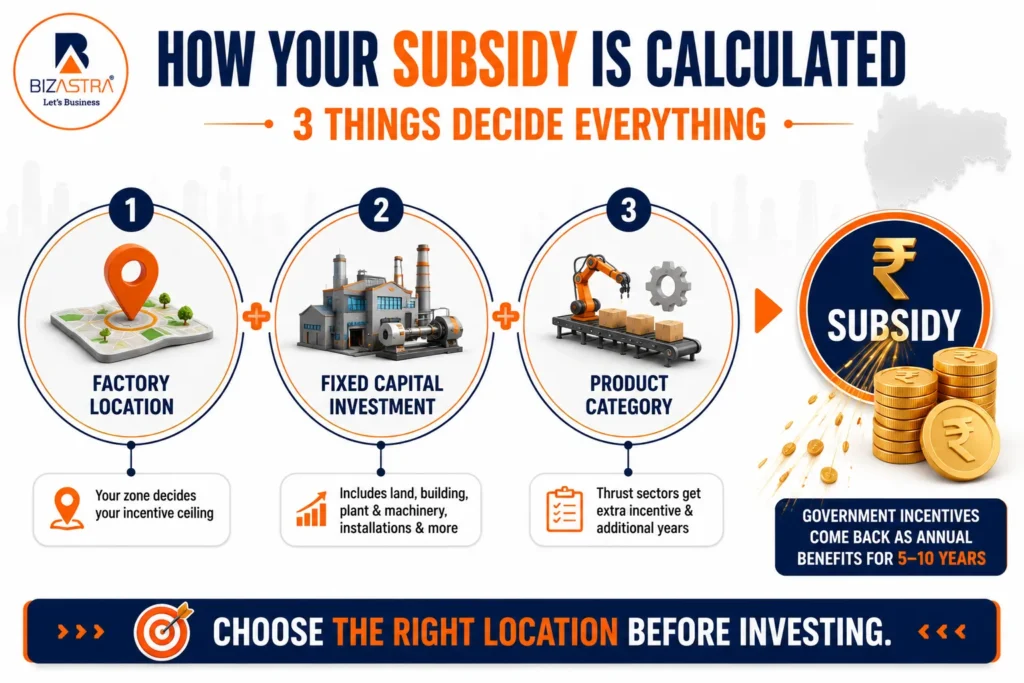
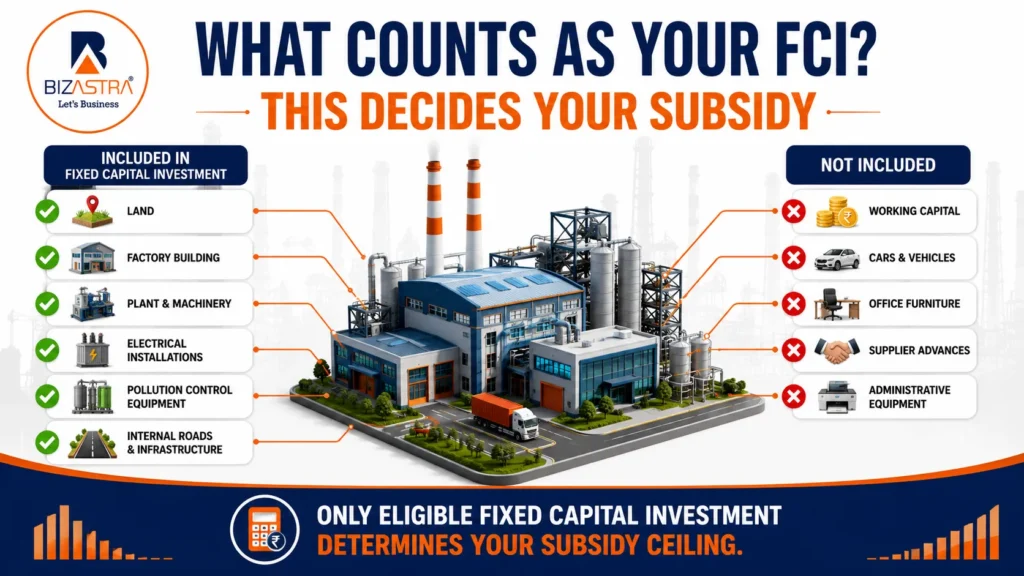
Here’s something that surprises almost every first-time factory owner: the government does not calculate your capital subsidy on everything you spend. It only counts certain items, called Fixed Capital Investment (FCI).
What counts as FCI:
Land you purchase or develop for the factory. The building you construct. Machines and equipment installed. Electrical systems and installations. Pollution control and effluent treatment systems. Roads and infrastructure inside your factory premises.
What does NOT count:
Working capital for daily operations. Vehicles. Office furniture and computers used for administration. Advance payments to suppliers not yet received.
Why this matters: say you spend Rs 10 crore to start your factory, but Rs 4 crore of that is working capital and vehicles. Your basket is calculated on Rs 6 crore, not Rs 10 crore. Many manufacturers are caught off guard when their eventual subsidy amount comes in lower than expected. Misclassifying expenses at the planning stage is the single most common, and most avoidable, reason why.
The good news: if you plan your investment categories correctly before you spend the money, you can make sure as much of your outlay as possible counts toward your ceiling. This is exactly the kind of planning BizAstra does for clients before a single rupee is committed. For general context on Maharashtra’s broader industrial policy landscape, see our Maharashtra state overview.
You know your zone, and you know what counts. The third variable is what your factory makes. For thrust sector products, the government adds 20% extra incentive and 2 more years of eligibility on top of everything else.
Real Numbers from Three Different Factories
Enough theory. Below are three worked examples answering how much subsidy for a factory in Maharashtra actually comes to, using the zone-wise figures that apply under the current policy. Run your own project through the same logic.
Factory 1 – Pharma Unit in Nashik (₹5 Crore Investment)
Location: Nashik – Zone B (7-year base benefit period)
What it makes: Medicines / Pharmaceuticals – a recognised thrust sector
Basket: 40% of FCI, extended to 60% with the thrust sector’s +20% bonus
Benefit period: 7 years + 2 thrust-sector years = 9 years
Total estimated incentive: ₹3 crore (~₹33 lakh per year for 9 years)
This is the MSME subsidy amount Maharashtra pharma manufacturers in Zone B can realistically plan around – before adding interest subsidy and stamp duty waiver on top.
Factory 2 – Auto Components Unit in Chhatrapati Sambhajinagar (₹15 Crore Investment)
Location: Marathwada region – Special Belt (10-year benefit period)
What it makes: Auto components – general manufacturing, no thrust classification
Basket: 80% of FCI
Total estimated incentive: ₹12 crore (~₹1.2 crore per year for 10 years)
Factory 3 – General Engineering Unit in Nagpur (₹5 Crore Investment)
Location: Nagpur – Vidarbha, Special Belt (10-year benefit period)
What it makes: General engineering components, no thrust classification
Basket: 80% of FCI
Total estimated incentive: ₹4 crore (~₹40 lakh per year for 10 years)
Disclaimer: The figures above are indicative and for general understanding only. Actual benefits depend on your specific project, location, sector, investment size, and scheme rules applicable at the time of your application. Please consult a qualified consultant before making any investment or location decisions.
Notice what’s common across all three: the Industrial Promotion Subsidy is the engine driving most of the benefit, paid year after year against the SGST your factory actually deposits, not as a lump sum. The longer your zone’s eligibility period, the more you accumulate.
How the Money Actually Reaches You
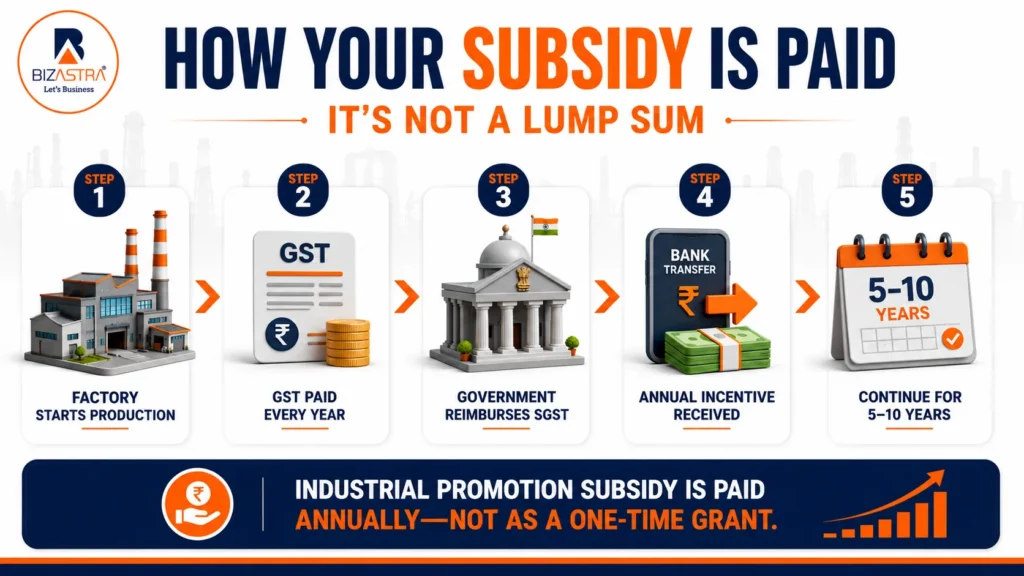
The state does not hand you a cheque on day one. Incentives arrive through four separate streams, each landing at a different point in your factory’s life.
Stream 1, Industrial Promotion Subsidy (IPS)
The biggest one. Every year, the government reimburses you against the SGST your factory has actually deposited on sales within Maharashtra. For MSMEs, this is 100% of your Gross SGST, up to your zone’s ceiling. It continues for 5 to 10 years depending on your zone.
Stream 2, Interest Subsidy
Reduces your bank loan cost by reimbursing up to 5% per year on your term loan, subject to a project cap. Claimed annually after your EMI payments.
Stream 3, Stamp Duty Waiver
100% stamp duty exemption in Group C, D, D+, and No-Industry Districts. In Group A and B, you get a 50% waiver on your first land lease or conveyance deed. This is the only benefit received upfront, at registration.
Stream 4, Power Tariff Subsidy and Electricity Duty Exemption
From Group C onward, eligible units get roughly ₹1 per unit of electricity consumed for 5 years, plus full electricity duty exemption for the eligibility period. Group A and B units generally don’t get this unless they’re EOU, IT, or BT units.
When does the first payment come? The honest answer: not immediately. The Industrial Promotion Subsidy starts roughly 12-13 months after your factory begins production – after you’ve filed a full year of GST returns and applied for reimbursement at your District Industries Centre (or MIDC, for larger units). The Stamp Duty Waiver is the only benefit you get on day one.
For a step-by-step walk through of exactly how the SGST reimbursement claim works – application process, documents, and the mistakes that most often delay payments.
Connect with us
You now know the zones, what counts, and three real examples. One last thing – does what your factory makes change your benefits? For some sectors, it adds 20% more and two extra years on top of everything else.
Does What You Make Change Your Benefits?
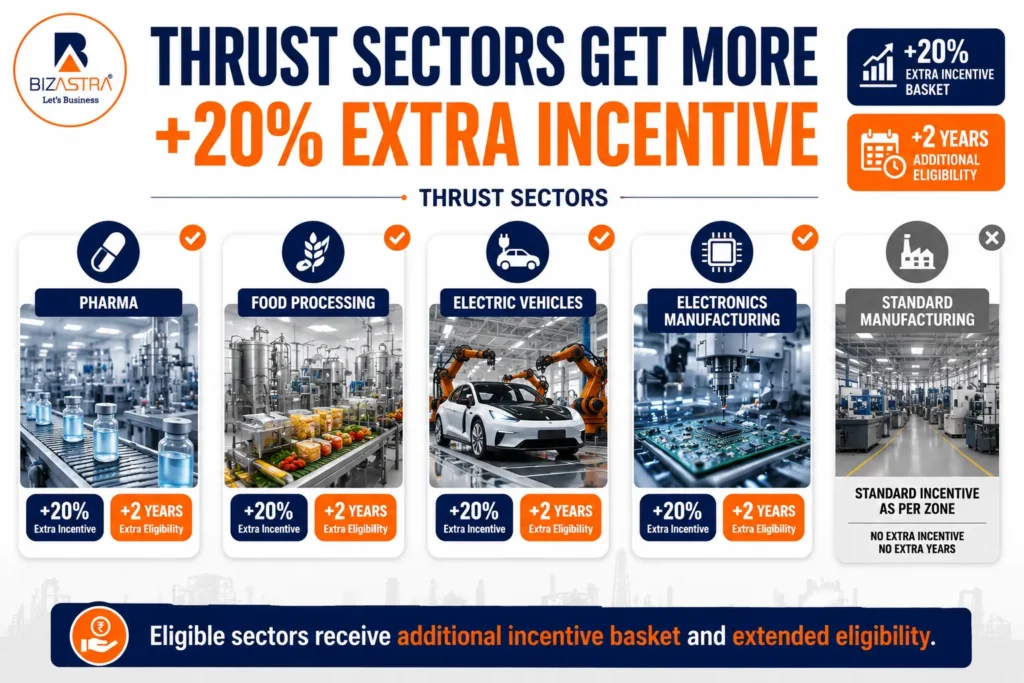
Yes – significantly. Certain product categories are classified as Thrust Sectors that Maharashtra particularly wants to develop, earning a 20% extra incentive basket plus two additional years of eligibility. Here’s a quick guide:
| What You Make | Incentive Basket | What It Means in Simple Words |
|---|---|---|
| Medicine / Pharma | Higher basket | Recognized thrust sector. Gets 20% extra incentive basket over the standard zone cap, plus 2 additional years of eligibility. |
| Food Processing | Higher basket | Secondary and tertiary food processing is a thrust sector. Eligible for the same 20% additional incentive basket and 2 extra years. |
| Electric Vehicles (EV) | Higher basket | EV manufacturing is a thrust sector and qualifies for the highest incentive basket, regardless of location. |
| General Manufacturing | Standard basket | Eligible for Industrial Promotion Subsidy, Interest Subsidy, Stamp Duty Waiver and Power Tariff Subsidy based on the applicable zone. No sector-specific bonus. |
Disclaimer: The figures above are indicative and for general understanding only. Actual benefits depend on your specific project, location, sector, investment size, and scheme rules applicable at the time of your application. Please consult a qualified consultant before making any investment or location decisions.
Questions People Ask Us Every Week
How much subsidy can a small business actually expect?
Small and medium businesses are the primary target of this policy. There’s no large minimum investment that bars you. For MSMEs, the MSME subsidy amount Maharashtra offers can reach up to 100% of FCI in the highest-tier zones. The key is completing your Eligibility Certificate application at your District Industries Centre before commercial production starts.
Is Pune eligible for any subsidy at all now?
Yes – as of 31 December 2025, Zone A locations (Pune, PMC, Mumbai) get 30% of FCI over 5 years for the first time. It’s still well below what Group B and beyond offer, but it’s no longer zero.
Is the subsidy amount taxable?
Yes, treat it as taxable income and plan accordingly with your CA.
Can I run a maharashtra subsidy calculator on my own project before committing to a location?
The zone table above is the starting point. For a number specific to your investment size, sector, and exact taluka, including thrust sector bonuses, BizAstra runs the full calculation in one phone call.
Connect with us and check eligibility
How do I get started on the factory setup itself?
Location, approvals, and investment structuring all happen before you touch subsidy paperwork. Our complete guide on how to set up a factory in Maharashtra walks through the full sequence.
When will my first subsidy payment actually arrive?
The Stamp Duty Waiver is the only benefit you get upfront.
The main benefit, the Industrial Promotion Subsidy, starts roughly 12 -13 months after production begins, once you have filed a full year of GST returns and applied for reimbursement.
Does the subsidy come as a lump sum or every year?
Mostly yearly. The Industrial Promotion Subsidy is paid each year against the SGST your factory deposits, over your zone’s 8 to 10 year period. Only the stamp duty benefit is one-time.
What is FCI in simple terms?
FCI, or Fixed Capital Investment, is the part of your spending the government counts for the subsidy. It includes land, building, plant and machinery, and installation. It does not include working capital, vehicles, or office furniture.
Can a service business get the subsidy, or only manufacturing?
The main subsidy is built for manufacturing units. Some service activities, like IT, logistics, and tourism, are covered under specific Maharashtra policies. Check your exact activity before assuming eligibility.
Can I claim a central scheme like PLI along with the Maharashtra subsidy?
Yes. The Maharashtra subsidy rewards your capital investment, while central schemes like PLI reward your production output. They work on different heads and can usually be claimed together with correct planning.
Is there a minimum investment or job requirement?
There is no large minimum investment that bars small units. Some benefits and higher tiers do carry employment or investment conditions, so the exact rules depend on your zone and unit size.
What documents do I need to claim the subsidy?
Typically your Udyam or IEM registration, MPCB consent, GST returns, audited financials, the fixed asset schedule, and proof of investment . The Eligibility Certificate application must be filed with the respective departments/ authorities as per the scale and type of unit before commercial production starts.
Want to Know the Exact Number for Your Factory?
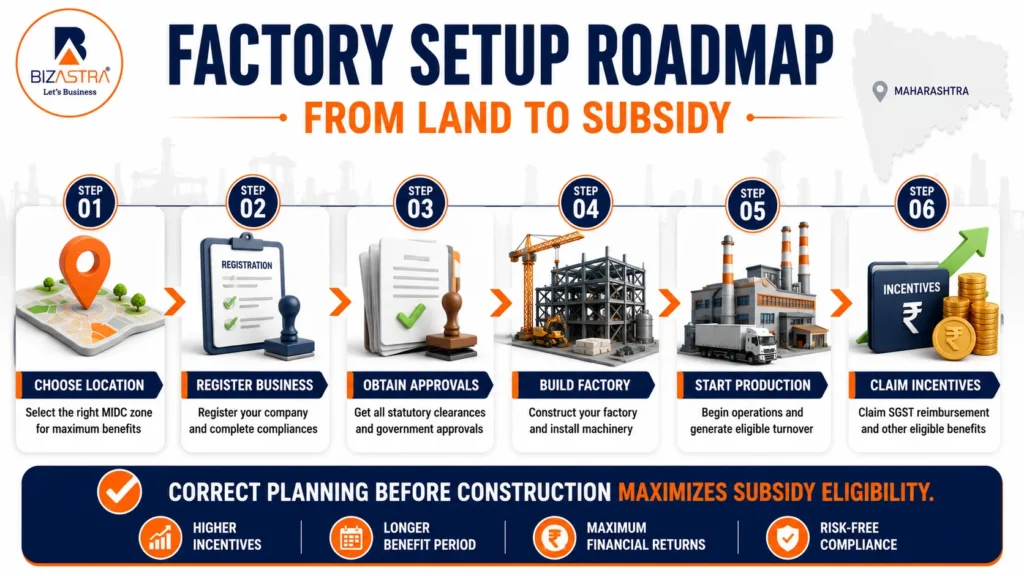
Most manufacturers we speak to are either leaving money on the table or expecting more than they will actually receive. Both problems are avoidable, with the right calculation done before you commit. BizAstra gives you a free Subsidy Report, your zone, your sector, your real number, in one phone call. No jargon. No commitment.
[ Get Your Free Subsidy Report, Contact BizAstra Today ]
Disclaimer: The figures above are indicative and for general understanding only. Actual benefits depend on your specific project, location, sector, investment size, and scheme rules at the time of your application. Please consult a qualified consultant before making any investment or location decisions.
Author: CA, BizAstra. Reviewed against the MIISP 2025 policy. Based on 500+ subsidy calculations across all zones.