
Why This List Exists, and Why You Should Check It First
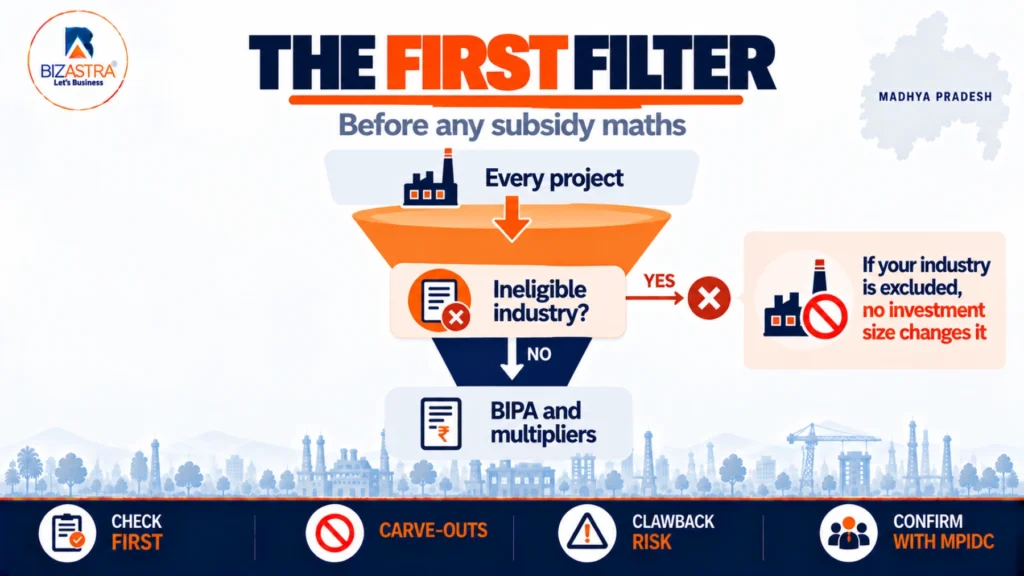
Most of the questions we field about IPP 2025 start with numbers: how much BIPA can I claim, what counts toward EFCI, do I qualify as a Mega unit. All fair questions, but they assume you’re eligible to begin with. For a specific set of industries, that assumption doesn’t hold, no matter how large the investment or how many jobs it creates.
This isn’t a minor footnote. It’s the first filter every project should be checked against, before a single projection or subsidy calculation gets built, because none of that work matters if your industry sits on the excluded list.
The reasoning behind the exclusions isn’t spelled out line by line in the policy, but the pattern is fairly easy to read. A few of the excluded categories are health-linked (tobacco, gutka, liquor), a few are environmentally sensitive or low value-add (mining without value addition, sawmilling, stone crushing), and a few are simply outside what a state industrial incentive scheme is designed to subsidise in the first place, like thermal power generation or basic scrap pressing.
So, what exactly is on that list? Here it is, in full.
The Full List of Ineligible Industries
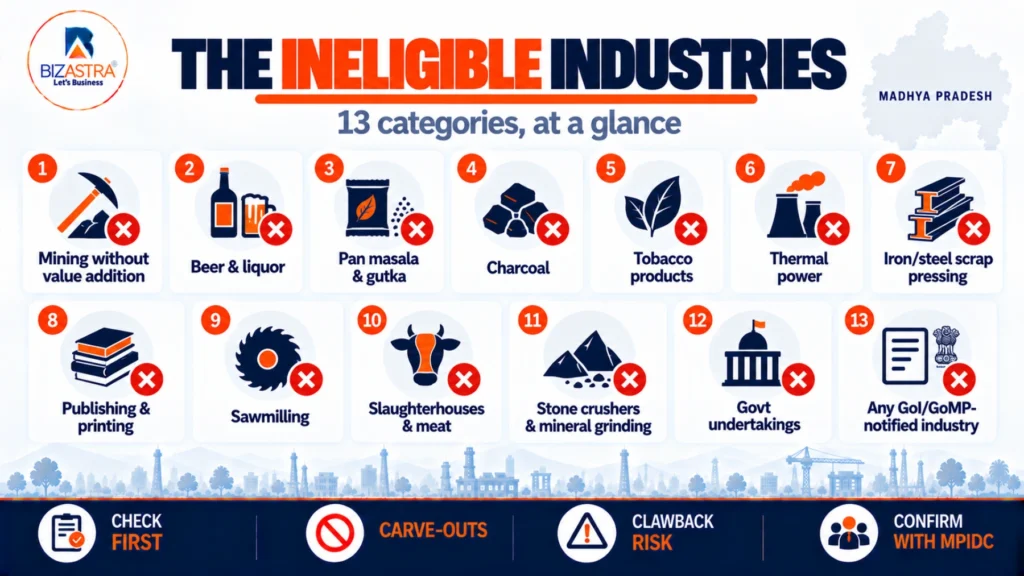
Read that list twice and a few entries probably don’t look like what you expected, because several of them are narrower than the headline word suggests. That’s exactly where projects get wrongly ruled in or out.
The Carve-Outs and Exceptions Worth Knowing
Several entries on this list aren’t blanket bans, they’re bans with a specific door left open, and missing that door is an easy way to wrongly assume you’re ineligible when you’re not.
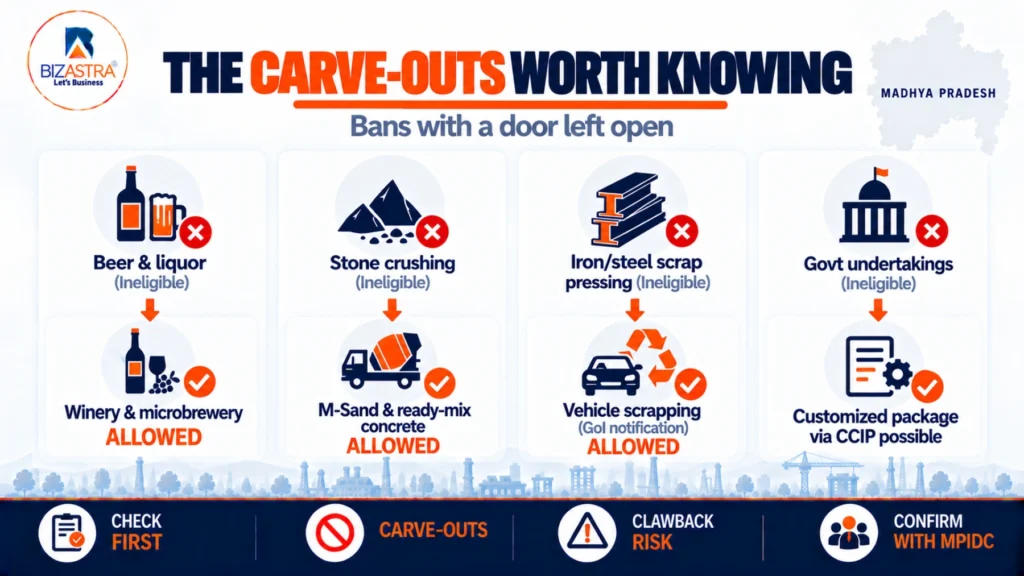
Beer and liquor is excluded, but winery and microbrewery operations are specifically carved back out. If you’re setting up a winery in Madhya Pradesh, you’re not automatically shut out just because “liquor” appears on the list.
Stone crushing and mineral grinding is excluded, but M-Sand and ready-mix concrete manufacturing are carved back out. Same logic: read past the headline category before assuming you don’t qualify.
Iron and steel scrap pressing is excluded, except for vehicle scrapping done under the applicable central government notification. If your unit specifically handles end-of-life vehicle scrapping rather than general scrap pressing, that exclusion doesn’t apply to you.
Central and State Government undertakings are on the list too, but with an asterisk attached: the state’s Cabinet Committee on Investment Promotion can still consider a customized package for them on a case-to-case basis. So even a government undertaking isn’t automatically and permanently locked out, it just doesn’t get standard, formula-based incentives the way a private manufacturer would.
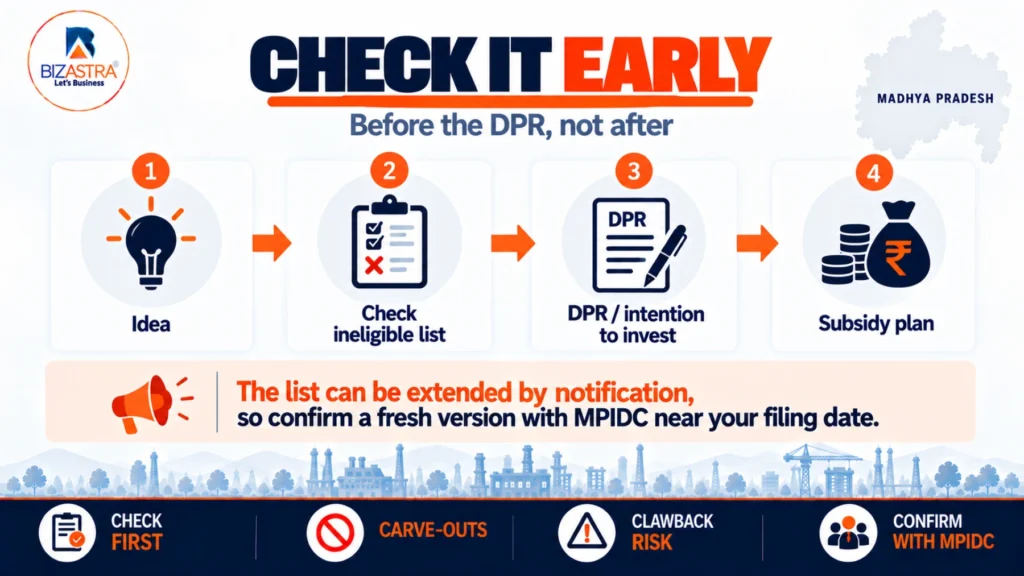
And one line on this list is worth reading carefully for a different reason: any industry the Government of India or Government of Madhya Pradesh declares ineligible “from time to time.” This list isn’t fixed. It can be added to by future notification, which is exactly why this is worth rechecking closer to your application date, not just once during early planning.
Knowing you’re on the list, or not, is only step one. What actually happens if this gets missed, or worse, ignored?
What Happens If You Apply Anyway
This is the part that turns “ineligible industry” from a technicality into a real financial risk. If a unit makes a false declaration to obtain incentives, or if incentives end up being availed by a unit that was never eligible in the first place, the policy allows the state to recover the entire incentive amount, calculated from the date it was originally availed, with interest compounding annually at 10%.
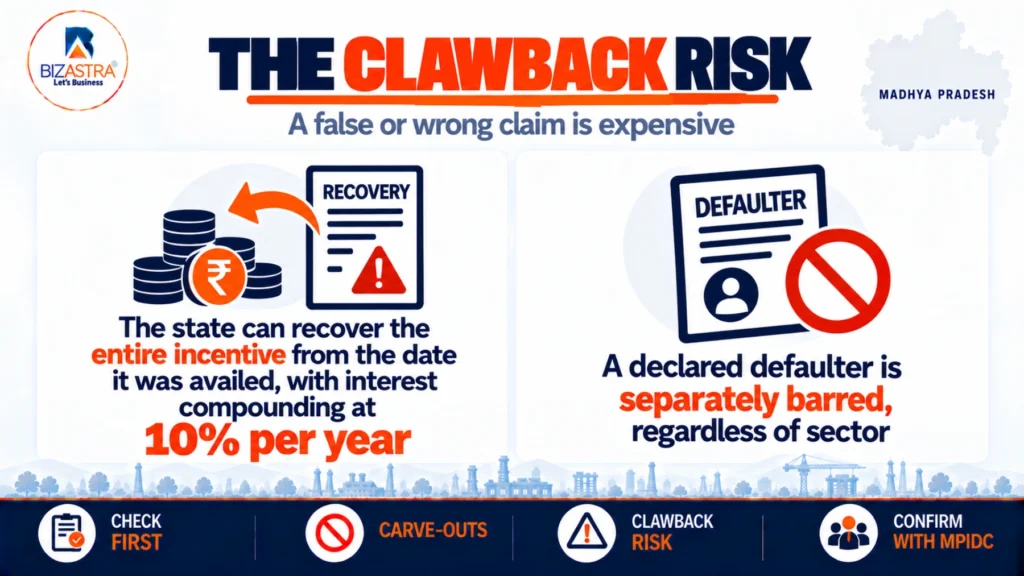
That’s a meaningfully different situation from simply being told no at the application stage. It means incentives already disbursed, potentially over several years, can be clawed back with years of compounded interest on top, if eligibility issues surface later rather than upfront.
It’s also worth knowing that industry type isn’t the only eligibility gate. Any industry the state or central government has formally declared a defaulter is separately barred from assistance under the policy, regardless of what sector it’s in. So a clean check against the ineligible industries list is necessary, but it isn’t the whole eligibility picture on its own, which naturally raises a few questions worth settling before you go any further.
Frequently Asked Questions
Does this list apply only to brand-new units, or to expansion and diversification projects too?
Both. When an existing unit applies for a customized package through the CCIP route, its eligibility is checked against the same ineligible industries list, alongside criteria like expansion size and employment generation. Growing an existing eligible unit doesn’t exempt you from this screening.
What if only one product line in my facility falls under an excluded activity?
The policy doesn’t spell out a rule for mixed-activity units where only part of the operation touches an excluded category. This is exactly the kind of situation worth confirming directly with the relevant department or a policy advisor before you commit capital, rather than assuming either way.
At what stage of planning should this list actually be checked?
As early as possible, ideally before your DPR is finalised or your intention to invest is filed. It shapes far more than your subsidy eligibility; it can affect how your project is structured and described from the outset.
Where should I confirm the current version of this list before applying?
Directly with MPIDC or a policy advisor close to your filing date. Since the list can be extended by government notification rather than a policy reprint, the safest check is a fresh one, not the version you read six months into planning.
Not Sure If Your Industry Qualifies?
Checking your sector against the ineligible list, and against any narrower carve-outs that might apply to you, is one of the first things worth doing before you build out a subsidy projection for a Madhya Pradesh project. We can confirm your eligibility and flag any exceptions that apply to your specific business before you invest time in the wrong direction.
Disclaimer: This article reflects our reading of the Madhya Pradesh Investment Promotion Scheme 2025 notification and is intended for general informational purposes. It is not legal or financial advice. Provisions may be amended by the Department of Industrial Policy and Investment Promotion, Government of Madhya Pradesh; please verify current terms with the Department or with us before making investment decisions.
Written by the BizAstra team. Nashik-based advisors on industrial subsidies, state investment policy, and MIDC compliance across India.