
1. What Is the MP Investment Promotion Scheme 2025?
Most explanations either summarise this policy in a single line or drown you in notification language nobody can act on. This one takes a different approach, treating the policy as a system with clear parts, and explaining each part on its own terms.
Before getting into the mechanics, it is worth understanding what this policy actually governs, and what sits outside its scope.
2. What This Policy Actually Covers
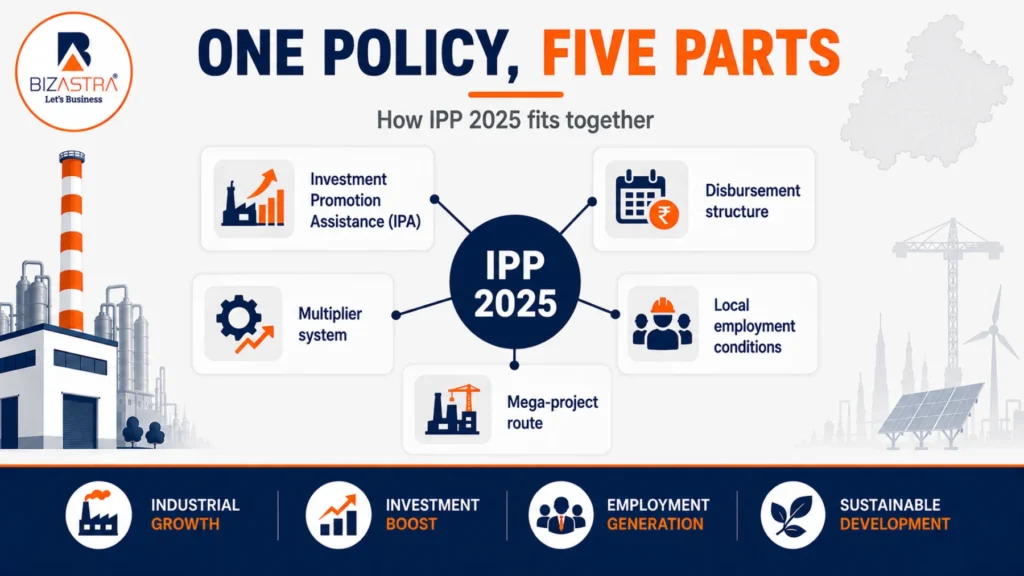
The IPP 2025 is not a single subsidy, it is a framework that determines how industrial investment across Madhya Pradesh gets supported, from large manufacturing units to mega-scale projects.
| Policy Element | What It Governs |
|---|---|
| Investment Promotion Assistance (IPA) | The core capital subsidy formula, based on eligible investment size |
| Disbursement structure | How and when assistance is actually paid out |
| Multiplier system | Additional uplift for exports, jobs, location, and FDI |
| Local employment conditions | Thresholds tied to hiring residents of the state |
| Mega-project provisions | A separate, customised route for very large investments |
Each of these pieces works together, but they do not all apply the same way to every investor, which is exactly why understanding what changed in 2025 matters before diving into any one part.
3. What Changed Under the 2025 Policy
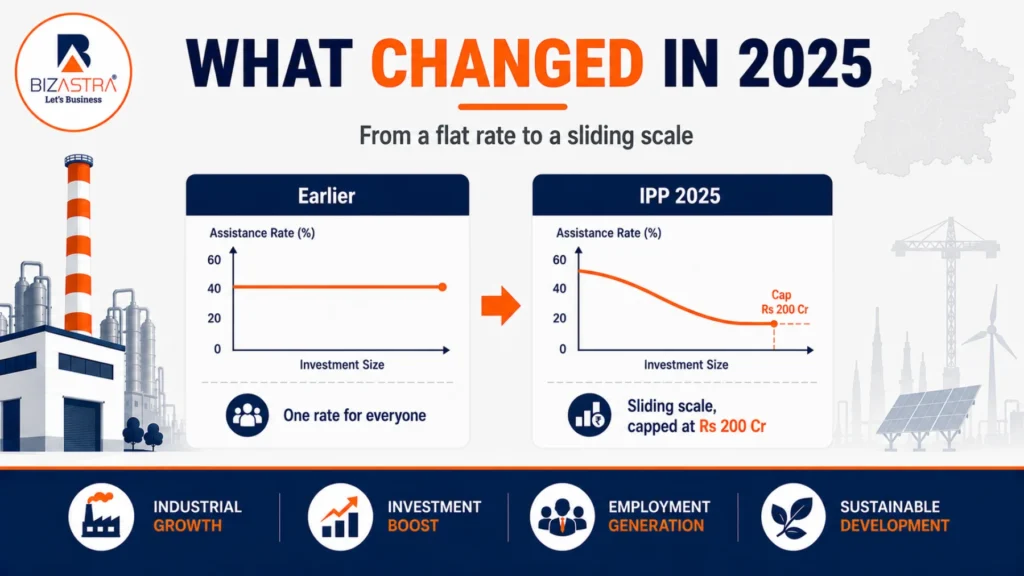
Madhya Pradesh periodically refreshes its industrial policy to reflect changing investment priorities, and the 2025 edition continues that pattern with one structural shift worth understanding clearly.
Earlier approaches leaned toward flatter, simpler percentage rates. The 2025 policy instead formalises a sliding-scale calculation: smaller investments earn the highest percentage return, while larger investments taper into a substantial but capped figure. It is a shift from one rate for everyone to a rate that reflects where your project sits on the scale.
That scale is where most investors want clarity first: how much can you actually expect back?
4. The Incentives Under the IPP 2025 Scheme
At the centre of the policy is Investment Promotion Assistance (IPA), calculated based on eligible capital investment. This determines the base incentive amount before applicable additional benefits or multipliers are considered.
| Incentive | What It Covers |
|---|---|
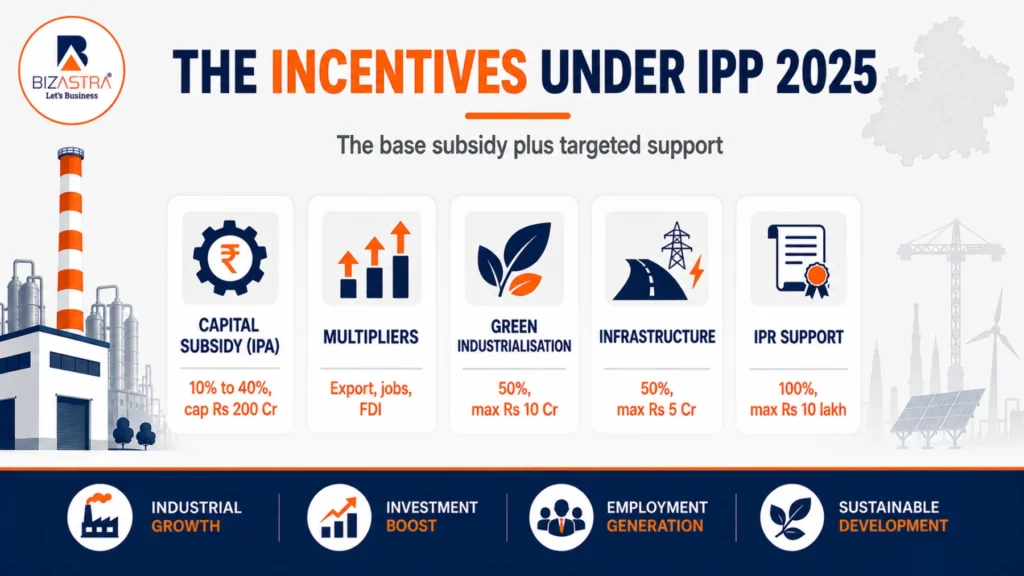
| Capital Subsidy, Industrial Promotional Subsidy (IPA) | Between 10-40% on the eligible capex. (Up to a capping of Rs 200 Cr.) |
| Additional Multipliers for New Units (Benefits) | Export, employment and FDI multipliers (these are over and above the capital subsidy) |
| Green Industrialization Assistance | Capital subsidy of 50%, max of Rs 10 Cr, for setting up ETP, STP, pollution control devices and Zero Liquid Discharge (ZLD) etc. |
| Infrastructure Development Assistance | 50% assistance, to a max of Rs 5 Cr, for developing power, water, gas pipeline, road, drainage and sewage infrastructure up to the factory gate. |
| Assistance for IPR and Organic Certification | IPR assistance: 100% reimbursement of expenses, to a max of Rs 10 lakh per unit, for filing patents, copyrights, trademarks, etc. |
Eligible investment means expenditure on plant, machinery and buildings for production and manufacturing activities. Land and working capital are excluded from the calculation.
Once the base IPA is determined, the applicable multipliers and associated conditions determine the final benefit available to the unit.
5. The Mega-Unit Customised Package
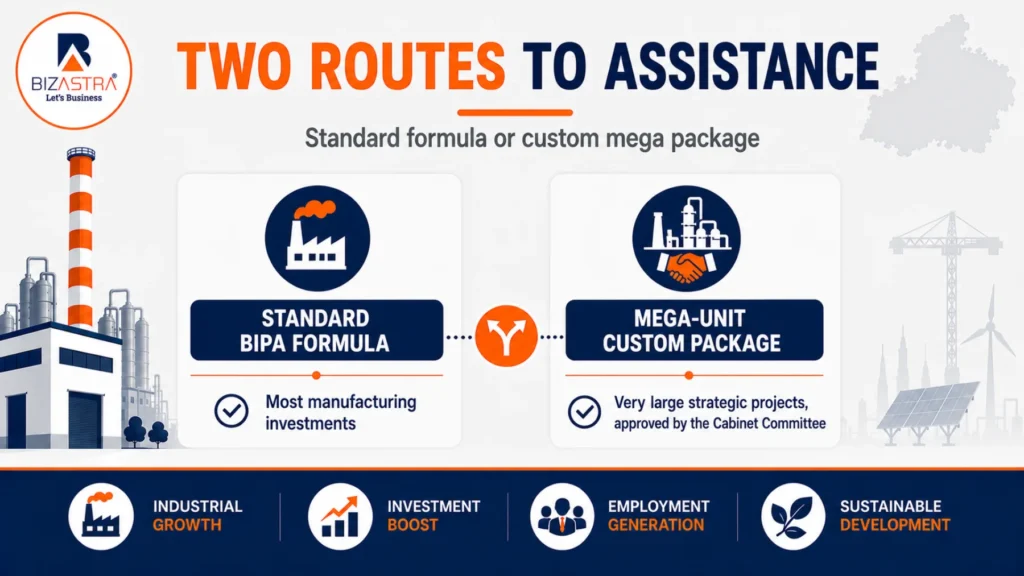
Not every investment fits a formula, and the policy accounts for that directly. Genuinely large-scale, strategically important projects can bypass the standard calculation altogether through a customised assistance package.
These cases are routed through the Cabinet Committee on Investment Promotion, which holds the authority to approve bespoke packages that go beyond what the standard rules allow. This route exists because a project of sufficient scale can justify support tailored to its specific circumstances, rather than being fitted into a formula built primarily for standard industrial units.
| Route | Best Suited For |
|---|---|
| Standard BIPA formula | Most manufacturing investments, regardless of size |
| Mega-unit custom package | Very large, strategically significant projects where the standard cap undersells the state’s interest in the investment |
6. How Multipliers Change Your Final Number
Once your base assistance is calculated, it is not fixed. A set of multipliers adjusts it upward based on how your business actually performs.
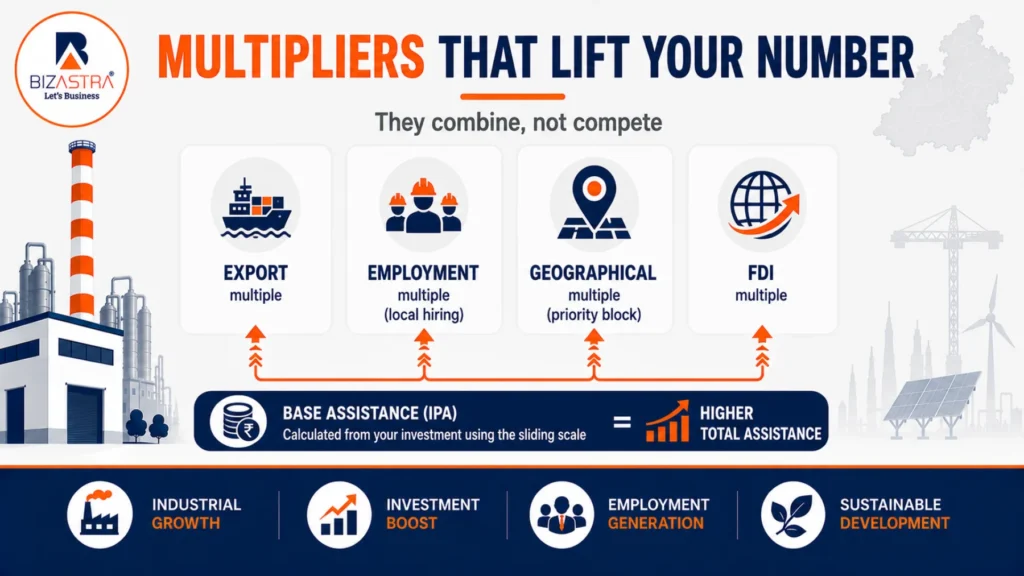
| Multiplier | What Increases It |
|---|---|
| Export multiple | Higher share of production exported |
| Employment multiple | More jobs created, particularly for state residents |
| Geographical multiple | Location in a designated priority block |
| FDI multiple | Foreign direct investment above a defined threshold |
These multipliers combine rather than working in isolation, so a well-located, export-oriented, job-generating unit can see its total assistance climb meaningfully above the base figure alone. Knowing which of these genuinely apply to your project is what separates a rough estimate from a number worth building a business case around.
7. Frequently Asked Questions
Who actually qualifies for assistance under this policy?
Large and mega manufacturing units investing in plant, machinery, and building in Madhya Pradesh generally qualify, subject to sector eligibility and the specific conditions attached to each type of assistance.
Is 40% the maximum I can receive?
No, 40% is the base rate. Multipliers for exports, employment, location, and FDI can push total assistance higher, and larger projects follow a different, tapering calculation entirely.
What happens if my investment is very large?
Above certain thresholds, assistance tapers gradually and caps at Rs 200 crore. For genuinely mega-scale, strategically important projects, a customised package can be considered outside the standard formula.
Does hiring local employees actually affect my assistance?
Yes. Employment-linked assistance depends on maintaining a growing minimum share of bona fide state residents in your workforce over time. Falling short reduces this portion proportionally rather than cancelling it outright.
How is the assistance actually paid out?
Through 7 annual instalments rather than a lump sum, with the exact figure recalculated each year against your unit’s performance on the relevant multipliers.
Is this the same as the MSME-specific subsidy scheme?
They are closely related but distinct. This policy sets the broader industrial promotion framework, within which the MP MSME subsidy scheme and other targeted schemes also operate.
8. Key Takeaways
Madhya Pradesh’s Industrial Promotion Policy 2025 is best understood as a system, not a single number: a tapering base formula, a disbursement schedule tied to performance, a workforce condition that rewards local hiring, a separate route for mega-scale projects, and a multiplier layer that rewards exports, jobs, location, and foreign investment.
Every one of these pieces shapes your final outcome differently depending on your project’s size and structure, which is exactly why understanding the policy as a whole, rather than just its headline rate, is what turns a general framework into a specific number you can plan around.
Planning an investment under MP’s Industrial Promotion Policy 2025? See the full Madhya Pradesh industrial subsidy schemes or get a tailored assessment of exactly what your project qualifies for.