
1. Why Does India Have a PLI Scheme for Electronics?
India has historically imported a large share of the electronics it consumes, from finished mobile phones down to the components inside them. The PLI approach was designed to change that by paying manufacturers a direct incentive to produce more in India, rather than relying only on import duties or generic industrial subsidies to make local production attractive.
The goal is broader than import substitution. It’s about building India into a genuine manufacturing base for electronics, at a moment when global companies are actively looking to diversify their supply chains beyond a single country. That means encouraging large-scale investment and jobs, and over time, moving India up the value chain from simple assembly toward making more of the components and sub-assemblies that go into a finished device, rather than importing them. This is also why the scheme structure keeps splitting and evolving: as one part of the electronics value chain matures, the government tends to spin up a more specific, better-targeted scheme for it, which is how ECMS and MPMS came about.
2. What Is the PLI Scheme for Electronics Today?
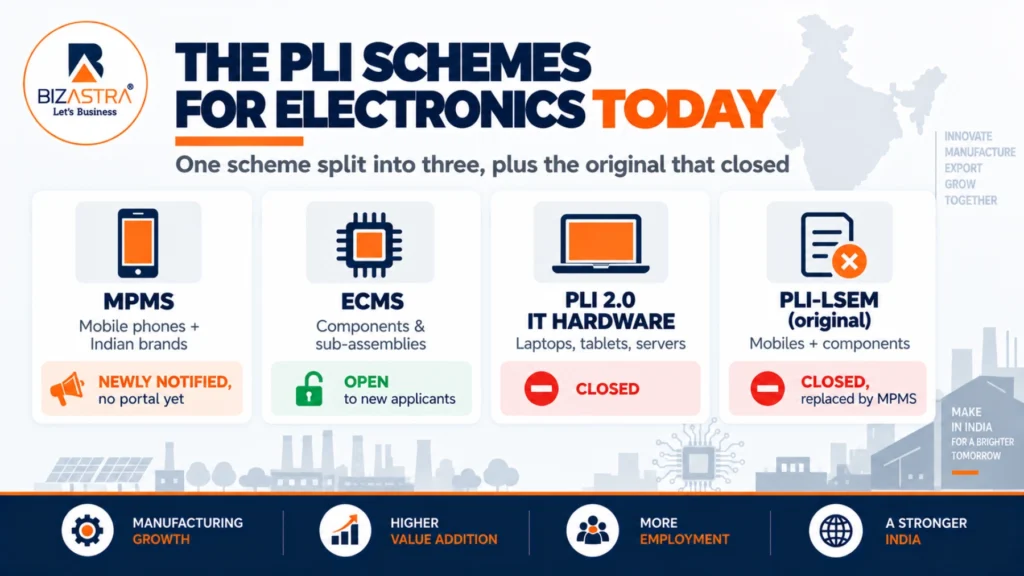
Electronics sits within India’s broader Production Linked Incentive programme, run by the Ministry of Electronics and Information Technology (MeitY). Within electronics, here’s the current picture, newest first:
Mobile Phone Manufacturing Scheme (MPMS). The newest of the three, recently notified. Covers mobile phone manufacturing, with a dedicated track for Indian-owned mobile phone brands investing in design and R&D.
Electronics Component Manufacturing Scheme (ECMS). Covers electronic components and sub-assemblies, the parts that go into a finished device rather than the device itself. This is the scheme currently accepting new applications.
PLI 2.0 for IT Hardware. Covers laptops, tablets, all-in-one PCs and servers. Its application window has already closed.
PLI for Large Scale Electronics Manufacturing (PLI-LSEM), the original scheme. The one most people still think of as “the PLI scheme.” It covered mobile phones and components together, has since closed, and MPMS has effectively taken over its mobile phone mandate.
3. Who Is Eligible?
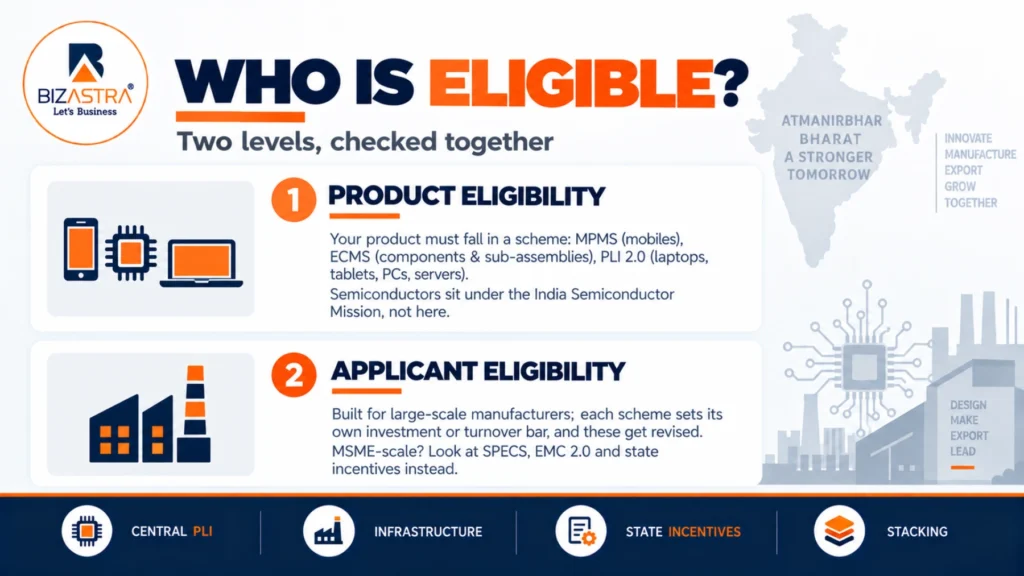
Eligibility works on two levels across all three schemes.
Product eligibility. Your product has to fall within what each scheme actually covers: MPMS for finished mobile phones, ECMS for components and sub-assemblies such as circuit boards, camera and display modules, capacitors, resistors and connectors, and PLI 2.0 for IT Hardware for laptops, tablets, all-in-one PCs and servers. Semiconductor fabrication and display fabs sit outside all three, under a separate programme, the India Semiconductor Mission.
Applicant eligibility. These schemes are built for large-scale manufacturers. Each sets its own minimum investment or turnover bar, and these thresholds get revised over time, so don’t rely on a number you’ve seen quoted elsewhere without checking the current guidelines. If your business is closer to MSME scale, look instead at infrastructure and component-support schemes and state-level incentives, which tend to be more accessible.
4. How Do the Incentives Work?
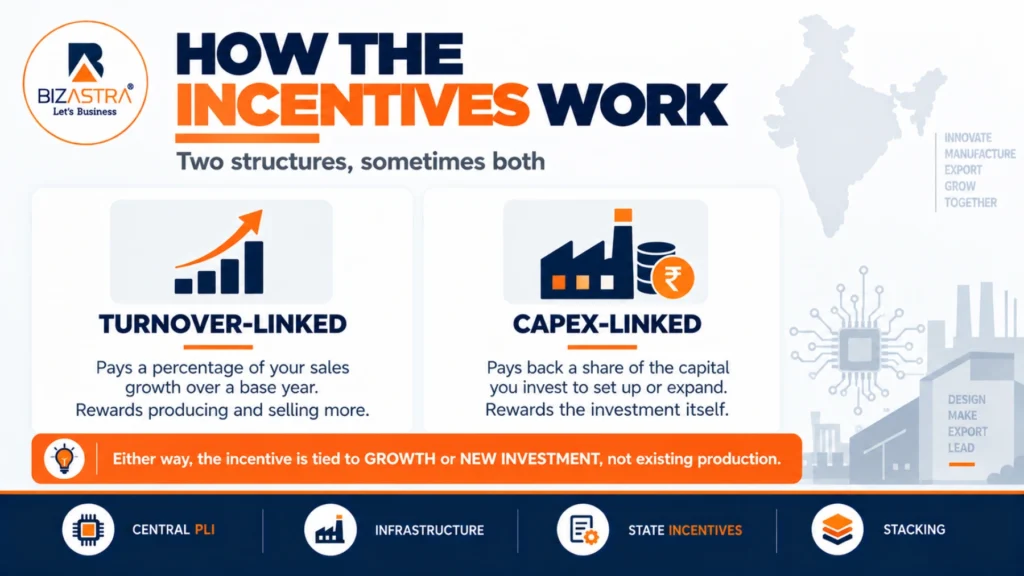
These schemes generally use one of two structures, sometimes both together.
A turnover-linked incentive pays out a percentage of the sales growth you achieve over a base year, rewarding you for producing and selling more than you did before.
A capex-linked incentive instead pays back a share of the capital you invest in setting up or expanding your facility, rewarding the investment itself rather than the sales it eventually generates.
Either way, the incentive is tied to growth or new investment, not existing production. A factory already running at full capacity doesn’t get paid for continuing to operate; it gets paid for expanding beyond where it already was.
5. ECMS: The One That’s Actually Open Right Now
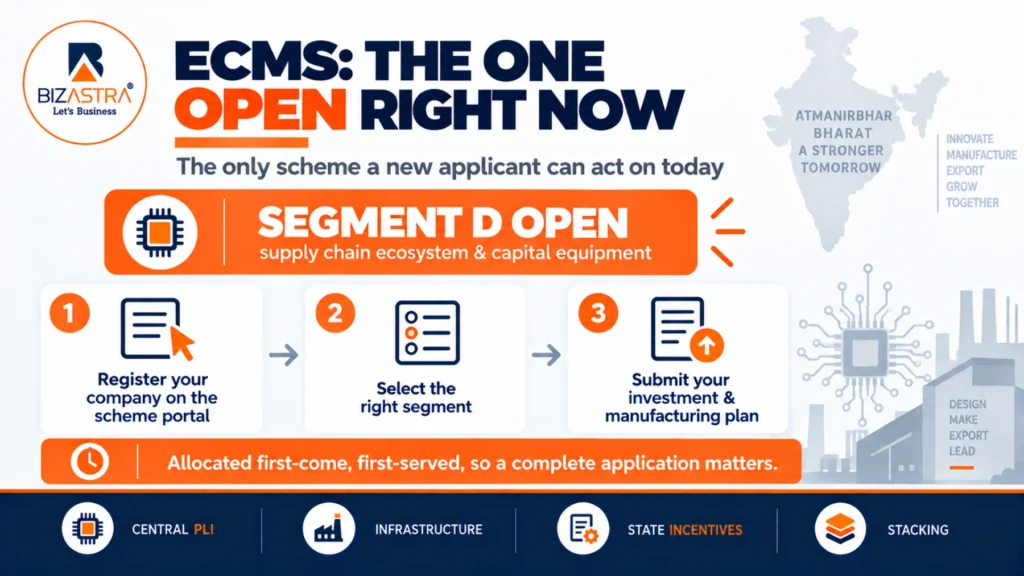
Of the three current schemes, ECMS deserves particular attention, because it’s the only one where a new applicant can act today. One segment remains open, covering supply chain ecosystem support and capital equipment, while the rest of the scheme has already closed to new applicants.
Applying involves registering your company on the scheme’s online portal, selecting the right segment, and submitting your investment and manufacturing plan along with supporting documents. Incentives under ECMS are allocated on a first-come, first-served basis, so a complete, well-prepared application matters more here than it would under a scheme with a fixed allocation for every eligible applicant.
If component or sub-assembly manufacturing is anywhere in your plans, this is the scheme to look at seriously before its remaining window closes.
6. What About MPMS and PLI 2.0 for IT Hardware?
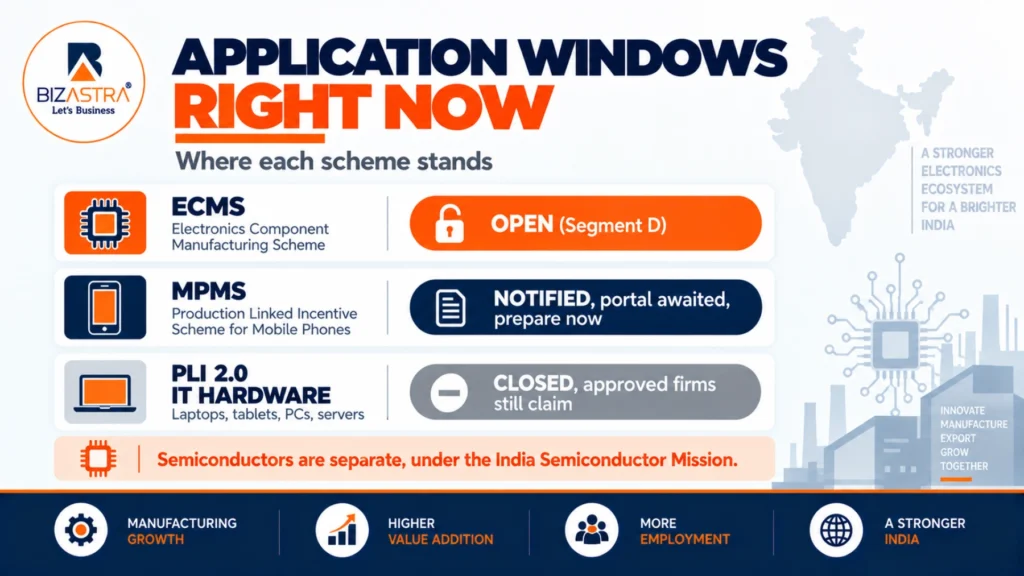
These two sit at opposite ends of the same situation: neither has an application window open right now.
MPMS has only just been notified. There’s no portal or process to apply to yet, that’s expected to follow once MeitY finalises the detailed guidelines. If mobile manufacturing is part of your business, the useful move right now is preparation, not applying: get your financials and sourcing documentation in order so you’re ready the moment the process opens.
PLI 2.0 for IT Hardware already went through its application cycle, and that window is closed. Companies approved at the time continue filing periodic claims, but there’s no route in for a new applicant today. MeitY has reopened windows for other PLI schemes before, so it’s worth watching this one too, though nothing is confirmed.
7. What Do People Get Wrong About This?
The incentive rewards growth, not your existing turnover. All three schemes pay out on the increase over a base year, or on new qualifying investment, not on production you were already doing.
Approval under one scheme doesn’t carry over to another. Getting approved under ECMS doesn’t automatically qualify you for MPMS or PLI 2.0, even if your business touches more than one product category. Each runs its own separate application and evaluation process.
8. Frequently Asked Questions
Why did the government launch a separate scheme just for components?
Components and finished devices sit at different points in the value chain, with different investment needs and different players. Splitting them lets each scheme be designed around what that part of the industry actually needs.
Is the PLI scheme for electronics still open for new applicants?
Only partly, and only through ECMS. MPMS and PLI 2.0 for IT Hardware currently have no open application window.
Can a components manufacturer claim both ECMS and MPMS?
No, they cover different activities. A components manufacturer applies under ECMS. A mobile phone maker claims domestic sourcing credit as part of MPMS itself.
Are these incentives taxable?
Yes, they’re treated as business income, so factor them into your tax planning, not just your cash flow.
Does this cover semiconductor manufacturing?
No. That’s handled separately, under the India Semiconductor Mission.
9. Want to Know Which Scheme Fits Your Electronics Project?
Get a scheme-fit assessment based on your product line and scale, before an open window like ECMS’s closes without you in it.
Contact Us for a Free Assessment
Disclaimer: The information above is for general understanding only, based on official MeitY notifications and scheme guidelines available as of August 2026. Actual eligibility, incentive structures and application windows depend on the specific scheme guidelines in force when you apply, and MPMS’s implementation details were still being finalised as of this update. Please consult a qualified consultant before making any investment or financial decisions.
Author: CA, BizAstra. Reflects official MeitY guidance on PLI-LSEM, MPMS, ECMS and PLI 2.0 for IT Hardware, current as of August 2026.