
At BizAstra, our CA-led team has guided hundreds of manufacturers through this process. This guide gives you the full picture – in plain language, no jargon.
Thinking about setting up a factory in Maharashtra? You are in the right state. Maharashtra is one of India’s most industrially developed states, with excellent infrastructure, a strong supplier ecosystem, and one of the most generous subsidy programmes in the country for new manufacturers.
Setting up a factory in Maharashtra takes 4-6 months and involves picking a location, getting 3-4 approvals, and structuring your investment so the government gives you back up to 100% of what you spend. Here is a plain-language walkthrough of everything you need to know.
Pick Your Location First – It’s the Most Important Decision You’ll Make
Before you think about land prices, construction, or machinery – think about location. Not just for logistics, but for subsidies.
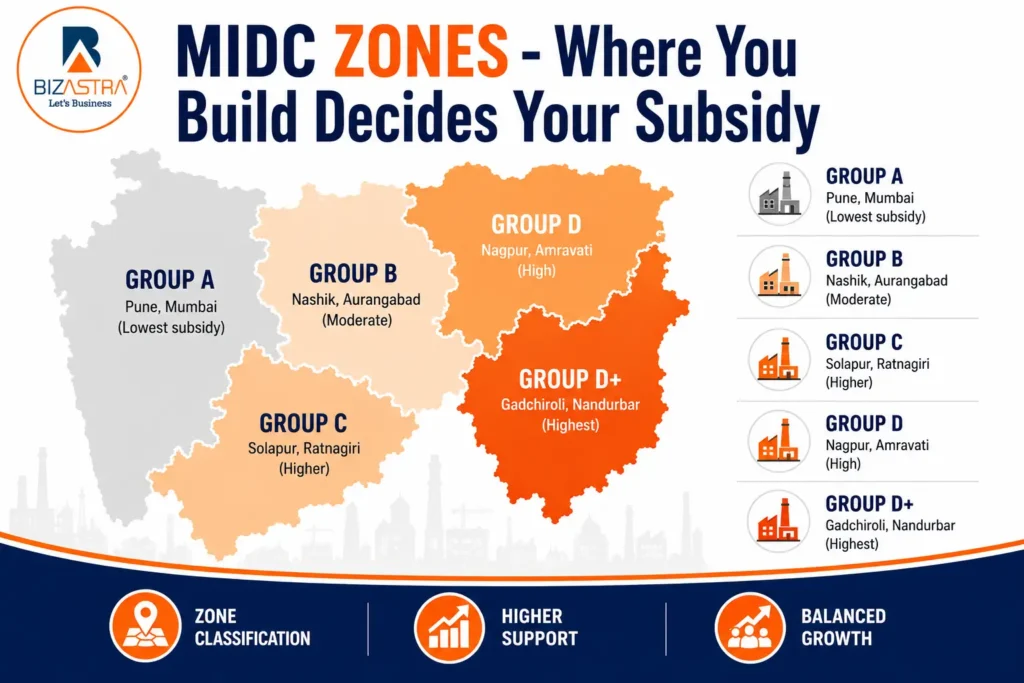
Maharashtra divides its industrial areas into zones. The zone your factory falls in determines how much financial support you receive from the government. Simply put, factories set up in more developed areas like Pune get lower subsidies, while factories set up in less developed regions like Nagpur or Vidarbha get significantly higher support – because the government wants to encourage industrial growth in those areas.
The difference between zones can be crores of rupees over the life of your subsidy. Two factories with the exact same investment can end up with very different subsidy amounts just because one is 30-40 km further from a city.
Maharashtra has hundreds of industrial areas managed by MIDC (Maharashtra Industrial Development Corporation) spread across the state – from Nashik to Aurangabad to Nagpur and beyond. Each of these areas has good infrastructure, power supply, road connectivity, and water availability already in place, which makes setting up faster and easier.
Here is how the zone classification works under MIISP 2025 (Maharashtra’s current industrial policy):
| Zone | Level of Development | Example Locations | Subsidy Level |
|---|---|---|---|
| Group A | Most developed | Pune, Mumbai, Thane, Navi Mumbai, PCMC | Lowest |
| Group B | Moderately developed | Nashik, Aurangabad, Ranjangaon, Kolhapur | Moderate |
| Group C | Developing | Solapur, Ratnagiri, Ahmednagar, Mahad | Higher |
| Group D | Less developed | Nagpur, Amravati, Yavatmal, Latur | High |
| Group D+ | Least developed | Gadchiroli, Osmanabad, Washim, Nandurbar | Highest |
Source: MIDC official FAQ (midcindia.org) and MIISP 2025. Zone classification is at the taluka level – always verify the exact taluka before finalising land.
Before you finalize any land, check which zone it falls under. A good consultant can tell you this in minutes – and it could change your entire financial plan.
The Approvals You Need (And Why You Don’t Have to Figure Them Out Alone)
Most people assume setting up a factory involves mountains of paperwork and years of running after government offices. The reality is much simpler – but only when you have the right people handling it.
There are broadly three approvals involved: registering your manufacturing unit, getting pollution board clearance from the MPCB (Maharashtra Pollution Control Board), and obtaining your factory license from DISH (Directorate of Industrial Safety and Health, Maharashtra). Each has its own timeline, documentation requirements, and sequencing.
What most business owners don’t realise is that the order in which you do these approvals directly affects your subsidy eligibility. A misstep here – even an innocent one – can reduce your subsidy entitlement before your factory has even been built.
Done with the right support, the entire approval process can be completed in 2 to 4 months. Done without guidance, the same process can stretch, stall, or quietly cost you money you didn’t know you were losing.
This is exactly the kind of work BizAstra handles end to end – so you can focus on your business while we make sure nothing is missed, delayed, or filed incorrectly.
Structure Your Investment the Right Way – Before You Spend Anything
This is the step most first-time factory owners skip – and it costs them heavily.
Maharashtra’s subsidy programme is generous, but it has rules. The government looks at when you registered your project, how your land was purchased, how your loan was structured, and when you applied for your eligibility certificate. Get any of these things wrong and you could lose a large portion of your subsidy entitlement – even if you did everything else correctly.
A few things to keep in mind:
Register your project before you start spending. The subsidy is calculated from your registration date. Money spent before registration may not count toward your eligible investment.
Check your zone before finalising land. As mentioned earlier, zone classification determines your subsidy. Don’t assume – verify.
Make sure your loan is structured correctly. Not all loan types qualify for interest subsidy. The type of loan, the bank it comes from, and how it’s disbursed all matter. This needs to be set up right from the start.
Apply for your Eligibility Certificate before production begins. This is the official document that starts your subsidy claim. If you miss applying for it before you begin commercial production, you lose your eligibility entirely.
None of this is complicated once you know what to look for. But it requires doing things in the right order – which is exactly where a subsidy consultant adds real value. One conversation before you make your first payment can protect your entire subsidy outcome.
What Subsidies Does Maharashtra Offer?
Maharashtra’s industrial policy is designed to give manufacturers meaningful financial support over several years. The main benefits are:
GST Refund The state government refunds the state portion of GST that you pay on your sales, year after year, for a number of years depending on your zone. For an active manufacturing unit, this adds up to a substantial amount over time.
Stamp Duty Waiver When you purchase industrial land, you normally pay stamp duty on the transaction. Maharashtra waives this completely in most industrial zones, saving you a lump sum right at the start.
Interest Subsidy The government pays a portion of the interest on the loan you take to set up the factory. This reduces your effective cost of borrowing significantly over the repayment period.
Electricity Rate Concession For a few years after your factory starts production, you pay reduced electricity rates. For any manufacturing unit that uses significant power, this makes a real difference to monthly operating costs.
Direct Cash Grant (For Specific Sectors) Businesses in sectors like electric vehicles, pharmaceuticals, and electronics may also qualify for a direct grant – a cash payment from the government based on a percentage of your investment. This is over and above the other benefits.
The combination of all these benefits means that a well-structured factory investment in Maharashtra can see a very significant portion of costs recovered through government support over time.
For full details on each subsidy, eligibility conditions, and sector-specific incentives under MIISP 2025 (Maharashtra Industry, Investment and Infrastructure Policy 2025), see our Maharashtra Industrial Subsidy Guide.
Mistakes That End Up Costing Manufacturers a Lot
These are not rare or unusual situations. These are things we see regularly.
Starting construction before registering the project It feels like you’re saving time, but you’re actually losing money. Pre-registration spending often doesn’t count toward your subsidy base. Register first, then break ground.
Finalising land without checking the zone The zone is everything when it comes to subsidy calculations. Always confirm zone classification before signing any land agreement.
Getting the loan structure wrong Interest subsidy has specific conditions on loan type and disbursement. If your bank or CA structures it the wrong way, you lose the subsidy on interest – even if the loan itself is perfectly valid for other purposes.
Missing the Eligibility Certificate deadline You must apply before production starts. This is non-negotiable. There is no way to claim this retroactively once you have begun commercial operations.
Not updating your business registration after growth Once your factory is running and growing, your registration details need to be updated periodically. Outdated information can limit your subsidy entitlement or cause you to miss benefits you are actually entitled to.
What Does It Actually Cost?
The honest answer is: it depends on your location, sector, the size of your factory, and how you structure everything.
What we can say is this – when done correctly, the government’s subsidy support is substantial enough that your net effective investment (what you actually end up spending after recovery) is meaningfully lower than your headline investment.
A small factory set up in the right zone, with the right structure, can recover a significant portion of its costs over the subsidy period. A larger factory, similarly structured, can recover even more in absolute terms.
The best way to understand your specific numbers is to sit down with a consultant, share your investment plan, and get a proper subsidy eligibility calculation done. That exercise – which takes a few hours – gives you a clear picture of what you will actually spend versus what you will get back, and when.
FAQ – Set Up a Factory in Maharashtra
Q: How long does the entire process take?
For approvals alone, expect anywhere from 2 to 5 months if things are running in parallel. For the full journey from starting the process to beginning production, most factories take somewhere between 8 months to a year, depending on construction timelines.
Q: I have already bought land. Can I still get subsidies?
Possibly. It depends on whether you had registered your project before the purchase. If you hadn’t, that land cost may not count toward your eligible investment base. Speak to a consultant – the situation isn’t always as bad as it sounds, and sometimes it can be managed.
Q: Which location in Maharashtra is the best for setting up a factory?
There is no single best location – it depends on what you are manufacturing, where your customers and suppliers are, and how much subsidy you want to capture. Pune and Nashik are great for connectivity but offer lower subsidies. Aurangabad and Nagpur offer higher subsidies with good infrastructure. The right answer is personal to your business.
Q: Is it necessary to hire a consultant?
Technically no. Practically, for most business owners, yes. The subsidy programme involves multiple applications, annual filings over many years, and very specific compliance requirements. One error at any stage can cost you significantly more than the consultant’s fee. Most manufacturers who try to handle it alone end up with incomplete claims or avoidable losses.
Q: Can a company with foreign investment set up a factory and claim subsidies?
Yes. Companies with foreign investment that are incorporated in India are eligible for Maharashtra’s industrial subsidies under the same conditions as any other company.
Q: Are there any sectors that are not eligible?
Most manufacturing sectors are covered. The common exclusions are liquor, tobacco, gutka, and pan masala. If you are in a mainstream manufacturing sector, you are almost certainly eligible.
Thinking About Setting Up a Factory in Maharashtra?
Before you finalise your location or sign any agreements, get a free subsidy eligibility mapping done. It takes a short conversation, costs you nothing, and gives you a clear picture of what support you can expect from the government.
BizAstra’s CA-led team has guided hundreds of manufacturers through this exact journey – from choosing the right zone to filing annual subsidy claims years down the line.