
What is SGST Refund?
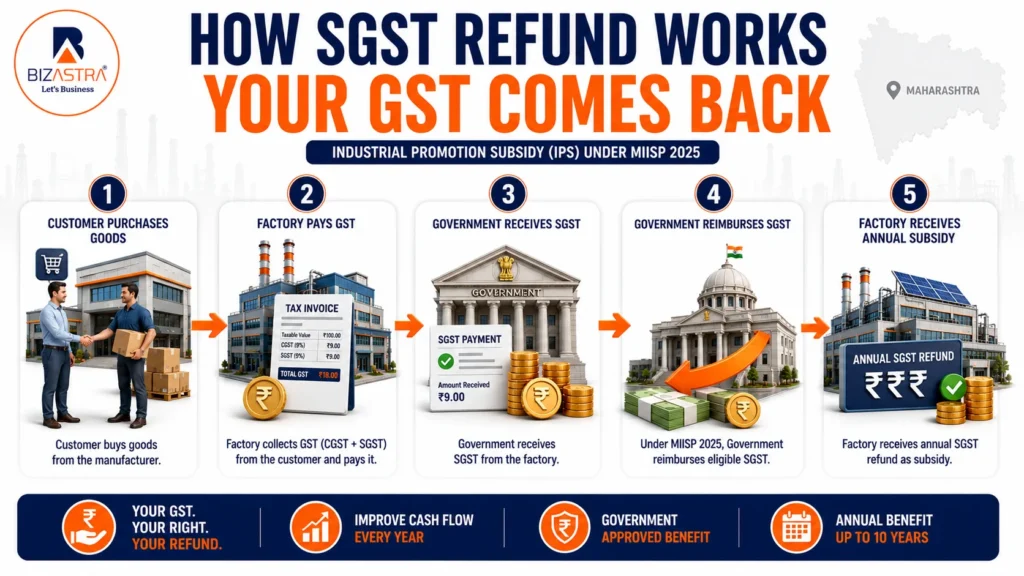
An SGST refund means the Maharashtra government returns the state portion of the GST you generate on your sales, every year, for 5 to 10 years depending on your zone and classification. Officially called the Industrial Promotion Subsidy, it is the single biggest component of the state’s factory incentives.
The government’s stated goal is to provide a “grant of fiscal and non-fiscal incentives” that help manufacturing units achieve sustainable growth. Rather than a single lump sum, this “basket of incentives” is disbursed every year, a recurring cash flow injection during your first decade of operation. Introduced to encourage the dispersal of industries to lesser-developed areas, this SGST refund drastically lowers the long-term capital burden of setting up a new plant.
But how does this recurring package of incentives actually work in practice? Let’s break down the basic math.
2. How GST Splits
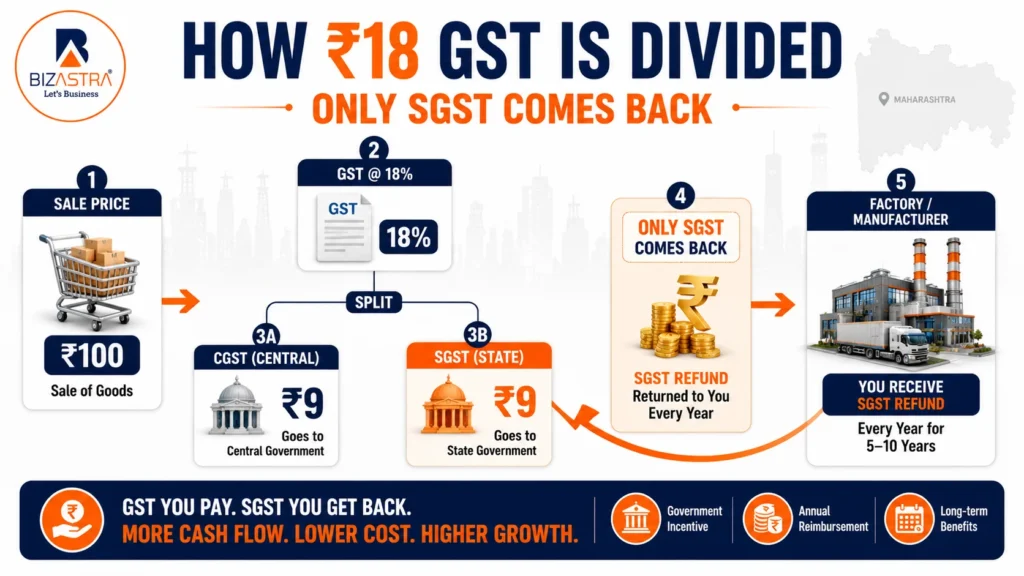
When you sell manufactured goods for Rs 100 plus 18% GST, the Rs 18 splits down the middle: Rs 9 goes to the central government (CGST), and Rs 9 goes to Maharashtra (SGST). The SGST refund returns that Rs 9 state portion directly to you.
Sounds good on paper. It gets even better when you see these numbers at scale. Let’s look at a real scenario to see exactly how much cash this puts back into a business.
3. One Worked Example: The Power of SGST Refund
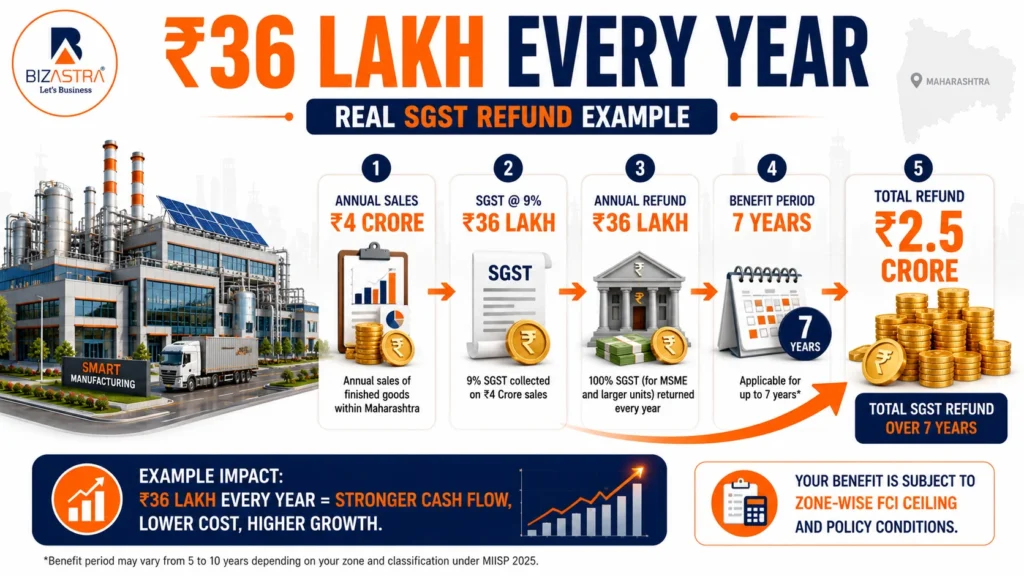
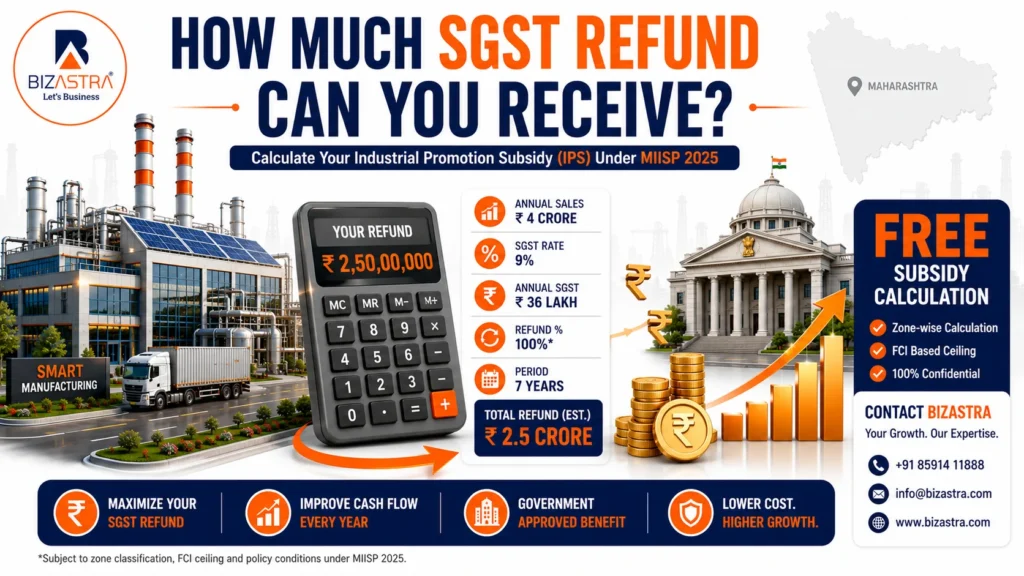
This is the core of how the industrial promotion subsidy functions. Imagine you build a new manufacturing facility near Nashik (Zone B). Your factory produces and sells Rs 4 crore of goods per year, all within Maharashtra.
The SGST collected on those sales is approximately Rs 36 lakh. Because your business is classified as an MSME, you get 100% of your Gross SGST back every year. The reimbursement rate is the same 100% for MSMEs and larger units. What varies by zone and classification is the total ceiling, not the annual percentage. That means you receive Rs 36 lakh every year.
Over a 7-year eligibility period, that adds up to about Rs 2.5 crore returned to your bank account, as long as your zone’s Fixed Capital Investment ceiling allows it. Your benefit is the lower of the SGST you accumulate or your zone’s cap (40% of FCI in Zone B)
| Year | Annual Sales | SGST Collected | Refund Amount |
|---|---|---|---|
| Year 1 | ₹4 crore | ₹36 lakh | ₹36 lakh |
| Year 2 | ₹4 crore | ₹36 lakh | ₹36 lakh |
| Year 3 | ₹4 crore | ₹36 lakh | ₹36 lakh |
| Year 4 | ₹4 crore | ₹36 lakh | ₹36 lakh |
| Year 5 | ₹4 crore | ₹36 lakh | ₹36 lakh |
| Year 6 | ₹4 crore | ₹36 lakh | ₹36 lakh |
| Year 7 | ₹4 crore | ₹36 lakh | ₹36 lakh |
| Total | ₹28 crore | ₹2.52 crore | ₹2.52 crore |
Your total return is strictly capped by two factors: what exactly counts as your eligible capital, and where your factory is located.
4. What Actually Counts Towards Your Investment Limit?
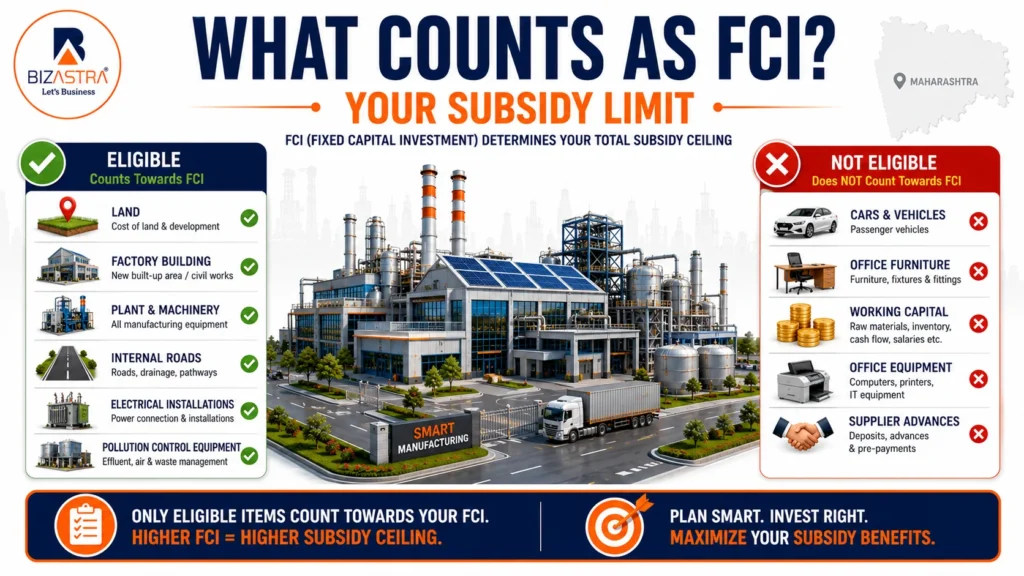
Your total payout across the 5 to 10 year period cannot exceed a set percentage of your project cost. The government has strict definitions of what qualifies as an eligible asset, officially termed your Fixed Capital Investment (FCI). It includes:
- Land and Building: the cost of the land, development (fencing, roads), and new built-up areas.
- Plant and Machinery: all tools, handling, and haulage equipment required for manufacturing.
- Technology Transfer Research and Development and technical know-how fees are eligible upto 20% reimbursement of R&D and technology transfer costs: R & D and royalties
What is excluded? Working capital, standalone vehicles are not eligible to be counted toward the subsidy cap.
Your unit’s classification also matters. Under the current policy, size is based on your investment in plant and machinery: Micro up to Rs 2.5 crore, Small Rs 2.5 to 25 crore, Medium Rs 25 to 125 crore (together, the MSME category). Above Rs 125 crore, you move into Large Scale Industry (LSI) or Special LSI territory, with different caps and shorter benefit periods.
5. How Location and Size Dictate Your Refund
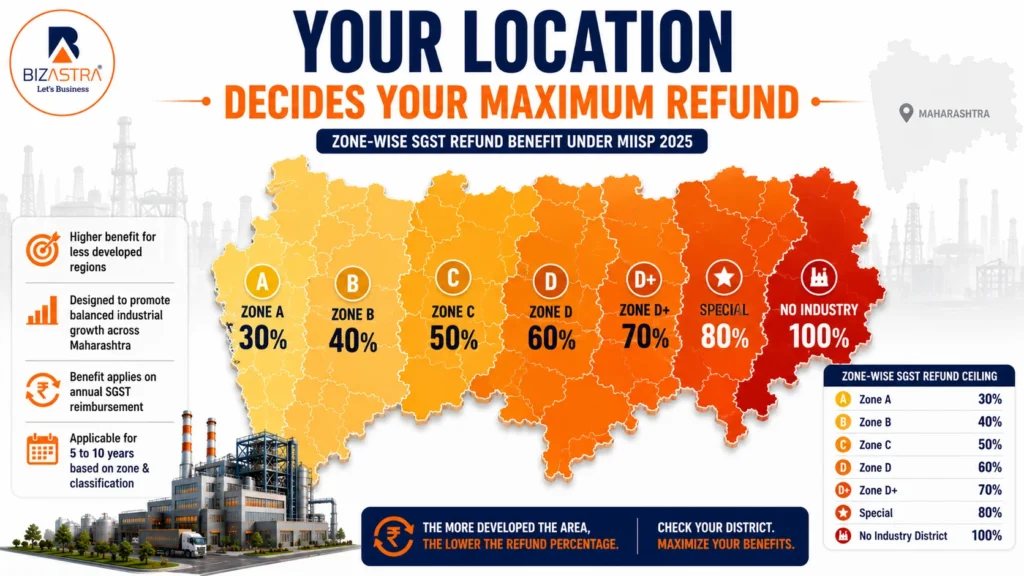
The SGST refund Maharashtra offers varies by zone, designed to push industries into lesser-developed regions. Every taluka in the state is classified into a developmental zone. These figures reflect Maharashtra’s newest industrial policy, MIISP 2025, notified on 31 December 2025. Many other sources still quote the older PSI-2019 numbers.
5.1 Location Classifications
| Zone | Example Cities / Districts | MSME Cap / Period | LSI / Special LSI Cap / Period |
|---|---|---|---|
| A | Mumbai, Pune, PCMC | 30% / 5 years | 40% / 7 years |
| B | Nashik, Kolhapur | 40% / 7 years | 40% / 7 years |
| C | Satara, Sangli | 50% / 7 years | 50% / 7 years |
| D | Jalna, Latur | 60% / 10 years | 60% / 7 years |
| D+ | Interior Vidarbha / Marathwada talukas | 70% / 10 years | 80% / 7 years |
| Special Belt | Vidarbha, Marathwada, Ratnagiri, Sindhudurg, Jalgaon, Dhule | 80% / 10 years | 90% / 9 years |
| No-Industry, Naxal-Affected & Aspirational | Gadchiroli, Washim, Dharashiv, Nandurbar | 100% / 10 years | 100% / 9 years |
Disclaimer: The figures above are indicative and for general understanding only, based on the Maharashtra Industries, Investment & Services Policy 2025 (notified 31 December 2025). Actual benefits depend on your project, location, sector, investment size, classification, and the scheme rules at the time of your application. Please consult a qualified consultant before making any investment or financial decisions.
Note the change: Zone A (Pune, Mumbai, PCMC) is no longer excluded. Under the earlier scheme, these areas got nothing. Under the current policy they get 30% of FCI over 5 years for MSMEs (40% over 7 years for LSIs), modest compared to the interior zones, but real.
5.2 MSME vs LSI vs Special LSI
The industrial promotion subsidy reimburses 100% of Gross SGST every year for both MSMEs and LSIs. The reimbursement rate itself does not change by size. What changes is the total ceiling (as a percentage of FCI) and the number of years you can claim. LSIs generally get a slightly higher percentage cap than MSMEs in the same zone, but over a shorter period (7 –to 9 years instead of 7 –to 10).
Special LSI status higher investment band, confirm the exact range against the GR) unlocks the highest caps and some additional benefits like EPF reimbursement. If your project is an LSI or Special LSI, confirm your exact classification and cap against your Eligibility Certificate before modelling your returns.
6. The Rules You Must Follow
Following this GST refund for manufacturers requires meeting specific government mandates under Maharashtra’s current industrial policy, MIISP 2025 (which was notified to succeed PSI-2019 on 31 December 2025). Here are the 5 plain rules you must know:
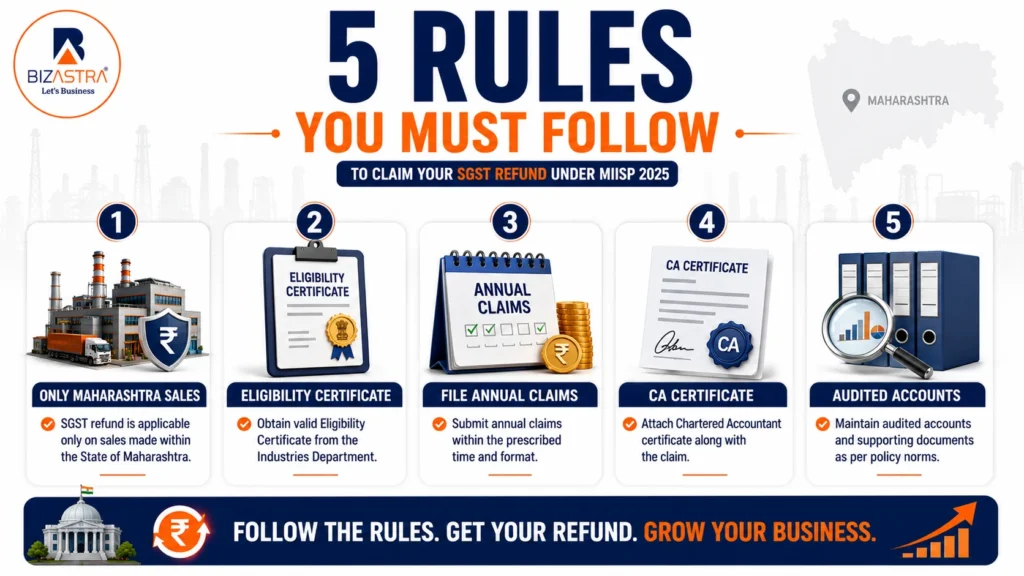
- Only local sales count: the incentive is calculated only on the first sale within Maharashtra (intra-state SGST). Exports and sales to other states under IGST do not qualify.
- The reimbursement rate is 100% of Gross SGST for everyone: what differs by size and zone is your total ceiling and benefit period, not the annual percentage.
- Location determines the ceiling: your total refund across all years is capped at a set percentage of FCI based on your zone.
- Certification is mandatory: you cannot claim a single rupee until you have secured an Eligibility Certificate. For MSMEs this is issued by the District Industries Centre (DIC); for LSI and larger units, by MIDC, after commercial production begins.
- Audited yearly claims: you file a claim once a year. The amount is monitored and must be backed by a certified true copy of your audited annual accounts and a CA certificate confirming the SGST deposited.
7. Common Confusion
7.1 It’s a Refund, Not a Discount
You cannot charge your customers less or hold back your tax payments. You must collect and pay the full GST to the government first. The government then processes your audited yearly claim and returns the money later. Expect a 12 to 18 month wait for your very first payment.
7.2 The Refund is Taxable Income
When these funds hit your bank account, they do not arrive tax-free. The return is treated as taxable business revenue. Factor this into your financial models and ROI calculations.
8. Frequently Asked Questions
Is the SGST refund available in Pune?
Yes, and this changed recently. Under the earlier PSI-2019 policy, Pune and PCMC (Group A) were excluded from standard IPS. Under MIISP 2025, Group A locations now get 30% of FCI over 5 years for MSMEs (40% over 7 years for LSIs), a broad zone-based change, not limited to specific high-tech sectors as some older articles suggest.
Do exports count toward the SGST refund?
No. The incentive applies only to intra-state SGST, goods billed and delivered within Maharashtra. Inter-state sales (IGST) and exports do not generate any SGST refund.
How long do SGST refund payments take?
Because claims are filed annually based on audited accounts, it typically takes 12 to 18 months from the start of commercial production for your first claim to be verified, processed, and deposited.
Is the industrial promotion subsidy taxable?
Yes. It is a revenue receipt and is taxable income for your business. Plan for it in your tax provisioning, not just your cash flow.
Can I claim this without a consultant?
Technically possible, but risky. The paperwork needs precise alignment between your GST returns, CA certificates, and zone classification. A single formatting error, wrong classification, or missed deadline can void that year’s claim.
Is SGST refund the same as the Industrial Promotion Subsidy (IPS)?
Yes. SGST refund is the everyday name for the Industrial Promotion Subsidy. IPS is the official term used in the policy; both mean the state returning your SGST each year.
Is SGST refund the same as a regular GST refund from the tax department?
No. A regular GST refund corrects excess or wrongly paid tax. SGST refund here is an industrial incentive: you pay your GST in full, then the state returns its SGST share to you as a benefit.
Who issues my Eligibility Certificate, the DIC or DI?
For MSMEs, the District Industries Centre (DIC) issues it. For Large Scale and larger units, DI issues it. In both cases it is issued after commercial production begins.
Can I claim the SGST refund and interest subsidy at the same time?
Yes. They are separate benefit heads under the same policy. You can claim the SGST refund and the interest subsidy together, along with the stamp duty and power benefits you qualify for.
What happens if my Maharashtra sales are low in a year?
You only receive the SGST you actually deposited that year. If your sales are low, your refund that year is smaller. Your zone cap is a ceiling, not a guaranteed payout, so low sales mean you may not reach the full cap.
Is there a minimum turnover or investment to qualify?
There is no large minimum that bars small units. Your zone, size classification, and completing the Eligibility Certificate on time matter more than turnover. Confirm the conditions for your unit type.
Can a trader or service business claim SGST refund?
The SGST refund is built for manufacturing units. Traders do not qualify. Some service activities are covered under specific Maharashtra policies, so check your exact activity before assuming eligibility.
Can I get SGST refund on an expansion of my existing factory?
Often yes. Expansion and diversification units can qualify if they meet the scheme conditions and complete the required steps. Confirm your unit type against the policy before you plan.
9. Want to Know Your Exact SGST Refund Potential?
Get a free calculation based on your projected sales, exact taluka, unit classification, and investment size, before you build your financial model around an assumed SGST refund number.
[ Contact Us for a Free Calculation ]
Disclaimer: The figures above are indicative and for general understanding only, based on the Maharashtra Industries, Investment & Services Policy 2025 (notified 31 December 2025). Actual benefits depend on your project, location, sector, investment size, classification, and the scheme rules at the time of your application. Please consult a qualified consultant before making any investment or financial decisions.
Author: CA, BizAstra. Figures reflect the Maharashtra Industries, Investment & Services Policy 2025 (GR No. M/Ind-2023/P.No.187/Udyog-2, dated 31 December 2025), cross-referenced against Grant Thornton Bharat’s policy analysis (Jan 2026). The GR’s Annexure-I has not been re-verified line by line, so please confirm before publishing client-facing numbers.