
If you’re setting up an IT, ITeS, or electronics manufacturing (ESDM) or Data Centres business in Madhya Pradesh, this policy can save you a lot of money. But most companies either don’t know what they qualify for, or they apply under the wrong category and end up getting less than they should.
As subsidy consultants, this is the exact problem we help solve.
What Is This Policy For?
The Madhya Pradesh government wants to grow three sectors under this policy: IT, IT-enabled services (like BPOs), and electronics manufacturing (ESDM). Data Centres are also covered, as a separate category within the same policy.
Over five years, the state wants to:
- Create 2 lakh new jobs
- Bring in ₹10,000 crore in new investment
- Build 10 million sq. ft. of office and factory space for these industries
Which Category Do You Fall Into?
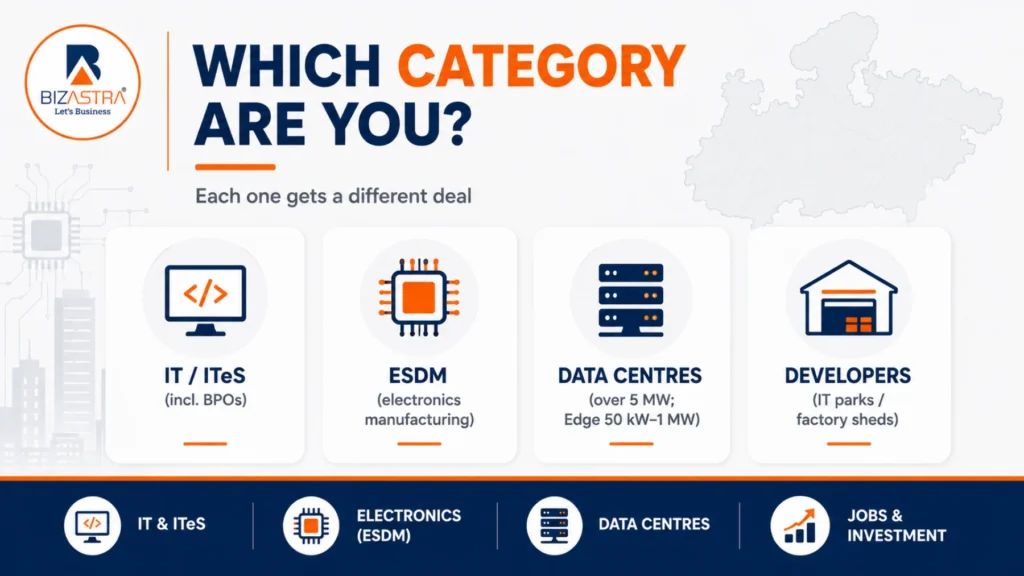
This is the most important question. Each category gets a different set of benefits, and picking the wrong one can cost you money you were otherwise entitled to.
- IT/ITeS companies (including BPOs), either building their own office, or renting ready-made office space
- ESDM companies, electronics manufacturing, including R&D and testing labs
- Data Centres, needs over 5 MW of power capacity to count as a full Data Centre; smaller ones (50 KW to 1 MW) count as “Edge” Data Centres
- Developers, companies building IT parks, office space, or factory sheds for others to use
If you’ve already used an MP IT policy before and are now expanding to a new location, you can claim benefits again. The only condition: your new investment must be at least 30% of what you already spent.
How Much Do You Need to Invest?
| Category | Minimum Requirement for Land |
|---|---|
| IT/ITeS (own construction) | Minimum 10,000 sq. ft. built; 80% of that space must be used for core work |
| IT/ITeS (renting space) | 3,000 sq. ft. rented; 20+ employees to get hiring support |
| ESDM companies | No fixed investment amount; but 80% of built space must be used for core (ESDM) work |
| IT/ITeS park developers (first 5) | 2 lakh sq. ft., built within 4 years |
| ESDM shed developers (basic) | 25,000 sq. ft. |
| ESDM shed developers (with shared facilities) | 50,000 sq. ft. |
| Private IT Park land (ITIA) | 5+ acres; 4 lakh sq. ft.; ₹120 crore investment |
This policy doesn’t have a formal “Mega Project” category like some other states. The closest thing is the Anchor Data Centre group, the first five data centres with over ₹500 crore investment get the biggest benefit in the whole policy, up to ₹125 crore each.
If your project is that large, it’s also worth checking Madhya Pradesh’s separate, bigger industrial policy. You might qualify for both.
What Each Category Actually Gets
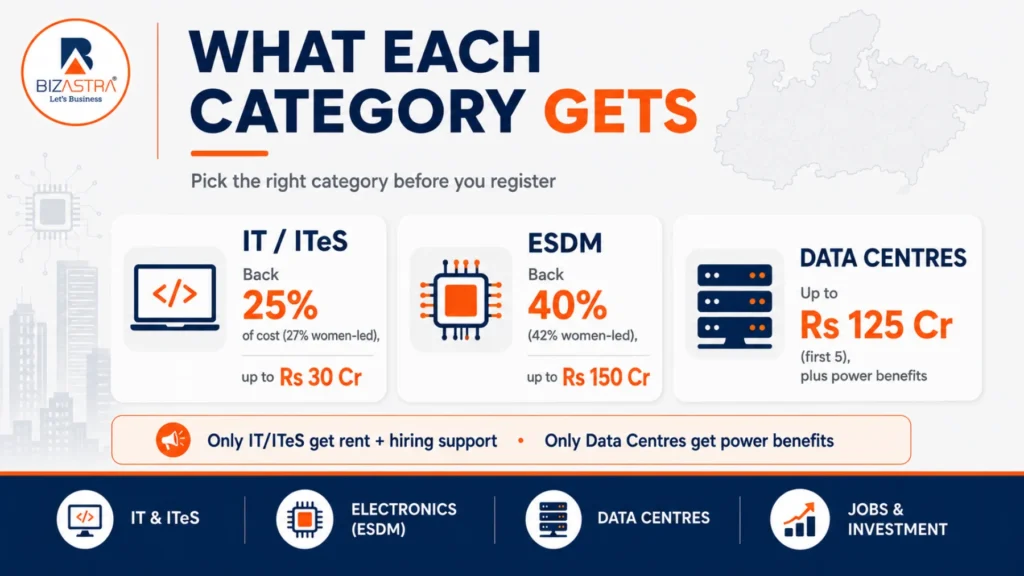
If you’re an IT/ITeS company, you choose one of two paths.
Building your own office gets you back 25% of your cost (27% if led by a woman entrepreneur), up to ₹30 crore, paid in yearly instalments over up to 7 years. You’ll need a minimum 10,000 sq. ft. built-up area, with 80% of it used for actual business work, not for cafeterias, parking, or other non-core space. You can also get a loan interest discount, up to ₹5 crore.
Renting office space instead gets you up to ₹10 crore toward rent in cities like Bhopal, Indore, Jabalpur, Gwalior, and Ujjain, or up to ₹5 crore in smaller towns, for up to 3 years.
Either way, you can also claim hiring support: roughly ₹4,000 to 5,000 per employee per month, up to ₹15 crore total, for 3 years. This and the rent support are only for IT/ITeS companies. ESDM and Data Centres don’t get either.
If you’re an ESDM (electronics) company, you get the biggest benefit in the policy: back 40% of your cost (42% for women entrepreneurs), up to ₹150 crore, plus loan interest help up to ₹10 crore. Just like IT/ITeS, at least 80% of your built-up space needs to go toward core ESDM work. You also get help paying for product testing and certification, something only ESDM companies get.
What you don’t get: rent support or hiring support. If your business is a mix of software and electronics, it’s worth working out which category gives you more money before you register. We usually run the numbers both ways for clients.
If you’re building a Data Centre, the rules are different. You can get up to ₹125 crore back for the first five large centres, or up to ₹50 crore for others. On top of that, you get benefits no one else in this policy gets: lower power rates, exemption from electricity tax, and a discount on power transmission charges.
If you’re a developer building parks or sheds for others, you get help with construction costs and a waiver on stamp duty. You don’t get the extra benefits like rent or hiring support, those are for the companies that move in, not the developer.
Benefits Everyone Can Get
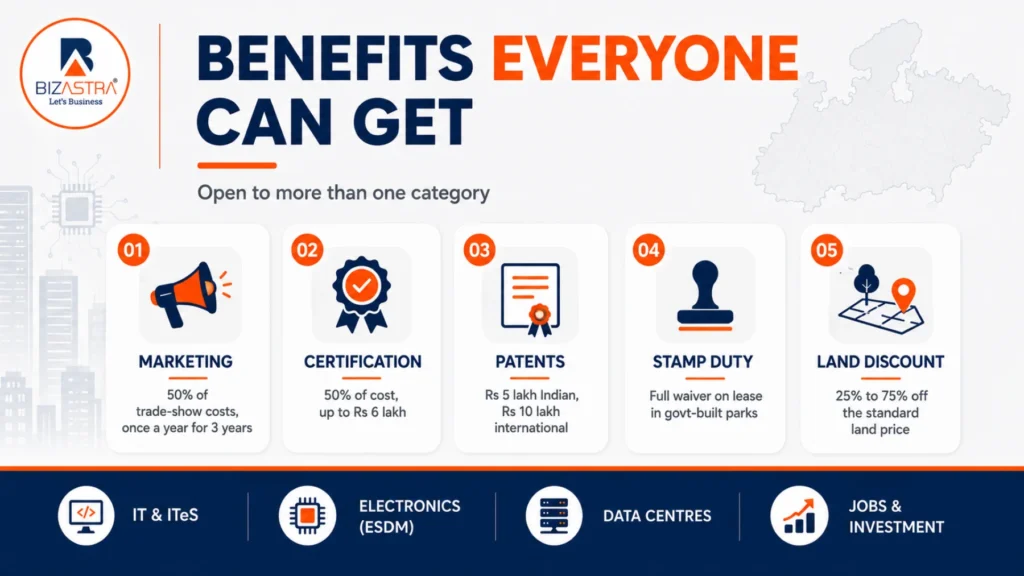
A few benefits are open to more than one category, and clients often miss these:
- Marketing help: 50% of costs for attending trade shows, once a year for 3 years (IT/ITeS, ESDM)
- Certification help: 50% of cost, up to ₹6 lakh (IT/ITeS, ESDM, Data Centres)
- Patent help: ₹5 lakh for an Indian patent, ₹10 lakh for an international one (IT/ITeS, ESDM, Data Centres)
- Stamp duty waiver: full waiver on lease costs in government-built parks (everyone)
- Land discount: 25% to 75% off the standard land price, depending on plot size (IT/ITeS, ESDM)
A Simple Example
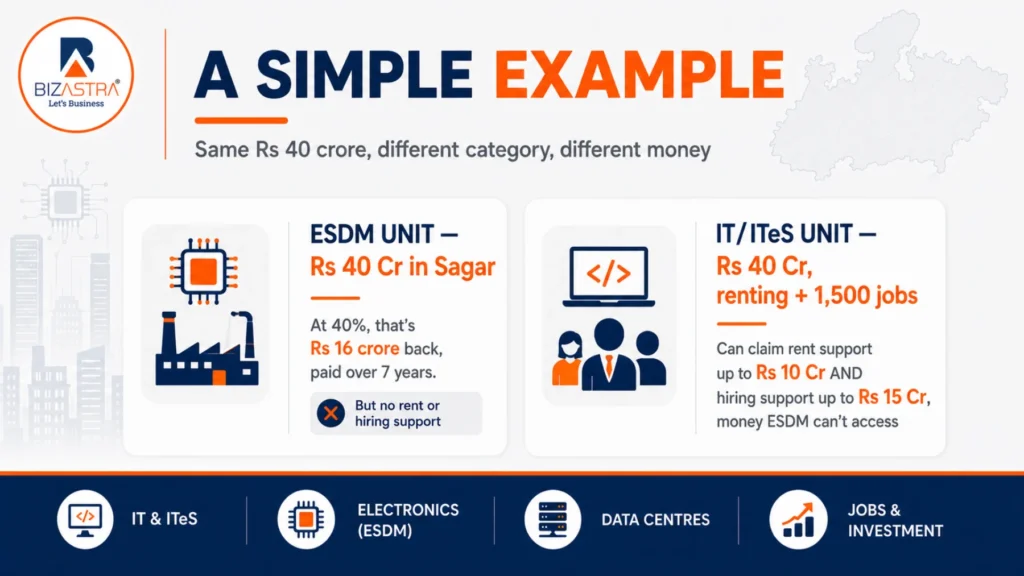
Say an ESDM company invests ₹40 crore in Sagar, and 80% of its factory space is used for actual manufacturing. At 40%, that’s ₹16 crore back, well within the ₹150 crore limit, paid over up to 7 years. Add the loan interest discount, plus marketing and testing help, and the company saves a good amount overall.
But it still can’t claim rent or hiring support, because ESDM doesn’t qualify for those.
Now compare an IT/ITeS company with the same ₹40 crore investment, renting its office space instead of building. It can’t match ESDM’s ₹150 crore limit. But if it hires 1,500 people, it can claim both rent support (up to ₹10 crore) and hiring support (up to ₹15 crore), money an ESDM company simply can’t access.
This is the kind of comparison we walk clients through before they decide how to register.
Frequently Asked Questions
Is there a minimum investment amount?
It depends on the type of benefit. Renting office space needs 3,000 sq. ft. and 20+ staff. Building your own IT/ITeS office needs at least 10,000 sq. ft. Large Data Centres need ₹500 crore. ESDM companies building their own space have no fixed rupee minimum, but do need to meet the 80% core-activity rule.
Is there a “Mega Project” category?
Not formally. The closest is the Anchor Data Centre group, the first five data centres investing over ₹500 crore, eligible for up to ₹125 crore each.
Do Data Centres get benefits?
Yes, construction cost support, plus power and electricity benefits no other category gets.
Can I claim again if I’m expanding my business?
Yes, as long as your new investment is at least 30% of what you already spent.
Do ESDM companies get rent or hiring support?
No. Those are only for IT/ITeS companies. ESDM gets a much bigger construction benefit instead.
Find Out Exactly What You Can Claim
Every company’s benefit package looks different, depending on your investment size, sector, location, and hiring plan. Before you plan your budget around guesswork, let us map out exactly what you qualify for, and handle the paperwork, filing, and follow-up with the department on your behalf.
Contact Us for a Free Eligibility Check
Disclaimer: These figures are for general understanding, based on the Madhya Pradesh IT, ITeS & ESDM Investment Promotion Policy 2023 (notified September 2023, valid till 2028). Actual benefits depend on your project details and the rules in force when you apply.