
Quick Answer
An amusement park in Maharashtra that qualifies under the Maharashtra Tourism Policy 2024 (MTP 2024) can claim a capital investment incentive of 15% of eligible capital investment, capped at Rs 15 crore, paid in five equal annual instalments. On top of that come zone-wise benefits: SGST reimbursement, electricity duty exemption, electricity tariff refund, interest subvention and stamp duty exemption. For MSME-class parks these run for 5 years in Zones A and B and 7 years in Zone C and special tourism zones. Your park must be registered with the Directorate of Tourism, and your first investment must fall on or after 18 July 2024.
1. What Counts as an Amusement Park
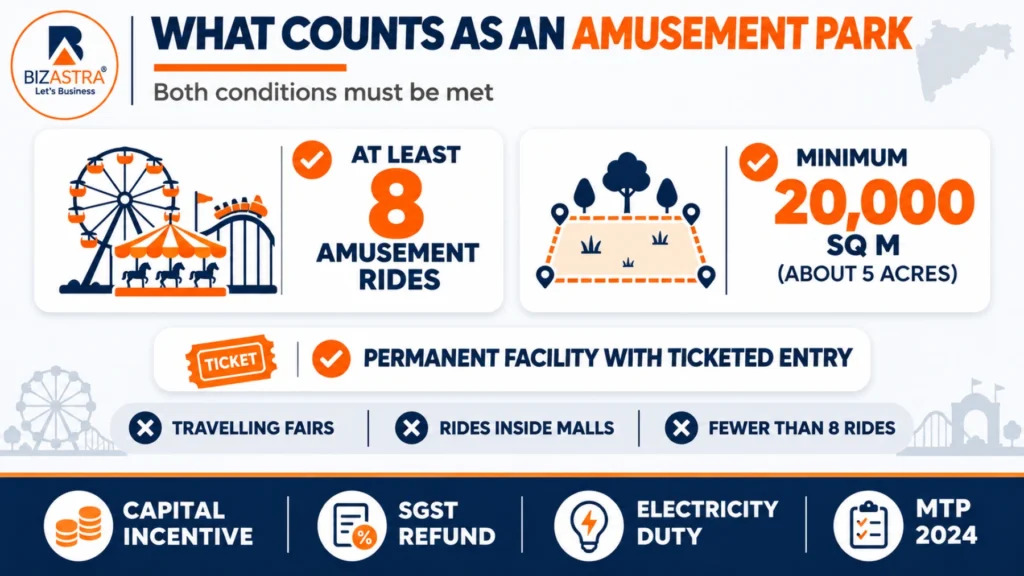
The policy defines an amusement park as a permanent, ticketed-entry facility with at least 8 amusement rides installed and a minimum area of 20,000 square metres (about 5 acres). Both conditions must be met.
Theme parks and water parks are separate unit types in the policy, each with its own definition. This article covers amusement parks only. A few boundaries are worth knowing:
- Temporary or travelling fairs do not fit, because the definition requires a permanent facility with ticketed entry.
- Rides inside malls and multiplexes are not treated as theme parks, and video game zones are eligible only when they are part of another eligible tourism unit. Do not assume an indoor family entertainment centre qualifies by itself.
- Smaller ride clusters with fewer than 8 rides, or on less than 20,000 square metres, fall below the definition. Check with the Directorate of Tourism whether another unit type, such as adventure tourism, fits instead.
Amusement parks sit in the policy’s Entertainment and Recreation category, which earns the 15% capital incentive rate. Accommodation units such as hotels follow a different rate; see our guide to the hotel subsidy in Maharashtra.
2. Registration and Eligibility
The usual path is:
- Register the project with the Directorate of Tourism (DoT) under the Tourism Policy 2024.
- Obtain, or at least apply for, a provisional registration certificate. Units that have obtained or applied for one are eligible for the capital incentive.
- Build, install the rides and start commercial operation (the Commercial Operation Date, or COD).
- Apply for the eligibility certificate from the Directorate of Tourism, which registered units must hold to claim incentives.
- Claim the incentives as the Directorate prescribes.
Conditions that decide whether you qualify:
- Timing of first investment. Your first investment (date of purchase or work order), first term loan disbursement, or development or construction permission must be on or after 18 July 2024, the date the policy was notified.
- Investment window. The permissible investment period is 4 years before your COD. Only capital assets acquired and paid for in that window count, and they must be installed at the site and in use.
- Expansions. An existing park can claim only for the expansion component, and the expansion must exceed 50% of existing capacity, which for a park means rides.
- Ownership or lease. A leased building needs a lease of at least 15 years. Other leased assets need a lease of at least half their estimated residual life. Leased assets are valued at net present value using a 10% discount rate.
- State-run PPP projects are not eligible for the financial incentives in this chapter.
3. How Your Park Is Classified
Your incentive table depends on how the policy classifies your project, which turns on fixed capital investment (FCI) and direct employment.
| Class | Investment | Direct employment |
|---|---|---|
| Micro | Up to Rs 1 crore | Minimum 10 |
| Small | Up to Rs 10 crore | Minimum 15 |
| Medium | Up to Rs 50 crore | Minimum 25 |
| Large | Above Medium, below Mega | As per project |
| Mega (Zone A) | Rs 300 crore | 400 |
| Mega (Zone B) | Rs 150 crore | 200 |
| Mega (Zone C) | Rs 100 crore | 50 |
| Mega (special tourism zones) | Rs 50 crore | 50 |
| Ultra Mega (entire state) | Rs 500 crore | 800 |
A park with 8 rides on about 5 acres will usually land in the Small or Medium class, so the MSME table (14.4.3 in the policy) is the one most operators will use. Larger parks fall under the Large, Mega or Ultra Mega table, which gives longer eligibility periods. Mega and Ultra Mega projects are approved by a High Powered Committee under the Chief Secretary and can seek higher or customised incentives. Check the Medium to Large boundary with the Directorate, because the policy cites its own Rs 50 crore limit while also referring to the MSMED Act.
4. What You Can Claim
Capital investment incentive: 15% of eligible capital investment or Rs 15 crore, whichever is less. Ultra Mega projects instead get 10% or Rs 25 crore. The incentive is paid in 5 equal annual instalments from the COD, at the end of each year. Units owned and managed by women, SC, ST or differently abled entrepreneurs, with at least 51% equity, get an additional 5%.
What counts as eligible capital investment: structures and buildings, indigenous and imported machinery and equipment (which covers rides), material handling equipment, mechanical, electrical and plumbing installations, fixtures, furniture and fittings, solid and liquid waste treatment facilities, transformers and generators, captive power and renewable energy, internal roads, fencing, signage and toilets, plus utility and installation charges. Land is not eligible.
Two ceilings to plan around. Yearly incentive disbursement is capped at your eligible capital investment divided by the eligibility period. And total incentives cannot exceed your eligible fixed capital investment.
5. Benefits by Zone for MSME-Class Parks
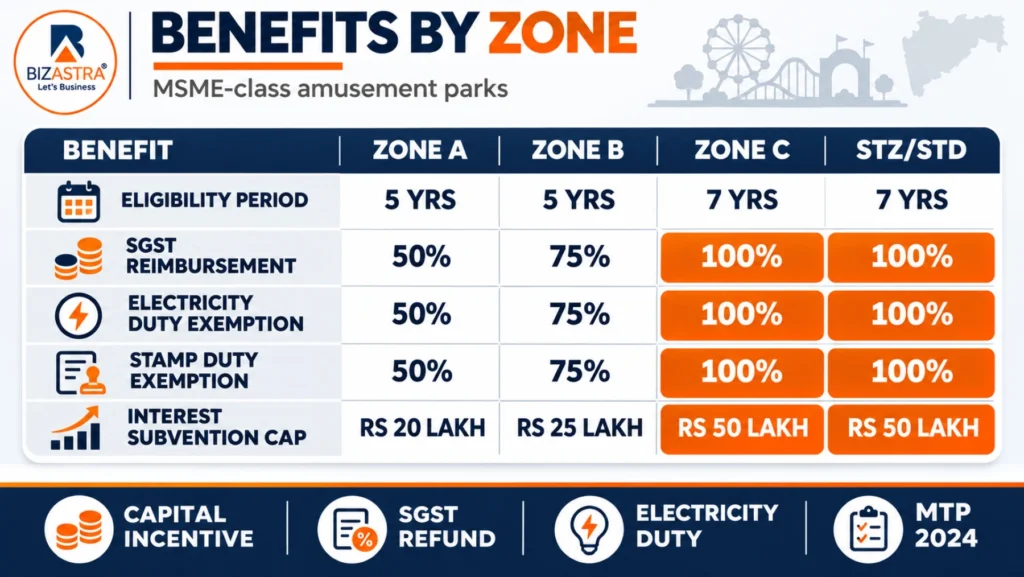
Zone A covers the Mumbai, Thane and Navi Mumbai municipal areas. Zone B covers the Nashik, Pune, Aurangabad (now Chhatrapati Sambhajinagar) and Nagpur municipal corporation areas. Zone C is the rest of Maharashtra. STZ/STD means specially declared tourism zones and destinations.
| MSME tourism unit benefit | Zone A | Zone B | Zone C | STZ/STD |
|---|---|---|---|---|
| Eligibility period | 5 years | 5 years | 7 years | 7 years |
| SGST reimbursement (on net SGST paid) | 50% | 75% | 100% | 100% |
| Electricity duty exemption | 50% | 75% | 100% | 100% |
| Electricity tariff refund (commercial vs industrial tariff difference) | 50% | 75% | 100% | 100% |
| Interest subvention: up to 5% on term loans up to | Rs 5 crore | Rs 10 crore | Rs 15 crore | Rs 20 crore |
| Ceiling on total interest subvention in the period | Rs 20 lakh | Rs 25 lakh | Rs 50 lakh | Rs 50 lakh |
| Stamp duty and registration charges exemption | 50% | 75% | 100% | 100% |
Benefits that apply across all zones and classes:
- Sustainability initiatives: up to 25% of the capital cost of the initiatives, capped at Rs 25 lakh per project or the actual GST-paid cost, whichever is less. Eligible items include rainwater harvesting, sewage treatment and zero liquid discharge systems, wastewater treatment and recycling, solar and other renewables, onsite organic waste converters, pollution control devices, smart water systems and electric vehicles for moving people and goods within the premises.
- Stamp duty details: the exemption applies to sale or lease deeds for purchase or lease of land or built-up area for the tourism project, provided the deed is executed during the policy period, and to mortgage and hypothecation for the project.
- Employing differently abled workers: Rs 1,500 per month per worker where more than 5 workers belong to the disabled category.
- Non-fiscal: industry status for tourism projects, exemption from non-agricultural tax and permission, development charges exempted while sanctioning the tourism component, licence renewals every 5 years instead of annually, open access electricity, and facilitation of environment and fire clearance within a month.
If your park is classified as Large, the same structure applies but with longer eligibility periods (5, 7, 10 and 10 years across the four zones) and slightly different interest subvention ceilings, for example Rs 30 lakh in Zone C.
6. Mistakes That Cost Operators the Subsidy
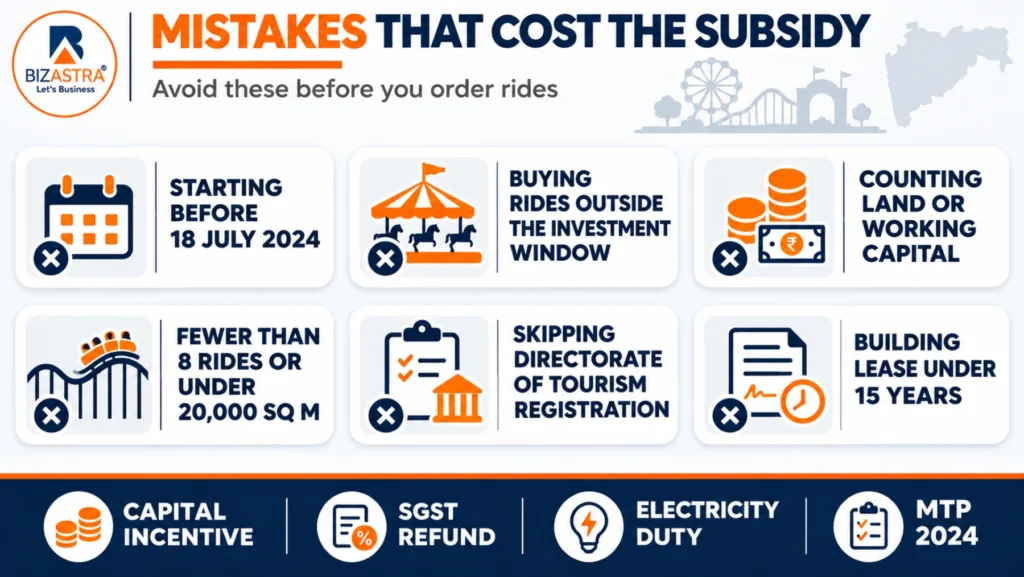
- Starting before 18 July 2024. At least one of your first investment, first term loan disbursement or construction permission must fall on or after the notification date. If all three happened earlier, you do not qualify under MTP 2024, unless the project began under the 2016 policy and has not yet started commercial operation.
- Buying rides too early. Assets must be acquired within the investment window before your COD, installed, in use and paid for. Keep invoices and payment proof for every ride and installation.
- Counting land, consultants or working capital. These are excluded from eligible capital investment, and over-claiming slows approval.
- Falling short of the definition. Fewer than 8 rides or under 20,000 square metres puts you outside the amusement park definition.
- Skipping registration. Without registration and a provisional certificate, or at least an application for one, the capital incentive is not available.
- Short building leases. A leased building needs at least 15 years.
- Mixing grants. Anything funded by a government or agency grant is excluded from incentive, so keep the funding trail clean.
- Misreading the SGST refund. It only helps if you actually pay SGST. Reimbursement is on net SGST paid, and the claim depends on correct GST filing.
Planning a farm-stay or agri-tourism add-on alongside the park? See our guide to the agro tourism subsidy in Maharashtra.
7. Frequently Asked Questions
Is there a subsidy for amusement parks in Maharashtra?
Yes. Under the Maharashtra Tourism Policy 2024, amusement parks are eligible tourism units and can claim a 15% capital investment incentive plus zone-wise SGST reimbursement, electricity duty exemption, tariff refund, interest subvention and stamp duty exemption.
How much is the capital subsidy for an amusement park?
15% of eligible capital investment or Rs 15 crore, whichever is less, paid in 5 equal annual instalments from the commercial operation date. Women, SC, ST or differently abled owned units with at least 51% equity get an additional 5%.
What is the definition of an amusement park under MTP 2024?
A permanent, ticketed-entry facility with at least 8 amusement rides and a minimum area of 20,000 square metres.
How long do the zone benefits last?
For MSME-class parks, 5 years in Zones A and B and 7 years in Zone C and special tourism zones. For Large projects the periods are 5, 7, 10 and 10 years.
Does land cost count?
No. Land cost is not eligible for the capital incentive. Buildings, rides, equipment, installations and similar assets are.
Can I claim for a park I already built?
Only if at least one of your first investment, first term loan disbursement or construction permission falls on or after 18 July 2024, and only capital assets acquired within the 4-year investment window before your commercial operation date count. A project begun under the 2016 policy that has not started commercial operation is treated under the 2024 policy.
Does the interest subvention cover all my loans?
No. It applies only to term loans, up to 5% on loans up to a zone-based limit, and is capped by a total ceiling for the eligibility period.
Do I need GST registration?
The SGST reimbursement works on net SGST paid, so you benefit only if you pay SGST. Admission tickets and food sales normally attract GST, so most operating parks will be registered. Check your own position with your CA.
Is the policy still valid?
The policy is valid for 10 years from 18 July 2024, or until amended. The state has sanctioned Rs 1,666 crore per year for incentives under it.
8. Check Your Amusement Park’s Eligibility
We will check your ride count and site area against the definition, classify your project, identify your zone, work out eligible capital investment and plan your registration and eligibility certificate filings, before you place ride orders. See our Maharashtra Tourism Policy 2024 advisory page for how we handle the full claim.
Check Your Amusement Park Eligibility
Disclaimer: The figures above are indicative and for general understanding only, based on the Maharashtra Tourism Policy 2024 (Government Resolution dated 18 July 2024) as available in October 2026. Actual benefits depend on your park’s classification, zone, investment, registration status and approvals, and policy rules can change. Please consult a qualified consultant before making any investment or financial decisions.