
Every state’s investment brochure claims to offer the best deal. None of the state brochures put Maharashtra, Gujarat, and Tamil Nadu side by side on the same page, because the moment you do, one of them usually loses.
We did it anyway. Below is the real factory subsidy comparison: the same Rs 10 crore factory, three states, one table.
But before you jump to a conclusion based on that one number, the best state for factory subsidy is not the same for everyone. A pharma unit and an auto-parts supplier can get completely opposite answers to which state gives the highest subsidy for their specific project. Here is where each state actually pulls ahead, and why.
1. Factory Subsidy Comparison: Maharashtra vs Gujarat vs Tamil Nadu
This is the core of the decision, so we are putting the numbers first and the explanations after.
| What you get | Maharashtra | Gujarat | Tamil Nadu |
|---|---|---|---|
| GST refund | 100% for 7 to 10 yrs | 80 to 100% for 5 to 10 yrs | 60 to 100% for 6 to 14 yrs |
| Capital grant | Extra for pharma, EV, electronics | Limited, sector-specific | 30 to 50% capital subsidy for electronics, EV, aerospace |
| Stamp duty exemption | 100% waived | 50 to 100% waived (zone-dependent) | 100% waived (select sectors) |
| Interest subsidy | Yes, share of interest reimbursed | Yes, capped scheme | Yes, capped scheme |
| Electricity savings | Duty and tariff support | Power tariff subsidy (select zones) | Power tariff subsidy (select sectors) |
| Tenure | Up to 10 years | Up to 10 years | Up to 14 years (select mega projects) |
| Mega project minimum | Zone-dependent threshold | Zone-dependent threshold | Higher entry threshold for top-tier benefits |
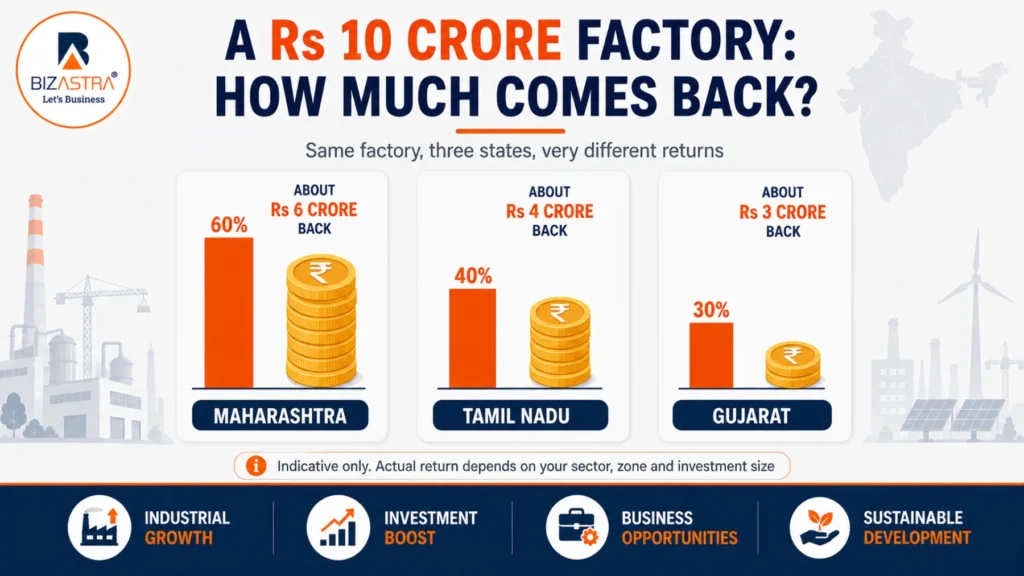
Figures above are simplified for comparison and indicative only, not a quote. Actual eligibility depends on your sector, zone, investment size, and each state’s current policy. A proper Maharashtra vs Gujarat vs Tamil Nadu subsidy comparison needs to be run against your actual project numbers, not a general table.
Numbers on a page are one thing. What they mean for your actual business depends on what you make, who you sell to, and how fast you need to move, and that is where the three states genuinely diverge.
2. When Gujarat Wins: Speed, Ports and Lower Land Cost
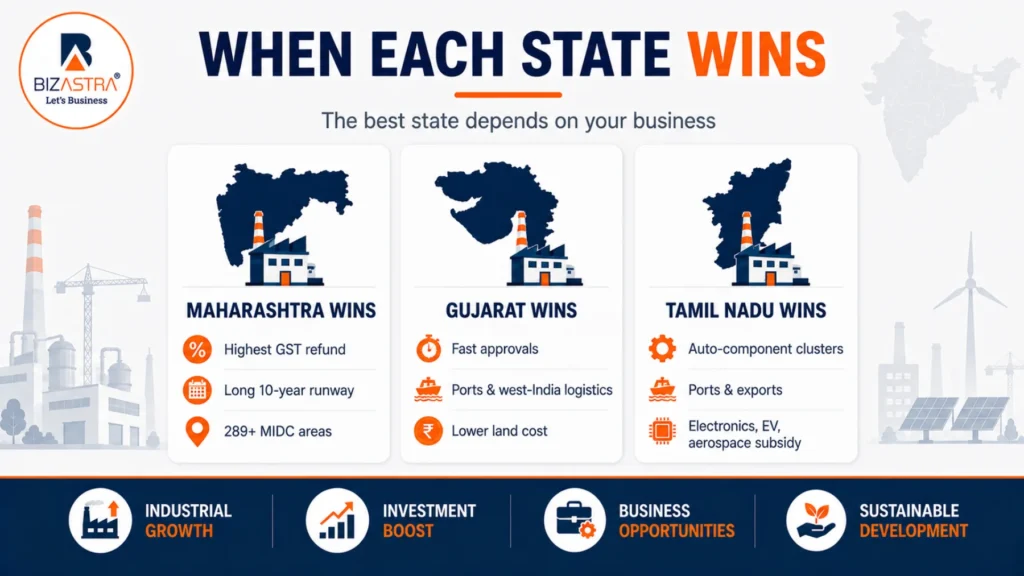
Gujarat is not chasing the highest subsidy number. It is chasing speed and infrastructure, and for a lot of manufacturers, that matters more than a few extra percentage points.
Approvals under Gujarat’s industrial policy tend to move faster than in most other states, largely because the state has invested heavily in single-window clearance systems and predictable timelines. If your business model depends on getting from land to production quickly, that speed alone can outweigh a smaller subsidy elsewhere.
Geography also plays in Gujarat’s favour. If your customers or raw material suppliers sit in North or West India, or you are exporting through Gujarat’s ports, the logistics savings can add up year after year, quietly closing the gap with a state offering a bigger one-time incentive. Gujarat is also home to established clusters for chemicals, ceramics, and textiles, so if you are in one of these sectors, you are plugging into a mature ecosystem of suppliers and skilled labour, not building from scratch. Land in GIDC (Gujarat Industrial Development Corporation) estates can also be cheaper than comparable MIDC land in Maharashtra, particularly in developing zones.
So if speed, West India logistics, or a chemicals, ceramics, or textiles cluster fit your business, Gujarat’s industrial policy earns a serious look, even with a lower headline subsidy number.
But logistics and speed are not the only variables. If your product ships by sea to global customers, there is a third state that changes the math entirely.
3. When Tamil Nadu Wins: Auto Clusters and Exports
Tamil Nadu plays a different game altogether. It does not try to out-subsidise Maharashtra on GST refund. Instead, it goes deep on specific sectors and specific advantages.
Chennai’s auto cluster is the clearest example. If you manufacture auto components, Tamil Nadu offers you a dense, mature supply chain of assemblers and Tier-1 suppliers already operating nearby, a locational advantage no subsidy percentage can fully replace. Being inside that cluster often means shorter lead times, easier hiring of skilled labour, and lower freight costs to your biggest customers.
Port access is Tamil Nadu’s second big lever. If you are an exporter, proximity to Chennai and Tuticorin ports can meaningfully cut your logistics costs and transit times compared to inland Maharashtra locations, a saving that compounds every single shipment.
And for electronics, EV, and aerospace manufacturers specifically, Tamil Nadu’s industrial policy offers a genuinely aggressive capital subsidy, in the 30 to 50% range for qualifying projects, administered through SIPCOT (State Industries Promotion Corporation of Tamil Nadu). For the right sector, that capital subsidy alone can outcompete Maharashtra’s GST-refund-led model.
So if you are in auto components, you export by sea, or you qualify for Tamil Nadu’s electronics, EV, or aerospace incentives, this is the state where the numbers can flip in your favour.
Which brings us back to Maharashtra, because for most manufacturers outside these specific situations, the comparison tilts back the other way, and by a wide margin.
4. When Maharashtra Wins: The Highest GST Refund
For the majority of manufacturers, especially those selling primarily within India, Maharashtra tends to come out ahead, and not by a small margin.
Start with the headline number: Maharashtra’s SGST refund gives back 100% of the state’s share of GST every year, for up to 10 years, capped by a zone-based ceiling. That reimbursement rate is higher and more straightforward than what Gujarat or Tamil Nadu typically offer for the same category of business.
The benefit period matters just as much as the rate. Maharashtra’s incentives, under its current policy MIISP 2025, are structured to pay out over a long runway, giving your business a steady, predictable cash flow injection through its most vulnerable early years, not just a one-time bump.
Location choice is another underrated advantage. Maharashtra’s MIDC network spans 289+ developed industrial areas across the state, giving you far more flexibility to find a location that fits your zone, your workforce needs, and your logistics, without being boxed into one or two industrial corridors the way some other states are.
Maharashtra’s advantage compounds if you are already selling into India’s largest state economy and biggest domestic consumer market. You are not just getting a subsidy, you are setting up next to your customers. On top of all this, pharma, EV, and electronics manufacturers get an additional cash grant layered on top of the standard incentives, making Maharashtra especially hard to beat for these sectors. Put simply: if you are not chasing a specific coastal export advantage or a Chennai auto cluster, Maharashtra is usually the one state that keeps paying you back the longest. With Maharashtra industrial subsidy schemes get highest GST Refund.
5. The Verdict: Best State for Manufacturing in India
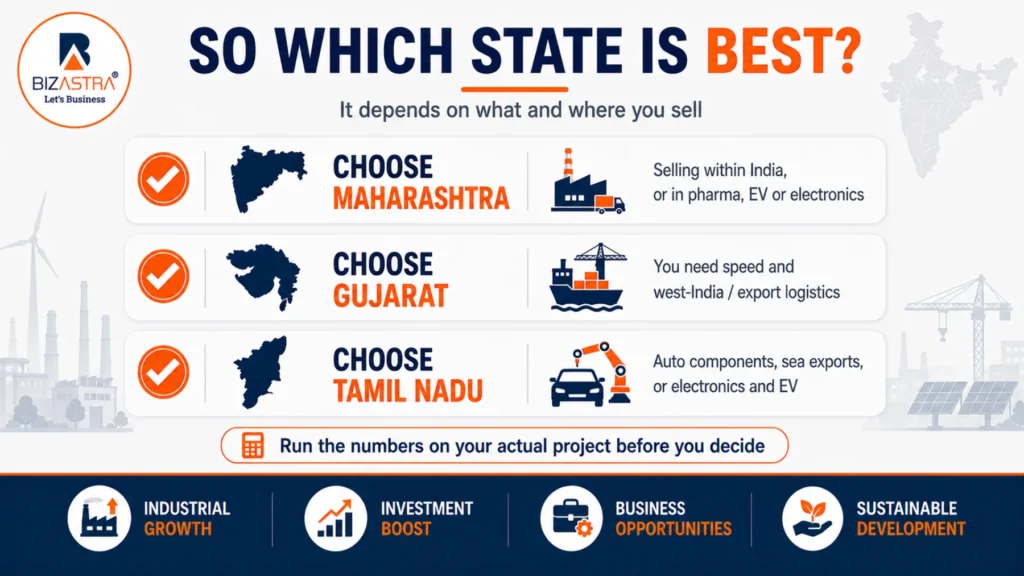
For most Rs 5 to 50 crore manufacturers selling within India, Maharashtra gives the highest total subsidy over the longest period. Gujarat wins on speed and West India logistics. Tamil Nadu wins on auto clusters, exports, and specific high-tech sectors. If you are asking what the best state for manufacturing in India actually is for your business, the honest answer is: it depends on your sector, your customers, and your export plans, which is exactly why this comparison needs to be run against your real numbers, not a generic table.
Frequently Asked Questions
Can I get a subsidy in two states at once?
No. You can only claim state industrial subsidies for the state where your registered manufacturing unit is actually located and operating. You cannot claim Maharashtra and Gujarat incentives for the same factory.
Which state is best for a pharma factory?
Maharashtra, in most cases. Its GST refund rate, long benefit period, and additional cash grant for pharma manufacturers combine to outperform Gujarat and Tamil Nadu for this sector.
Are foreign companies welcome in all three states?
Yes. Maharashtra, Gujarat, and Tamil Nadu all actively court foreign investment and offer incentives to foreign companies and joint ventures, subject to standard FDI norms.
Not sure which state fits your project? Get a free state comparison from BizAstra. [ Get My Free State Comparison ]
Written by BizAstra, Chartered Accountant with multi-state industrial subsidy advisory experience across Maharashtra, Gujarat, and Tamil Nadu.