
1. What Are Madhya Pradesh’s Thrust Sector Policies?
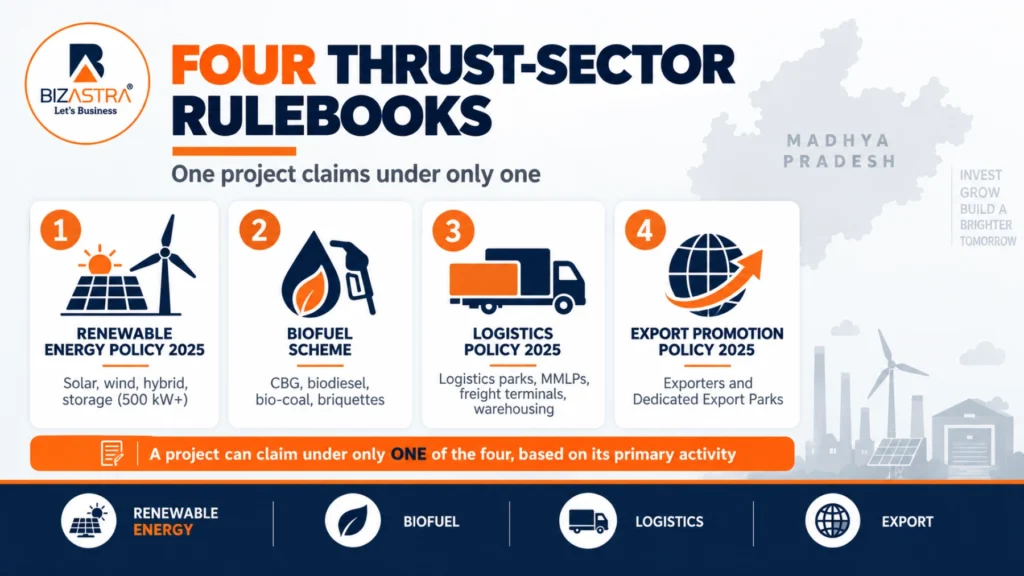
Madhya Pradesh isn’t offering investors one generic incentive package. It’s built four distinct rulebooks; each aimed at a sector the state has decided is worth betting on. Backed by a single-window clearance system, these four policies are the ones an investor evaluating MP in 2025 needs to know:
- Madhya Pradesh Renewable Energy Policy 2025, notified April 2025, valid five years, applicable to solar, wind, hybrid and storage projects of 500 kW and above.
- Scheme for Implementation of Biofuel Projects in Madhya Pradesh, officially a Scheme, not a standalone “Biofuel Policy.” It operates under the Renewable Energy Policy 2025 and covers CBG, biodiesel, bio-coal and briquette projects.
- Madhya Pradesh Logistics Policy 2025, approved February 2025, funding logistics parks, MMLPs, freight terminals and warehousing.
- Madhya Pradesh Export Promotion Policy 2025, the state’s first dedicated export policy, sitting on top of base industrial incentives for exporters and Dedicated Export Park developers.
Sounds like a lot to track. It gets simpler once you see the actual numbers each one puts on the table.
2. See the Numbers: A Worked Example (Biofuel Scheme)
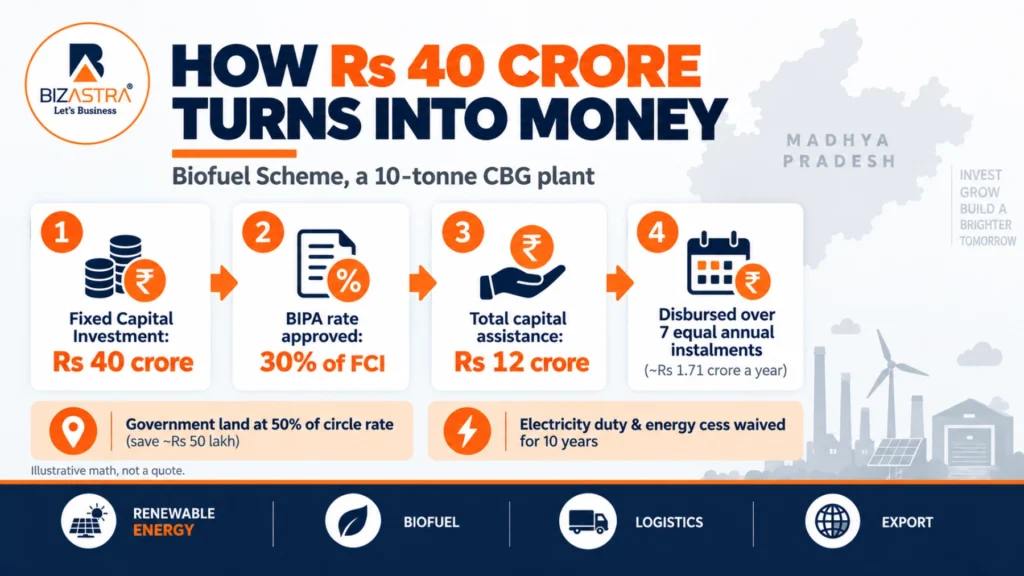
This is the part most blogs skip. Let’s run real math on one policy so you can see how “10% to 40% of FCI, up to ₹200 crore” actually turns into money in your account.
Imagine you’re setting up a 10-tonne compressed biogas (CBG) plant in Madhya Pradesh with a Fixed Capital Investment (FCI) of ₹40 crore. Under the Biofuel Scheme, your project qualifies for Basic Investment Promotion Assistance (BIPA). Say the department approves you at 30% of FCI, within the policy’s 10% to 40% band.
| Item | Amount |
|---|---|
| Fixed Capital Investment | ₹40 crore |
| BIPA rate approved | 30% of FCI |
| Total capital assistance | ₹12 crore |
| Disbursed over | 7 equal annual instalments |
| Approx. payout per year | ₹1.71 crore |
That ₹12 crore doesn’t land as a lump sum. It’s spread across 7 years, the same way the policy structures its 7-year disbursement window. On top of that:
- Government land for your plant (a 10-tonne CBG project needs a minimum of 10 acres) comes at 50% of the circle rate, so if that land is valued at ₹1 crore, you save roughly ₹50 lakh upfront.
- Your electricity duty and energy development cess are waived entirely for 10 years from commercial operation, which adds a recurring saving to your power bill every year of that decade.
Your actual approved percentage within the 10% to 40% band, and whether your project even qualifies at 30%, depends on classification and location. This is illustrative math to show the mechanics, not a quote.
3. What Incentives Can Investors Get Under Each Policy?
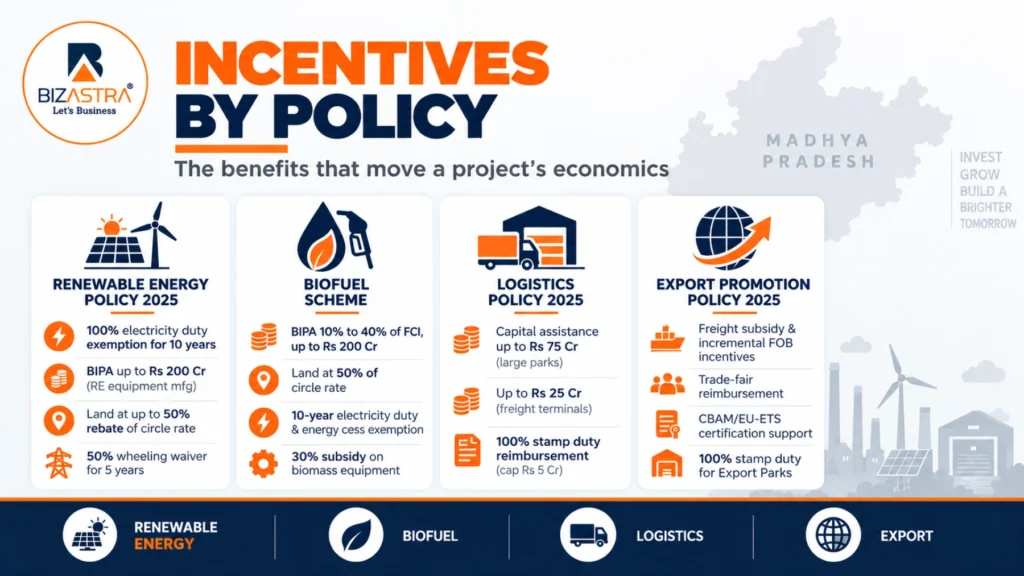
Here’s how the four policies compare on the benefits that actually move a project’s economics: capital assistance, land, power costs, and tax reimbursements.
| Sector | Investment Criteria | Key Benefits |
|---|---|---|
| Renewable Energy | Projects of 500 kW and above (decentralised systems excluded); mega units above ₹500 crore get a customised package | • 100% electricity duty exemption for 10 years • Capital subsidy (BIPA) up to ₹200 crore over 7 years, for RE equipment manufacturing units specifically • 50% stamp duty reimbursement on private land • Government land at up to 50% rebate on circle rate • 50% wheeling charge waiver for 5 years from COD • Infrastructure assistance up to ₹5 crore |
| Biofuel | CBG, biodiesel, bio-coal and briquette projects (excludes first-gen ethanol); land requirement scales with capacity | • BIPA of 10% to 40% of FCI, up to ₹200 crore, over 7 years • Land at 50% of circle rate • 10-year electricity duty and energy cess exemption • 30% subsidy on biomass aggregation equipment |
| Logistics | Logistics parks, MMLPs, ICDs, freight terminals and warehousing, sized by acreage | • Capital assistance up to ₹75 crore for large logistics parks • Up to ₹25 crore for freight terminals/CFS/ICDs • 100% stamp duty and registration reimbursement (capped ₹5 crore) • Up to 70% ground coverage allowance • Single-window fast-track approvals |
| Export | Assistance layered above the Industrial Promotion Policy‘s base incentives; covers first-time exporters, growing exporters, and Dedicated Export Park developers | • Freight subsidy and incremental FOB turnover incentives • Reimbursement for trade fairs • Support for green/international compliance certifications (EU ETS, CBAM) • Interest subsidy on export credit • 100% stamp duty reimbursement for Dedicated Export Parks |
Disclaimer: The figures above are indicative and for general understanding only, based on the Madhya Pradesh Renewable Energy Policy 2025, the Biofuel Scheme, the Logistics Policy 2025, and the Export Promotion Policy 2025. Actual benefits depend on your project’s classification, location, investment size, and the scheme rules in force at the time of your application. Please consult a qualified consultant before making any investment or financial decisions.
4. Which MP Policy Is Right for Your Business?
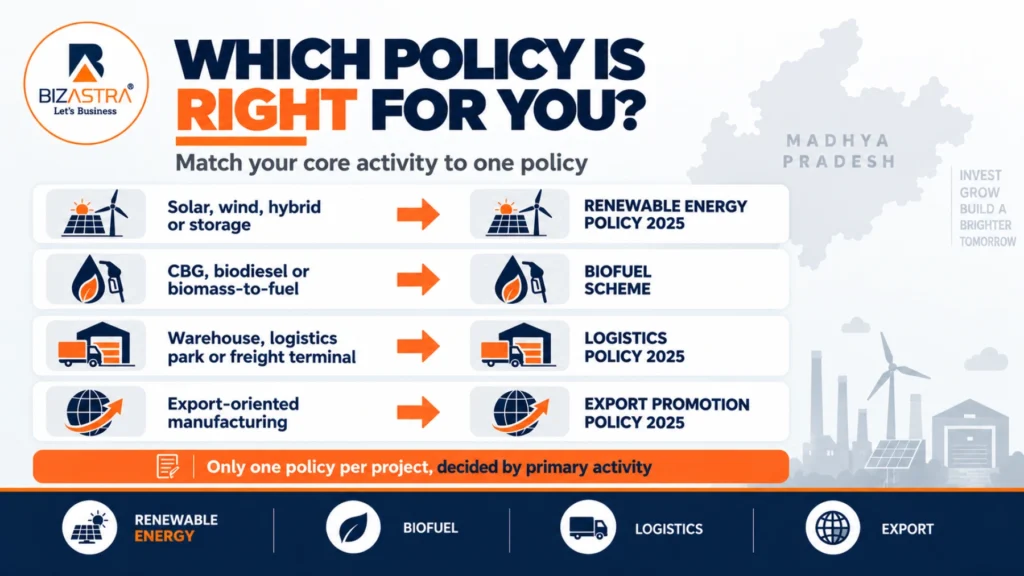
If you already know your project type, the mapping is direct:
- Solar, wind, hybrid, or storage project → Renewable Energy Policy 2025
- CBG, biodiesel, or biomass-to-fuel plant → Biofuel Scheme
- Warehouse, logistics park, or freight/cargo terminal → Logistics Policy 2025
- Export-oriented manufacturing business → Export Promotion Policy 2025
That said, a project can be classified and claim benefits under only one of these four thrust sector policies, the one matching its primary activity. A CBG plant that also exports its output still applies under the Biofuel Scheme, not the Export Promotion Policy; a warehouse serving an export park still applies under the Logistics Policy, not the Export Promotion Policy. Identify your project’s core activity first, since that’s what decides which single policy governs your incentive claim.
5. How Can Businesses Avail These Benefits?
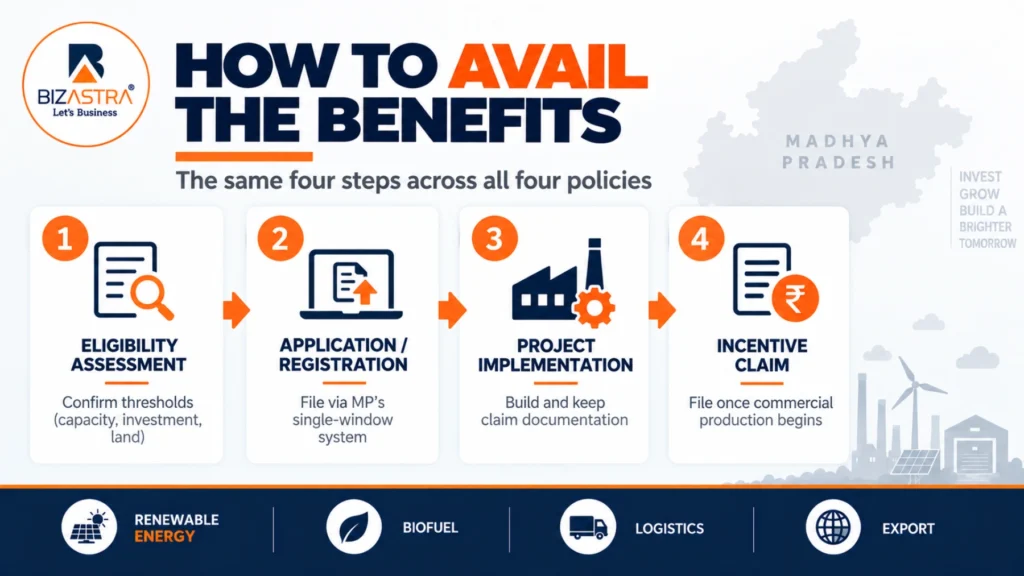
The process is broadly the same across all four policies:
- Eligibility assessment. Confirm your project meets the sector-specific thresholds (capacity, investment size, land area) and identify which incentive categories apply.
- Application/registration. File your intention to invest through MP’s single-window system and register with the relevant department
- Project implementation. Execute construction and installation while keeping documentation that will later support your incentive claim.
- Incentive claim. Once commercial production begins, file claims for each applicable benefit with supporting certificates, typically including a CA certification.
- Verification and disbursement. The department verifies your claim before releasing assistance, usually across several annual instalments rather than a lump sum.
6. Common Confusion
6.1 It’s Assistance, Not Upfront Cash.
None of these four policies hand you money before you’ve built the project. You fund construction, prove commercial production, get certified, and then the state reimburses or disburses assistance against verified spend, usually across multiple years, not on day one.
6.2 The Biofuel Scheme Is a Scheme, Not a Policy.
These trips people up. It doesn’t stand alone. It operates under the framework of the Renewable Energy Policy 2025. That distinction matters when you’re checking which document actually governs your eligibility conditions.
6.3 Percentage Caps Are Ceilings, Not Guarantees.
“10% to 40% of FCI” or “up to ₹75 crore” describes the maximum the policy allows, not what every applicant automatically receives. Your actual approved rate depends on your project’s classification, location, and the department’s assessment.
7. Frequently Asked Questions
Are there other investment policies in Madhya Pradesh besides these four?
Yes. MP also runs the Industrial Promotion Policy 2025 as its base framework, plus dedicated policies for Semiconductors, Drones, Civil Aviation, AVGC-XR, IT/ITeS & ESDM, GCCs, textiles, tourism, and MSMEs. Worth checking Invest MP for your specific sector. Chances are a dedicated policy already exists.
Is there a minimum investment size to qualify?
Yes, each policy sets its own minimum. For renewable energy, it’s 500 kW capacity. The threshold differs by sector, so check the specific policy for your project type.
Do the incentives vary by district within MP?
Not by zone-based tiers the way some other states do it. These four policies apply uniformly across MP. What does vary by location is land value (circle rate), which changes the actual rupee amount of any land-linked benefit.
Which MP policy is best suited for my investment project?
It depends on your project type. Energy generation fits the Renewable Energy Policy, CBG/biofuel projects fit the Biofuel Scheme, warehousing and freight infrastructure fit the Logistics Policy, and export-focused manufacturing fits the Export Promotion Policy. You apply under whichever one matches your core activity, not more than one.
How can businesses apply for incentives under these policies?
Through MP’s single-window system: file an intention to invest, register with the relevant department, implement the project, then submit incentive claims with supporting documentation once operations begin.
8. Want to Know Your Exact Incentive Potential?
Get a free calculation based on your project type, taluka/location, investment size, and sector, before you build your financial model around an assumed incentive number.
Contact Us for a Free Calculation
Disclaimer: The figures above are indicative and for general understanding only, based on the Madhya Pradesh Renewable Energy Policy 2025, the Scheme for Implementation of Biofuel Projects, the Logistics Policy 2025, and the Export Promotion Policy 2025 as notified in 2025. Actual benefits depend on your project, location, sector, investment size, classification, and the scheme rules in force at the time of application. Please consult a qualified consultant before making any investment or financial decisions.