
Quick Answer
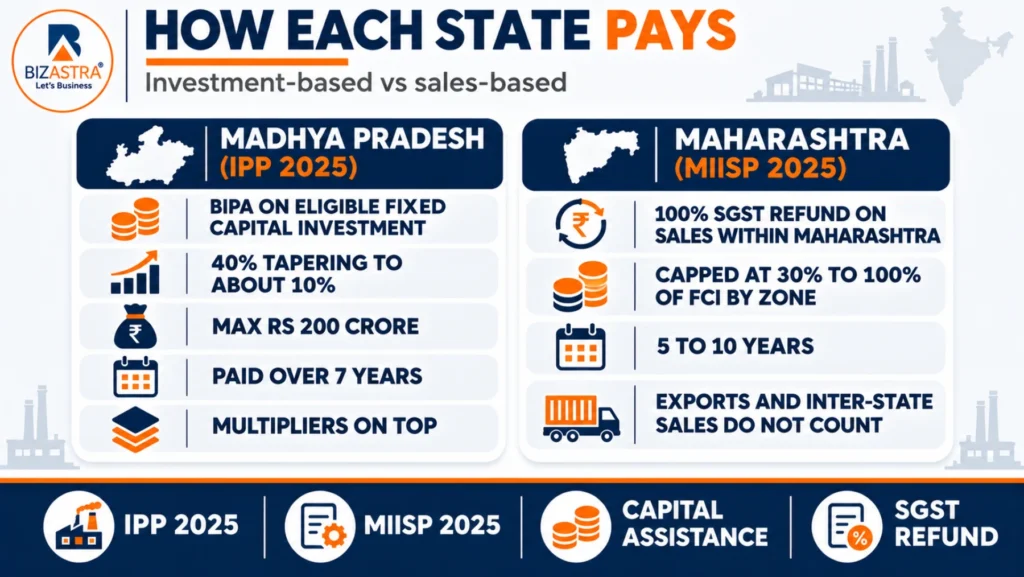
There is no single winner, because the two states pay in different ways. Madhya Pradesh (IPP 2025) pays formula-based assistance on your eligible fixed capital investment, from 40% on smaller projects down to about 10% on very large ones, over 7 years, with multipliers on top. Maharashtra (MIISP 2025) refunds the SGST on your Maharashtra sales, up to a zone-based ceiling of 30% to 100% of your fixed capital investment. If most of your sales are inside Maharashtra, its ceiling can be larger. If you sell mainly to other states or export, Madhya Pradesh is usually the more predictable payout.
1. Two Different Ideas of a Subsidy
Madhya Pradesh notified its Industrial Promotion Policy 2025 on 24 February 2025, with an Investment Promotion Scheme that sets out the rules for large and mega manufacturing units. The core benefit is Basic Investment Promotion Assistance (BIPA), calculated from your eligible fixed capital investment (EFCI), not from your sales. It is paid in 7 equal annual instalments, and multipliers can raise each year’s amount.
Maharashtra notified its Industries, Investment and Services Policy 2025 on 31 December 2025, replacing PSI 2019. Its main benefit, the Industrial Promotion Subsidy (IPS), refunds 100% of the gross SGST on your first sale of eligible products within Maharashtra, until you hit a ceiling set as a percentage of your fixed capital investment (FCI). A separate 20% capital subsidy exists, but only for specified thrust-sector units.
That difference drives everything else. Madhya Pradesh’s number is set mostly by what you invest. Maharashtra’s number is set by what you invest (the ceiling) and what you sell in the state (the actual payout).
2. Base Subsidy Compared
Under the Madhya Pradesh scheme, BIPA is 40% of EFCI up to Rs 50 crore and then tapers as the project grows, reaching the Rs 200 crore maximum above Rs 2,000 crore. Here is how the policy formula works out:
| Eligible fixed capital investment | Base BIPA | As % of investment | Per year (7 instalments) |
|---|---|---|---|
| Rs 50 crore | Rs 20.0 crore | 40.0% | Rs 2.9 crore |
| Rs 100 crore | Rs 35.9 crore | 35.9% | Rs 5.1 crore |
| Rs 300 crore | Rs 65.1 crore | 21.7% | Rs 9.3 crore |
| Rs 500 crore | Rs 91.4 crore | 18.3% | Rs 13.1 crore |
| Rs 1,000 crore | Rs 145.0 crore | 14.5% | Rs 20.7 crore |
| Above Rs 2,000 crore | Rs 200 crore (cap) | Under 10% | Rs 28.6 crore |
EFCI counts factory sheds and buildings (building cost recognised up to 100% of plant and machinery cost for the calculation), main manufacturing plant and machinery including erection and foundation, and certain extras such as in-house R&D and renewable captive power within stated limits. Land is not part of FCI. Old machinery is excluded, though imported second-hand or refurbished machinery with an expected life of at least 10 years is allowed.
Maharashtra’s ceilings by zone, for the SGST-based IPS, are set out below. These are caps, not guaranteed payouts. The table shows the figures for MSME units and Special LSI/LSI units.
| Zone | Example areas | MSME cap / period | Special LSI / LSI cap / period |
|---|---|---|---|
| A and B | Mumbai, Pune, PCMC, Nashik, Kolhapur | 30% to 40% of FCI / 5 to 7 years | 40% / 7 years |
| C | Satara, Sangli | 50% / 7 years | 50% / 7 years |
| D | Jalna, Latur | 60% / 10 years | 60% / 7 years |
| D+ | Interior Vidarbha and Marathwada talukas | 70% / 10 years | 80% / 7 years |
| Special belt | Vidarbha, Marathwada, Ratnagiri, Sindhudurg, Jalgaon, Dhule | 80% / 10 years | 90% / 9 years |
| No-industry, Naxal-affected and aspirational districts | For example Gadchiroli, Washim, Dharashiv, Nandurbar | 100% / 10 years | 100% / 9 years |
3. SGST, Electricity and Other Benefits
Here the two states look very different for a general manufacturer.
| Benefit | Madhya Pradesh (IPP 2025) | Maharashtra (MIISP 2025) |
|---|---|---|
| SGST refund | Not part of the large-unit scheme. Assistance is calculated on investment (BIPA), not on SGST | 100% of gross SGST on first sales within Maharashtra, up to the zone cap. Only intra-state sales count |
| Electricity | Power tariff reimbursement for specific sectors such as food processing, and garment, footwear, toys and accessories units | 100% electricity duty exemption for new units in Zones C, D, D+ and below. In Zones A and B, only for EOUs and units owned by women, SC/ST or persons with disabilities. Rs 1 per unit tariff subsidy for 3 years in Zones D, D+ and below, capped |
| Stamp duty | Reimbursement for specific sectors such as garment, footwear, toys and accessories units | 50% in Zones A and B, 100% from Zone C |
| Interest subsidy | For specific sectors such as textile and garment units | Up to 5% a year for eligible MSMEs, capped at Rs 1 crore a year |
| Capital subsidy | Built into BIPA for all large units. Separate green industrialisation support for effluent treatment and ZLD systems | 20% of eligible FCI for specified thrust-sector units, capped at Rs 25 crore overall and Rs 5 crore a year |
| Infrastructure | 50% of the cost of approach road, water, power, drainage and gas connections, within stated limits | Check the MIISP 2025 text for any infrastructure support before relying on it |
Two cautions. First, older articles still describe earlier Madhya Pradesh policies that were linked to SGST, so make sure you are reading about IPP 2025. Second, Madhya Pradesh runs a separate MSME policy, and units that qualify as MSMEs on the date of commercial production are handled there, not under the large-unit scheme. MSME thresholds were revised in 2025, so confirm your classification.
4. Multipliers and Caps
Madhya Pradesh multipliers on yearly BIPA:
- Geographic: 1.3 for units in priority blocks, which are blocks with no large industrial unit yet.
- Export: 1.0 to 1.3, rising with direct exports from 25% to 75% of production.
- Employment: 1.0 to 1.5, based on average employees, from 100 up to 2,500 (not available for expansion units).
- FDI: 1.1 to 1.2, depending on foreign equity between 26% and 50%.
- Sector: 1.5 for agri, dairy and food processing; 1.3 for listed sectors such as API and bulk drugs, medical devices, electric vehicles and high value-add manufacturing.
- Gross supply multiple: reduced if you use less than 40% of installed capacity in year one, or less than 75% of your previous peak (or 50% of capacity) later on.
Total assistance cannot exceed the unit’s fixed capital investment, and BIPA is limited to Rs 200 crore. Mega units (over Rs 500 crore in plant and machinery, or lower thresholds in priority blocks and listed sectors) can also seek a customised package from the state’s Cabinet Committee for Investment Promotion.
Maharashtra caps and conditions: the zone ceiling on IPS, reduced benefits for expansion units, and a capital subsidy limited to specified thrust-sector units. In Zones A and B only 50% of machinery cost counts toward the capital subsidy; in Zone C it is 80%; in Zones D, D+ and below, land, building and machinery all count. Incentives from all state departments together must stay within 100% of FCI.
5. A Rs 300 Crore Example
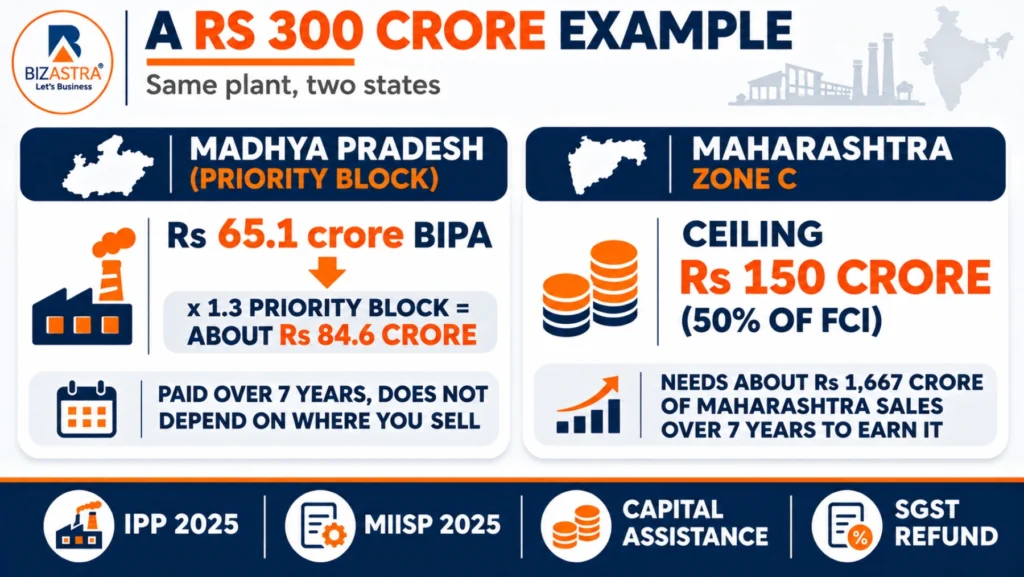
Say you build a large general manufacturing plant with Rs 300 crore of eligible fixed capital investment, in a Madhya Pradesh priority block and a Maharashtra Zone C location, and that the Maharashtra unit qualifies as a Special LSI.
| Madhya Pradesh | Maharashtra Zone C | |
|---|---|---|
| Base assistance | BIPA of Rs 65.1 crore (21.7%), about Rs 9.3 crore a year for 7 years | IPS ceiling of 50% of FCI = Rs 150 crore over 7 years |
| Multipliers | Priority block 1.3 takes this to about Rs 84.6 crore (28.2%). Other multipliers depend on exports, jobs and FDI | None; the ceiling is fixed |
| What decides the actual payout | Capacity utilisation and the multipliers | SGST on your Maharashtra sales. To collect Rs 150 crore you need about Rs 1,667 crore of intra-state sales over 7 years (about Rs 238 crore a year at 18% GST) |
| If you sell mostly outside the state | Payout is largely unaffected | Payout can fall far short of the ceiling, because IGST sales do not count |
The takeaway: in this example Maharashtra’s ceiling is higher, but you only earn it by selling a lot inside Maharashtra. Madhya Pradesh pays less on paper for a project this size, but the amount is far more predictable. A smaller project reverses the picture: at Rs 50 crore, Madhya Pradesh pays 40% (Rs 20 crore), which beats Maharashtra’s 30% to 40% ceilings in the most developed zones. The numbers use the policy formulas as written and assume 18% GST.
6. Sector Focus by State
- Madhya Pradesh: food processing, textiles, garments, footwear and toys, aerospace and defence, pharmaceuticals, biotechnology, medical devices, EV manufacturing, renewable energy equipment and high value-add manufacturing. Several carry multipliers or sector-specific benefits.
- Maharashtra: the policy covers 16 priority and thrust manufacturing sectors, including advanced materials, aerospace and defence, agro and food processing, automotive and components, battery and energy storage, chemicals, machinery and equipment, pharma, biotech and medtech, semiconductor and display fabs and ESDM, smart manufacturing and textiles, along with priority service sectors and emerging sectors.
Electronics makers should note the difference: Maharashtra lists semiconductors, displays and ESDM among its focus sectors, which can open the 20% capital subsidy where the thrust-sector conditions are met. Madhya Pradesh’s multiplier list centres on other sectors, so electronics would typically rely on the base BIPA, the high value-add route if it qualifies, and any customised package for mega units. Central schemes such as ECMS can sit on top of either state.
7. Which State for Which Factory
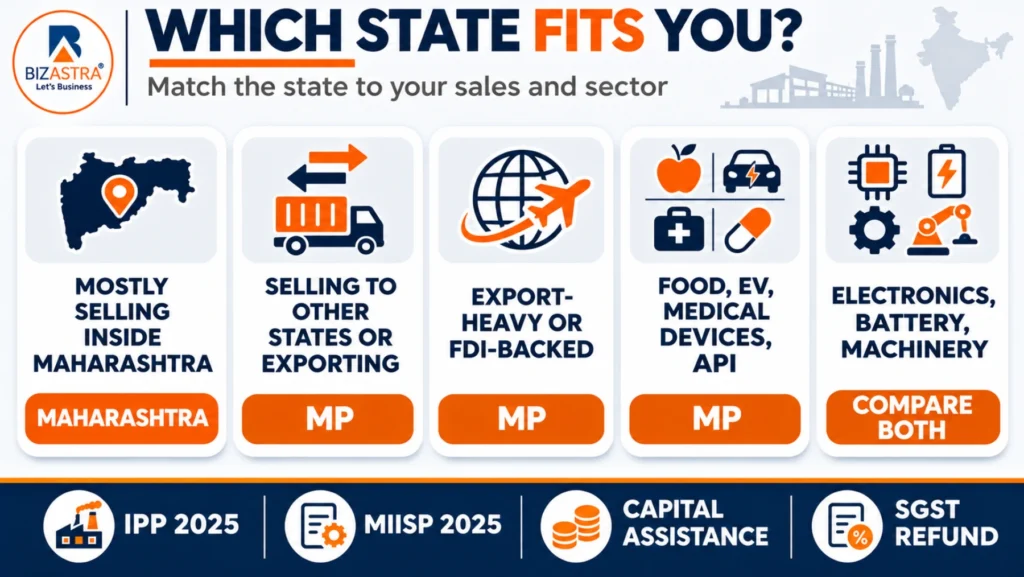
- Mostly selling inside Maharashtra to local customers: Maharashtra’s IPS can pay back a large share of your investment, especially in Zones C to D+.
- Selling to other states or exporting: Madhya Pradesh BIPA does not depend on where you sell. In Maharashtra, only intra-state SGST counts.
- Export-heavy and FDI-backed: Madhya Pradesh’s export and FDI multipliers reward you directly.
- Food, EV, medical devices, API: check Madhya Pradesh multipliers of 1.3 to 1.5.
- Electronics, battery and machinery makers: compare Maharashtra’s 20% capital subsidy (if your unit qualifies) plus IPS against Madhya Pradesh BIPA with the high value-add multiplier.
- Mega projects: both states can negotiate beyond the policy. Madhya Pradesh’s customised package route is set out in its scheme, and Maharashtra offers customised incentives for Mega and Ultra-Mega projects.
8. How to Decide
- Where will your sales go? Estimate the split between Maharashtra, other states and exports.
- What is your eligible investment and classification? Compute FCI under each state’s definition. They count different things.
- Which zone or block can you actually locate in? Maharashtra pays by taluka zone, and Madhya Pradesh by priority block.
- What are the conditions? Madhya Pradesh requires 70% of employment to go to state domiciles and requires the unit to stay in production for the assistance period plus 3 years. Check Maharashtra’s conditions in your Eligibility Certificate.
- How does it stack with central schemes? Madhya Pradesh lets you take central government assistance on top of IPP 2025, as long as total assistance does not exceed your fixed capital investment, and its claim form asks you to declare any central subsidy received. Check the stacking conditions in your Maharashtra Eligibility Certificate. See our guide to stacking central and state subsidies.
- What are the process deadlines? Madhya Pradesh needs an Intention to Invest on its portal and an application within 180 days of commercial production. Maharashtra needs an Eligibility Certificate before commercial production.
9. Frequently Asked Questions
Which state gives a bigger subsidy, Madhya Pradesh or Maharashtra?
It depends on project size, where you sell and your sector. Madhya Pradesh pays formula-based assistance on investment. Maharashtra refunds SGST on in-state sales up to a zone ceiling. For small projects and for units selling outside the state, Madhya Pradesh often pays more. For large projects with heavy Maharashtra sales, Maharashtra’s ceiling can be higher.
Does Madhya Pradesh give an SGST refund under IPP 2025?
Not under the large-unit Investment Promotion Scheme. Its core benefit is BIPA, calculated on eligible fixed capital investment. Earlier Madhya Pradesh policies were linked to SGST, so check which policy an article describes.
What is BIPA?
Basic Investment Promotion Assistance, Madhya Pradesh’s main incentive for large units. It is 40% of eligible fixed capital investment up to Rs 50 crore, tapering to about 10% at Rs 2,000 crore, with a Rs 200 crore maximum, paid over 7 years.
Does Maharashtra’s SGST refund apply to exports or inter-state sales?
No. IPS covers SGST on intra-state sales only. Exports and IGST sales do not generate a refund.
Does land count in the investment?
Under the Madhya Pradesh scheme, fixed capital investment excludes land. In Maharashtra, land and building can count toward the ceiling, but the capital subsidy treats them differently by zone. Check how each state defines it for your project.
Can I take benefits from both states?
Each incentive is tied to the unit in that state. A single plant gets one state’s package. If you set up separate plants in each state, each follows its own policy.
Can I combine state assistance with central schemes?
Often yes, subject to each scheme’s no-double-counting rules. The Madhya Pradesh scheme allows central assistance on top of IPP 2025 if cumulative assistance stays within your fixed capital investment, and you must declare central subsidies when you claim. Check the conditions of the specific schemes involved, including those in your Maharashtra Eligibility Certificate.
Are MSMEs treated differently in Madhya Pradesh?
Yes. The IPP 2025 Investment Promotion Scheme is for large and mega manufacturing units. MSME units fall under the state’s separate MSME policy. Confirm your classification on your date of commercial production.
Do I need to hire locally?
Madhya Pradesh requires 70% of total employment to go to state domiciles to avail IPP 2025 benefits. Check what your Maharashtra Eligibility Certificate requires.
10. Compare Your Project Across States
Give us your product, investment, sales split and shortlisted locations, and we will model the subsidy under each state’s policy side by side. See our IPP 2025 advisory page and MIISP 2025 advisory page for the detail on each state.
Compare Your Project Across States
Disclaimer: The figures above are indicative and for general understanding only, based on the Madhya Pradesh Industrial Promotion Policy 2025 and Investment Promotion Scheme 2025 (notified 24 February 2025) and the Maharashtra Industries, Investment and Services Policy 2025 (notified 31 December 2025), as publicly available in October 2026. Actual benefits depend on your project, location, sector, investment size, classification, sales pattern and the rules at the time of your application. Please consult a qualified consultant before making any investment or financial decisions.