
Quick Answer
Often yes, but not for free. A central government scheme and a state policy can usually both support the same project, as long as no rupee of cost or sales is rewarded twice where a scheme forbids it, and total support stays under every cap. In practice that means three checks: the same-cost test, the cap test and the undertaking test. The rules sit in each scheme’s own text, so map the stack before you order machinery, not after.
1. The Stacking Rule of Thumb
Every scheme asks one question in different words: has this investment or this sale already been rewarded somewhere else? Run any combination through three tests.
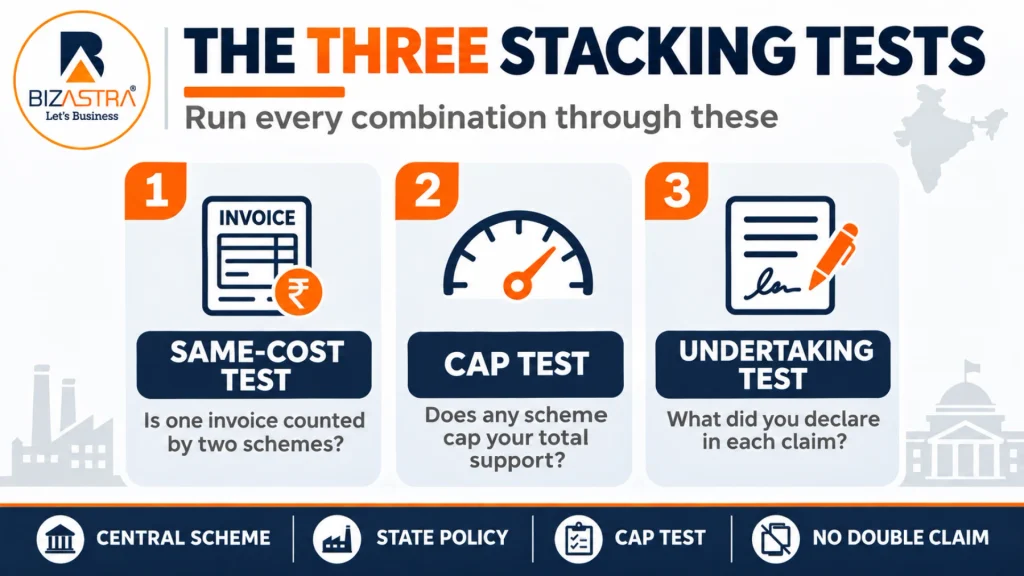
- The same-cost test. Is the same machine invoice, building cost or sales invoice being counted by two schemes? Overlap on the same item is where most refusals and clawbacks come from.
- The cap test. Does any scheme cap your total support? Madhya Pradesh caps total assistance at your fixed capital investment. ECMS caps its own incentive at 50% of your cumulative eligible incremental investment.
- The undertaking test. Almost every scheme makes you sign a declaration. ECMS wants a management undertaking that nothing is incentivised twice. Madhya Pradesh’s claim form asks you to list any central subsidy received. A wrong declaration is the most expensive mistake in the stack.
2. What Stacks and What Does Not
| Combination | Verdict | What the rules say |
|---|---|---|
| ECMS + another central incentive (PLI, MPMS or similar) on the same investment or sales | No | ECMS says eligibility under it does not affect eligibility under another scheme, but investment or sales incentivised under any other central scheme cannot be incentivised again under ECMS. You file an undertaking to this effect. |
| ECMS + a state capital subsidy on the same machinery | Usually yes, check the state text | The ECMS bar names other schemes of the Government of India, not state schemes. The state policy then decides. Madhya Pradesh allows central assistance on top of IPP 2025 if cumulative assistance stays within your fixed capital investment. |
| ECMS Segment D capex + a state SGST-linked refund (for example Maharashtra IPS) | Plausible | Different bases: Segment D pays on capital expenditure, while an SGST refund pays on state sales. Confirm in the approval letter and the state Eligibility Certificate. |
| Two states for one plant | No | Incentives are tied to the unit in that state. Separate plants in separate states each follow their own policy. |
| Two policies in the same state | Only if the policy says so | Madhya Pradesh gives one policy of your choice unless a policy states that it is over and above IPP 2025, and cumulative assistance cannot exceed fixed capital investment. |
| RDI Fund loan + ECMS capex | Unclear, ask both | The RDI Fund is financing, not an incentive on sales. But ECMS counts in-house R&D capex as eligible investment, so a concessional loan funding the same equipment needs to be cleared with both sides. |
| Customised mega package | Set by the package | Madhya Pradesh’s Cabinet Committee can sanction packages beyond policy for mega units. The stacking terms are written into the sanction. |
3. Worked Example: ECMS Segment D + a State Package
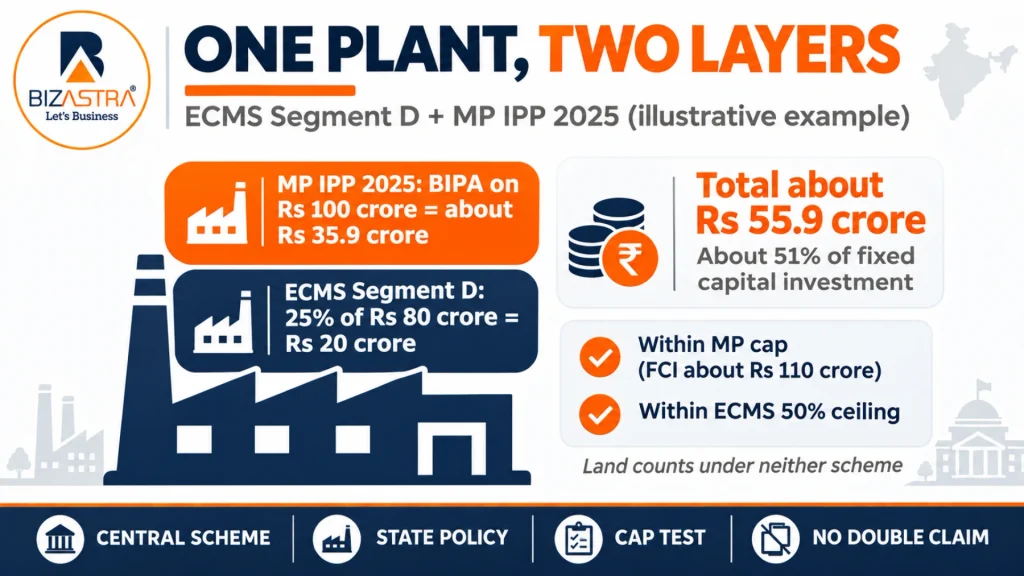
Say a company builds a plant making capital equipment for electronics factories in a Madhya Pradesh non-priority block. It qualifies for ECMS Segment D, with a 25% capex incentive, and for MP IPP 2025 as a large unit. All figures are assumed for illustration.
| Cost line | Amount | Counts under |
|---|---|---|
| Plant and machinery | Rs 70 crore | ECMS and MP |
| Associated utilities (captive power, clean rooms, etc.) | Rs 6 crore | ECMS (with auditor certificate) |
| Freight, insurance and erection | Rs 4 crore (cap: 7.5% of base cost = Rs 5.25 crore) | ECMS; MP counts erection and transport inside plant and machinery |
| Factory shed and building | Rs 30 crore | MP only (ECMS excludes buildings) |
| Land | Rs 10 crore | Neither |
Layer 1, ECMS Segment D. Eligible investment is Rs 80 crore (machinery, utilities and freight). At 25%, the incentive is Rs 20 crore, or Rs 16 crore at 20% if the employment threshold is missed.
Layer 2, MP IPP 2025. Eligible fixed capital investment is Rs 100 crore (building plus plant and machinery). The BIPA formula gives about Rs 35.9 crore, paid over 7 years, with no multipliers in a non-priority block with mostly domestic sales.
Stack check. Total support is about Rs 55.9 crore. MP’s cap is your total fixed capital investment (all fixed assets except land), roughly Rs 110 crore here, so the cap is not binding. ECMS’s own ceiling is 50% of eligible investment (Rs 40 crore), and Rs 20 crore sits well inside it. No cost is claimed under two central schemes. The state claim form asks you to declare the ECMS amount, and the ECMS undertaking confirms nothing else central is claimed on the same assets.
That is about 51% of fixed capital investment in total, but the cash arrives differently. ECMS pays on claims filed after commercial production and certified by your auditor and a Chartered Engineer, and MP pays in 7 equal yearly instalments from the first claim year. Plan your funding for years of negative cash flow before either arrives.
The same logic applies in Maharashtra, where the state capital subsidy and SGST refund (MIISP 2025) are added to the stack. The difference is that you should read the conditions in the Eligibility Certificate, since they are issued per unit, and Maharashtra keeps total incentives from all state departments within 100% of FCI.
4. Double-Dipping Limits and What They Cost
- Same asset, two claims. ECMS excludes any investment or sales incentivised under another central scheme. Under Madhya Pradesh rules, total assistance cannot exceed fixed capital investment.
- Verification. ECMS lets the project management agency inspect assets covering at least 25% of eligible investment and examine bank statements and payments behind your sales and investment.
- Clawback. If an ECMS claim is found excessive or false, you refund the amount with interest at the 3-year SBI MCLR, compounded annually. Madhya Pradesh recovers assistance with interest at 10% compounded annually for false declarations, and for units that stay closed more than 6 months during the assistance period or the 3 years after it.
- Lock-in. Madhya Pradesh requires the supported assets to stay in place, and the unit to keep producing, for the assistance period plus 3 years.
- Related-party sales. ECMS releases only 80% of the incentive on related-party sales first, with the balance after tax compliance.
5. How to Plan the Stack
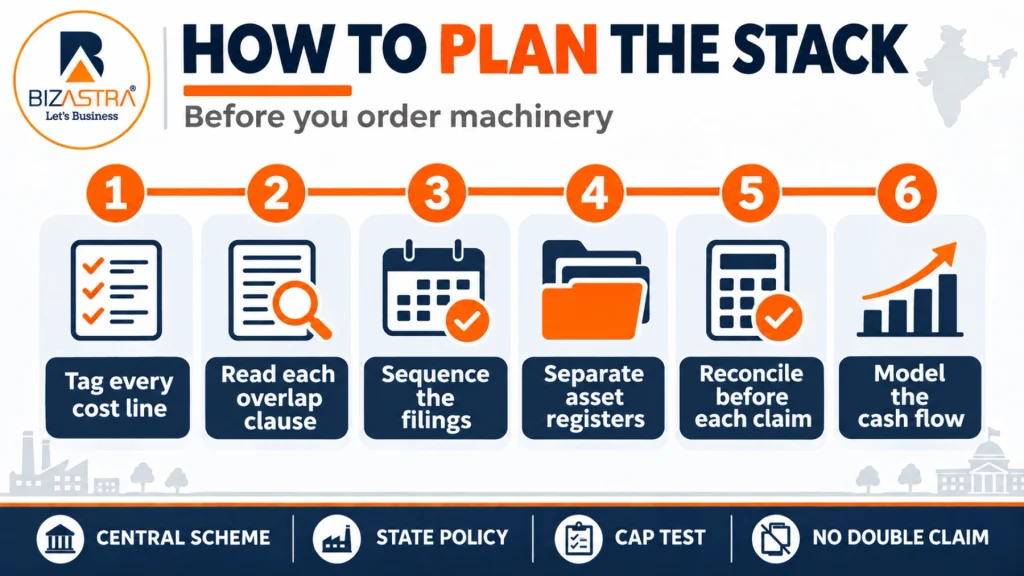
- List every cost line and every sales stream, and tag each with the scheme that will count it. A simple cost-line ledger prevents most conflicts.
- Read the overlap clause and the declaration of each scheme before applying. The undertaking text matters more than a summary.
- Sequence the filings. ECMS Segment D counts investment from the date of acknowledgement, so do not place orders first. Madhya Pradesh needs an Intention to Invest and an application within 180 days of commercial production. Maharashtra needs an Eligibility Certificate before commercial production.
- Keep clean books. Use a separate fixed asset register for each project, tag assets to the scheme claiming them, and separate trading from manufacturing sales.
- Reconcile before every claim, so the amounts in each application agree with each other and with your accounts.
- Model cash flow, not just totals. Different schemes pay at different times, and some pay only after production starts.
For individual schemes, see our guides to ECMS vs PLI, ECMS Segment D, funding R&D through the RDI Fund (RDI Fund vs bank loan vs VC and what TRL 4 means), the amusement park subsidy in Maharashtra and the MP versus Maharashtra comparison.
6. Frequently Asked Questions
Can I claim both central and state subsidy?
Often yes, if the same cost or sale is not rewarded twice where a scheme forbids it and total support stays within every cap. The rules are in each scheme’s own text.
Does ECMS allow state subsidies?
The ECMS bar on overlap refers to other schemes of the Government of India. State schemes are not named in that clause, so the state policy and your approval letter decide. You must file a management undertaking about other incentives.
Can I claim ECMS and PLI on the same product?
Not on the same investment or sales. ECMS excludes investment or sales that are incentivised under any other central scheme. Different products or separately tracked units may be treated differently.
Does Madhya Pradesh allow central assistance on top of IPP 2025?
Yes, as long as cumulative assistance does not exceed your fixed capital investment.
What is the cap on total assistance in Madhya Pradesh?
Gross investment assistance cannot exceed the fixed capital investment, which excludes land.
Can I use the RDI Fund and ECMS together?
They serve different purposes, with the RDI Fund financing R&D at TRL 4 or above and ECMS rewarding manufacturing. Ask both sides before using the same equipment under each, because ECMS also counts in-house R&D capex.
Should I apply for the central or state scheme first?
Sequence by each scheme’s timing rules. For ECMS Segment D, investment counts from acknowledgement, so file before major orders. Madhya Pradesh requires an Intention to Invest first.
7. Plan Your Subsidy Stack
Share your project, cost lines and shortlisted locations. We will map every scheme that applies, check the overlap and cap rules, and show you the combined cash flow before you commit. See our central government schemes page for the schemes we advise on.
Disclaimer: The figures above are indicative and for general understanding only, based on the Electronics Component Manufacturing Scheme guidelines (MeitY, April 2025), the Madhya Pradesh Investment Promotion Scheme 2025, the Maharashtra Industries, Investment and Services Policy 2025 and public information on the RDI Fund as of October 2026. Stacking rules differ by scheme and can change, and the example uses assumed numbers. Please consult a qualified consultant before making any investment or financial decisions.