
Quick Answer
TRL 4 means the basic components of your technology have been built and validated together in a laboratory environment. It sits one step beyond a proof of concept and one step before testing in a realistic environment. The RDI Fund (RDIF) finances companies developing technology at TRL 4 or above, so if your technology is still at the idea, paper or single-experiment stage, you are below the entry line.
1. The TRL 1 to 9 Scale
Technology Readiness Levels (TRLs) were pioneered at NASA and are now used worldwide to describe how mature a technology is, on a scale of 1 to 9. India adapted the scale for its own ecosystem through the TRL Compass platform (launched in June 2026), which groups the nine levels into three stages: proof of concept (TRL 1 to 3), prototype development (TRL 4 to 6) and market or operational deployment (TRL 7 to 9).
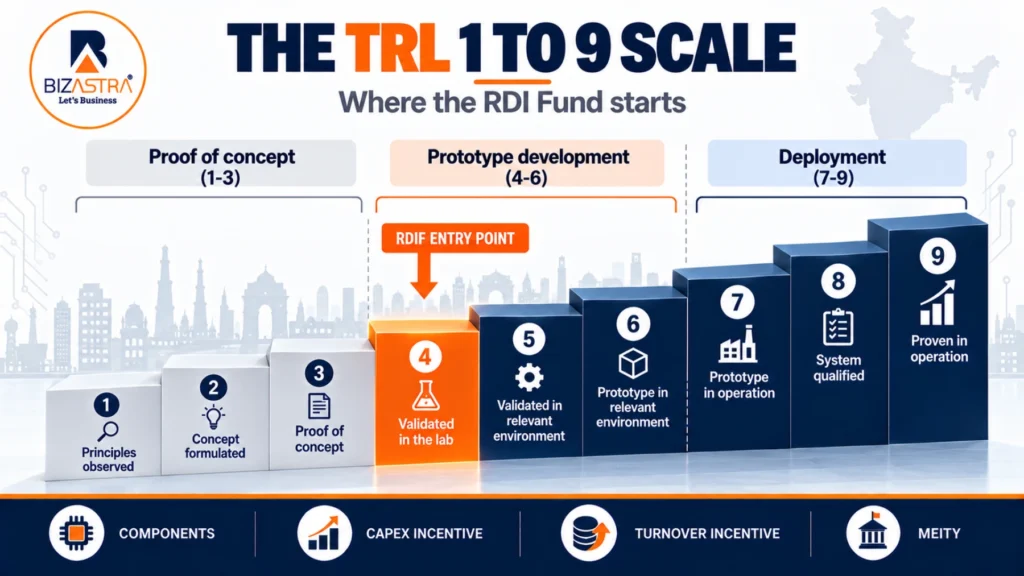
| TRL | Standard definition | In plain English | RDIF |
|---|---|---|---|
| 1 | Basic principles observed and reported | You have identified the science that could work | Below entry |
| 2 | Technology concept or application formulated | You have a defined idea and a use for it | Below entry |
| 3 | Proof of concept of a critical function | Experiments or analysis show the core idea can work | Below entry |
| 4 | Components or breadboard validated in a laboratory environment | Working building blocks, tested together in the lab against defined targets | Entry point |
| 5 | Validation in a relevant environment | Tested under conditions closer to real use | Eligible |
| 6 | Prototype demonstrated in a relevant environment | A representative prototype works under realistic conditions | Eligible |
| 7 | System prototype demonstrated in an operational environment | A near-final system is running in real conditions | Eligible |
| 8 | Actual system completed and qualified | Final system is complete and has passed qualification | Eligible |
| 9 | Actual system proven in operation | The product works in real-world operation | Eligible |
TDB’s RDIF page describes funding for entities “scaling up R&D from TRL 4 onward” and does not set an upper level. BIRAC’s RDI call has been described as supporting technology from TRL 4 to TRL 9.
Why the line sits at TRL 4: the national framework was designed partly because of a funding gap between roughly TRL 4 and TRL 7, often called the “valley of death”, where promising technology stalls between the lab and the market. That is the gap RDIF long-term loans are meant to help bridge.
2. What TRL 4 Looks Like in Practice
At TRL 4, you are no longer showing that an idea might work. You are showing that the basic pieces work together, in a controlled lab setting, against targets you defined in advance. Typical signs:
- You have built the key components, not just a single successful experiment.
- Those components have been integrated at a basic level and tested together.
- Testing took place in a laboratory environment, and the results are recorded, repeatable and measured against target performance numbers.
- You can say what is still unproven, such as behaviour at scale or in real operating conditions.
Illustrative example (energy storage). At TRL 3, a new battery material shows promising results in a small test cell. At TRL 4, you have built several cells to a defined design and tested them in the lab against target energy density and cycle life. At TRL 5, those cells are tested under realistic temperature and load. The same logic applies in other sectors: a bench-tested electronics breadboard, a software model tested on representative data in a controlled setting, or a biotech candidate validated in the laboratory. These are illustrations of the idea, not official criteria.
3. How to Evidence Your TRL
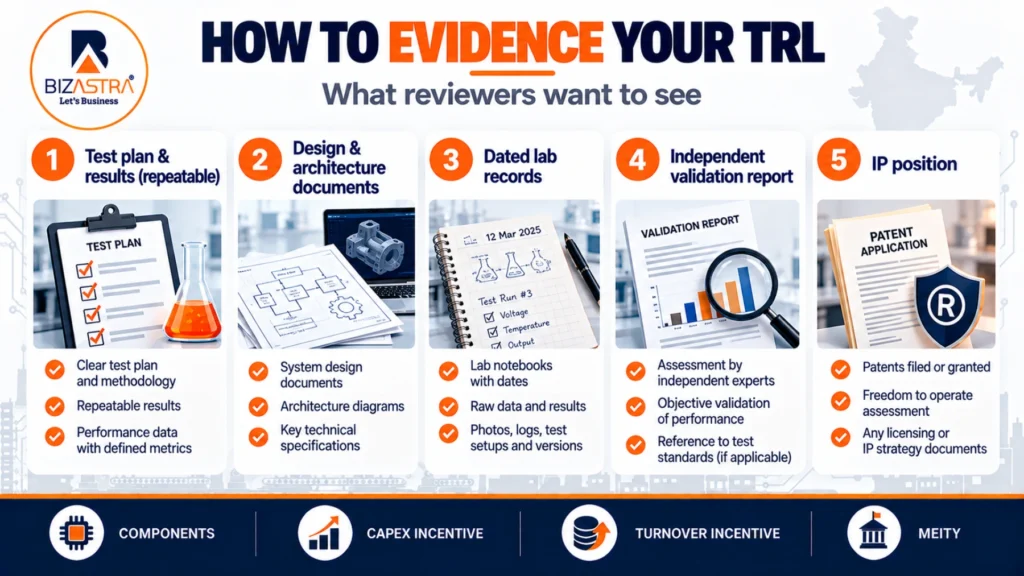
A TRL is a claim, and a fund manager will want the evidence behind it. Funds set their own application requirements, so check the specific form. In general, strong evidence looks like this:
- Test plan and results: documented tests with defined targets, methods, pass or fail criteria and raw data. Repeated runs matter more than one good result.
- Design and architecture documents: what the components are and how they connect.
- Lab records: dated notebooks, calibration records and equipment details that show where and how testing took place.
- Independent validation: a report from a university lab, research institute or accredited testing lab, where possible.
- IP position: patent filings or a documented freedom-to-operate view for the core technology.
- Self-assessment: a self-assessment on the TRL Compass platform, with a short gap list showing what stands between you and TRL 5 or 6.
Quick self-check. You are likely at TRL 4 if you can answer yes to all of these:
- Have you built the key components, not only simulated them?
- Have you tested them together as a basic system?
- Was the testing done in a laboratory environment?
- Did you measure results against targets you set in advance?
- Can you reproduce the results?
- Can you show the data and records to a third party?
- Do you know what still needs proving at TRL 5 and 6?
4. Common Misjudgements
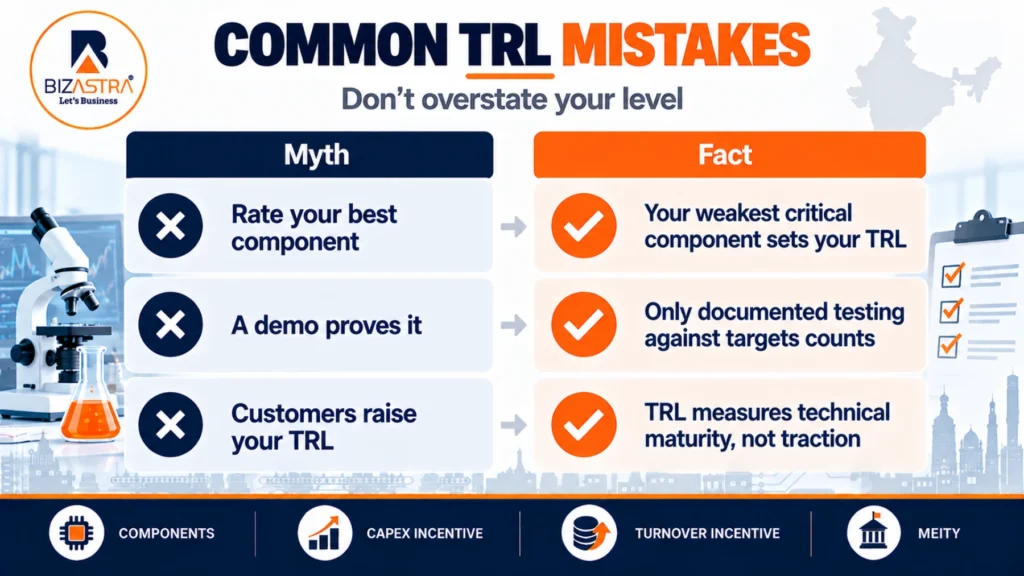
- Rating the best component, not the weakest. A system is only as mature as its least mature critical element. If one key component is still at TRL 3, your overall level is TRL 3.
- Mistaking a demo for validation. A working demo built for a presentation is not the same as documented testing against targets. Simulations alone usually sit below TRL 4.
- Confusing TRL with market readiness. Customer interest, pilots signed or revenue do not raise your TRL. It measures technical maturity, not commercial traction or design quality.
- Ignoring scale and environment. TRL depends on where and at what scale you tested. A result at tiny lab scale does not prove a larger system.
- Assessing for the wrong application. The same technology can sit at different levels for different uses. Rate it against the specific application in your project.
- Borrowing a partner’s claim. If you license technology, assess the version you will actually build, not the headline result from the original lab.
Overstating your level does more harm than understating it. Reviewers test the claim against your evidence, and a rejected or discredited application costs time you may not have.
5. If You Are Below TRL 4
If your honest assessment is TRL 1 to 3, RDIF is not the right tool yet. Its loans are long-term financing for R&D at TRL 4 and above, and the scheme does not provide grants. Your priorities are:
- Define the critical function and the performance targets that would prove it.
- Build the key components and run structured laboratory tests against those targets.
- Record everything in a way an outsider can audit.
- Fund this stage through early-stage grants, incubator or university lab access, angel money or founder funds, then reassess.
For how RDIF compares with a bank loan and venture capital once you qualify, see our guide to funding deep-tech R&D: RDI Fund vs bank loan vs VC.
6. Frequently Asked Questions
What does TRL 4 mean?
TRL 4 means the basic technological components have been built and validated together in a laboratory environment. It is the first level at which the pieces are tested as a basic system.
What TRL does the RDIF require?
TRL 4 or above. TDB describes funding for entities working at TRL 4 onward, and eligible technology entities must be developing R&D-intensive technology at that level.
Is there an upper TRL limit for RDIF?
TDB’s page does not set one. BIRAC’s call has been described as covering TRL 4 to TRL 9. Check the call you plan to apply to.
Who decides my TRL?
You state and evidence it in your application. The fund manager’s investment committee then evaluates your claim against the evidence you provide.
Is a prototype automatically TRL 4?
No. A prototype counts only if its components have been validated in a lab against defined targets. A non-functional mock-up or a one-off demo does not.
Can software or AI projects have a TRL?
Yes. The scale was written for hardware but is used for other technologies. In software, TRL 4 usually means a tested build working on representative data in a controlled setting. Confirm how your fund manager reads it.
My technology has several parts at different levels. Which TRL counts?
Your overall level is set by the least mature critical component. Plan to bring the weakest part up before you claim a higher level.
Do paying customers raise my TRL?
No. TRL measures technical maturity. Revenue and customer interest matter for other funding routes but do not change your technical level.
What if I am at TRL 3?
You are below the RDIF entry line. Focus on lab validation, build your evidence file, and reassess. See section 5.
Is the RDIF open right now?
TDB’s open call ran until 30 September 2026, and TDB said invitations would pause after that. Other fund managers are being selected. Check the TDB and ANRF RDI portals for the latest status.
7. Not Sure Where Your Technology Stands?
Our team will review your evidence and give you an honest read on your TRL, so you know whether to apply for the RDI Fund now or build up your file first.
Confirm Your TRL With Our Team
Disclaimer: The information above is general and for understanding only, based on publicly available material on Technology Readiness Levels and the Research, Development and Innovation (RDI) Fund as of September 2026. How a fund manager assesses readiness depends on its own guidelines, application form and investment committee. Please consult a qualified consultant before making any investment or financial decisions.