
Quick Answer
For deep-tech R&D at Technology Readiness Level 4 or above, the RDI Fund (RDIF) is the cheapest capital on offer: collateral-free loans at about 3% to 4% over 12 to 15 years, covering up to 50% of project cost, with no dilution in loan mode. A bank loan is faster and works for asset-backed spending, but it is costlier and rarely funds R&D risk. Venture capital costs the most (ownership, not interest) but is the only route that can fund the other 50% without repayment pressure. Most serious projects end up blending two of the three.
1. The Three Funding Routes
RDIF. The Research, Development and Innovation Scheme was approved by the Union Cabinet on 1 July 2025 with a corpus of Rs 1 lakh crore over six years, and launched on 3 November 2025. Money flows from a Special Purpose Fund under the Anusandhan National Research Foundation to second-level fund managers. TDB and BIRAC (for biotech) were the first two appointed. They lend to private companies developing technology at TRL 4 or above. See our RDI Fund advisory page for the full financing terms.
Bank or NBFC loan. Conventional term debt from a bank or non-bank lender, priced off the lender’s benchmark rate and usually secured against assets or a guarantee. Micro and small enterprises may access collateral-free lending through the CGTMSE guarantee route, subject to its limits.
Venture capital. Equity investment from a VC fund or angel investors. You give up a share of the company instead of paying interest, and the investor expects a large exit.
One point of context: TDB has approved 22 projects with a total project cost of Rs 4,744 crore and RDIF support of Rs 2,192 crore, as informed to Parliament in July 2026. That is roughly 46% of project cost, consistent with the scheme’s 50% cap. BIRAC had shortlisted 8 projects worth Rs 390 crore.
2. Cost of Capital Compared
RDIF (via TDB): interest of about 3% to 4% for 12 to 15 years, depending on the project. Loans are collateral-free and paid out in tranches against milestones, with repayment starting after a moratorium.
Bank loan: rates depend on your credit profile. Public sector bank MSME loans are listed in a range of roughly 7.75% to 9.2% for well-rated borrowers, against an RBI repo rate of 5.25% (as of September 2026). Pre-revenue R&D borrowers with weak collateral usually pay more, and unsecured NBFC borrowing costs more still.
Venture capital: no interest, but a real cost. A typical early round takes roughly 15% to 25% of the company, and that share stays with the investor through every later round.
Illustration. Suppose your project costs Rs 20 crore. You raise Rs 10 crore from RDIF at 3.5% and fund the other Rs 10 crore yourself. Opening-year interest on the RDIF loan is about Rs 35 lakh. The same Rs 10 crore at 9% would cost about Rs 90 lakh, a gap of roughly Rs 55 lakh a year before repayments. If you instead sold equity for Rs 10 crore at a Rs 40 crore pre-money valuation, you would give up 20% of the company. If the company is later worth Rs 500 crore, that stake is worth Rs 100 crore.
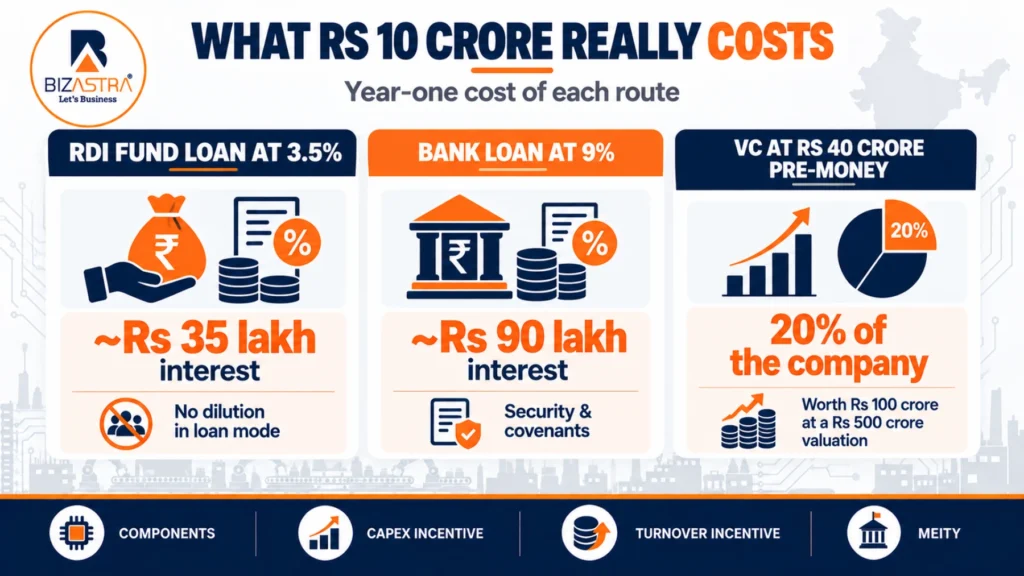
| Rs 10 crore raised through | Year-one cost | What you give up |
|---|---|---|
| RDIF loan at 3.5% | About Rs 35 lakh interest | Nothing in basic loan mode; loan must be repaid |
| Bank loan at 9% | About Rs 90 lakh interest | Security, covenants, possibly personal guarantees |
| VC at Rs 40 crore pre-money | No interest | 20% of the company (worth Rs 100 crore at a Rs 500 crore valuation) |
3. Control and IP
- RDIF loan: no shareholding in the basic loan mode. There are two optional structures. In loan plus equity, TDB can take equity of up to 25% of the assistance, with TDB holding no more than 25% of the company. In a loan-to-equity structure, up to 20% of the sanctioned debt can convert into equity at a pre-agreed discounted valuation if you later raise a much higher round. Read the sanction terms for any conditions on your technology.
- Bank loan: no ownership stake, but expect security over assets, financial covenants and, in some cases, personal guarantees from promoters.
- Venture capital: a board seat, investor protection rights and a liquidation preference are common. The investor will also push for a growth path that leads to an exit.
4. Tenure and Risk
RDIF has the longest patience: 12 to 15 years, with a moratorium before repayment starts. That suits R&D that takes years to reach revenue. The trade-off is that it is still a loan. You must repay it, and you must be able to fund the remaining half of the project yourself, through internal funds, private investors or commercial finance. The scheme does not provide grants, and it does not provide short-term loans.
Bank debt is shorter and starts amortising sooner, which strains a company with no revenue yet. Venture equity has no repayment date, but it has an implied clock: investors typically want an exit within a fund’s life, so growth pressure replaces repayment pressure.
There is also access risk. RDIF depends on fund manager calls, investment committee decisions and disbursement timelines. Do not treat an expected RDIF sanction as certain cash when you plan payroll or supplier orders.
5. Who Qualifies for the RDIF
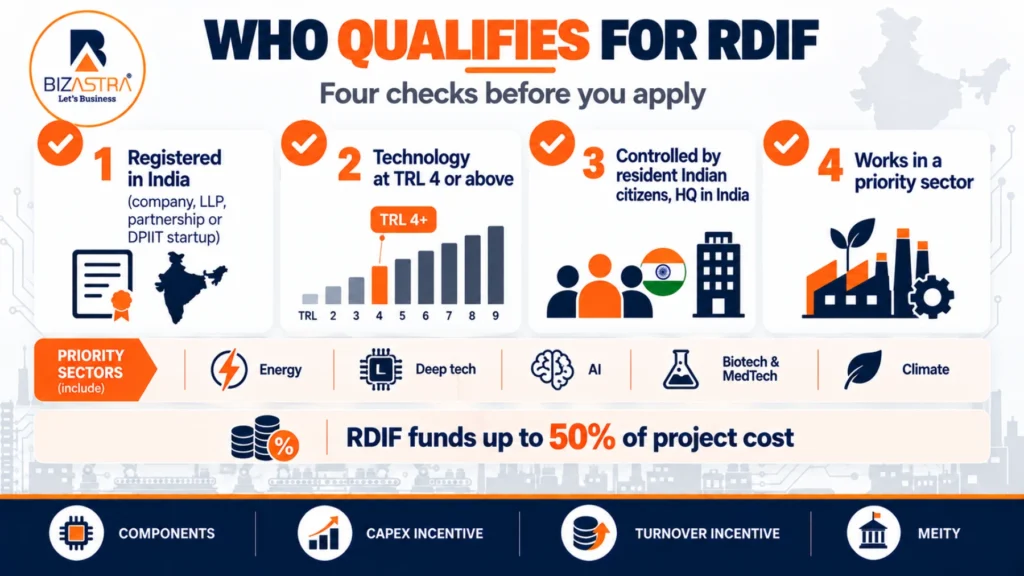
An eligible technology entity is a legal entity registered in India (a company, LLP or partnership, including DPIIT-recognised startups) that:
- Is engaged in developing R&D-intensive technology at TRL 4 or above (technology validated in a laboratory environment).
- Is under the control of resident Indian citizens, as defined in the FDI policy, and has its registered global headquarters in India.
- Works in a priority area: energy security and transition, deep technologies (quantum, robotics, space, semiconductors and electronics, advanced manufacturing, photonics, advanced materials), artificial intelligence, biotechnology and medical technologies, digital economy, climate action, or biomanufacturing and synthetic biology.
Financing is up to 50% of the assessed project cost, with the rest coming from you. In exceptional or strategic cases, the government can relax that limit. If you are unsure of your TRL, see our guide on what TRL 4 means and how to evidence it.
6. When Each Route Wins
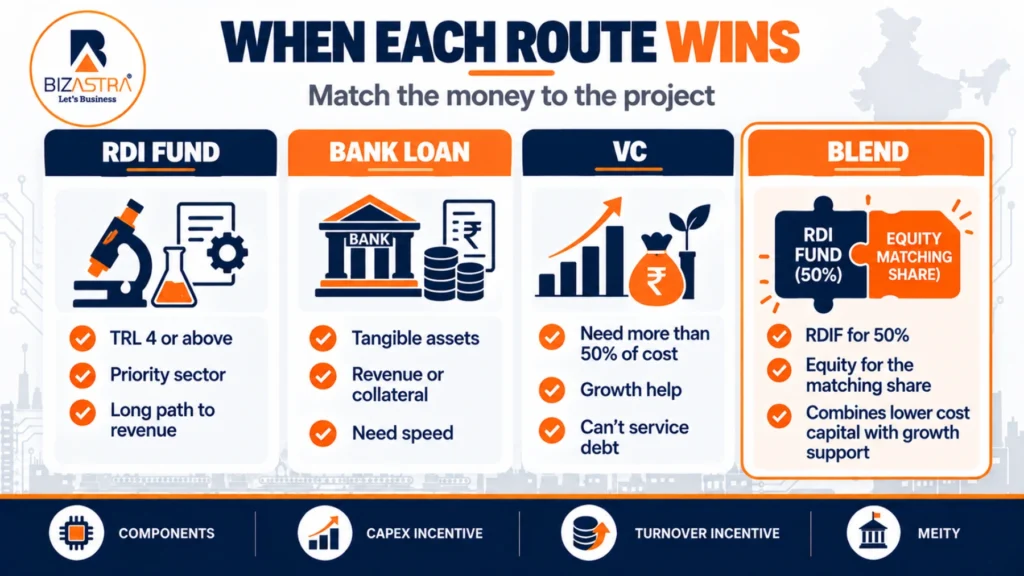
- RDIF wins when you are at TRL 4 or above, in a priority sector, with a long path to revenue and enough own funds or investors to match 50% of the cost. It is the lowest-cost, longest-tenor money available.
- A bank loan wins when the spend is on tangible, financeable assets, you have revenue or collateral, the ticket is modest, and you need money faster than a fund process allows. It also fits projects below TRL 4 that RDIF will not touch.
- VC wins when you need more than half the project cost, need strategic help or market access, cannot service debt yet, or sit outside RDIF’s priority areas.
- A blend often wins. For example, an RDIF loan covering half the cost, with venture or angel equity supplying the matching contribution. That keeps dilution lower than an all-equity round and satisfies the scheme’s requirement that you bring the rest.
7. Side-by-Side Comparison
| RDIF (via TDB) | Bank / NBFC loan | Venture capital | |
|---|---|---|---|
| Cost | About 3% to 4% interest | Roughly 7.75% to 9.2% for well-rated MSMEs; higher for riskier or unsecured borrowers | No interest; typically 15% to 25% ownership per round |
| Share of project cost | Up to 50% | Depends on assets, cash flow and lender appetite | Whatever the round size and valuation allow |
| Tenure | 12 to 15 years, with a moratorium | Shorter; repayment starts sooner | No repayment; exit expected within the fund’s life |
| Collateral | Collateral-free | Usually required, or guarantee-backed for micro and small units | None |
| Dilution | None in basic loan mode; limited equity in optional structures | None | Yes, with investor rights |
| Entry gate | TRL 4+, Indian-controlled, priority sector, own 50% share | Credit profile, security, cash flow | Team, market size, traction |
| Speed | Slower; depends on open calls and committee decisions | Fastest | Medium; depends on market |
| Best for | Long-horizon R&D at TRL 4+ | Asset-backed spend and working capital | Fast growth needing more than 50% of cost |
8. Frequently Asked Questions
What is the RDIF?
A Rs 1 lakh crore central government scheme, approved in July 2025 and launched in November 2025, that provides long-term, low-interest financing to private companies developing technology at TRL 4 or above. It works through second-level fund managers such as TDB and BIRAC.
What interest rate does the RDIF charge?
Through TDB, the stated rate is about 3% to 4% for 12 to 15 years, depending on the project. Other fund managers may set their own terms.
Is the RDIF a grant?
No. It does not provide grants. It provides long-term loans, with optional equity or conversion features in some structures.
Is the RDIF open for applications right now?
TDB’s open call ran from 4 February 2026 to 30 September 2026, and TDB said invitations would pause after that. BIRAC ran a biotech call with a first-phase deadline of 31 March 2026, and further fund managers are being selected. Check the TDB and ANRF RDI portals for the latest status.
Can a startup apply?
Yes. Startups recognised by DPIIT are covered, provided they are Indian-controlled, headquartered in India and working at TRL 4 or above.
Does the RDIF pay 100% of project cost?
No. It finances up to 50% of assessed project cost. You must arrange the rest yourself, through your own funds, private investors or commercial finance.
Can I combine RDIF with venture capital?
Yes. Equity from private investors is one way to meet your own share of the cost, and it can reduce dilution compared with funding the whole project through equity.
Can I get a bank loan if I am pre-revenue?
It is difficult. Banks lend against assets, cash flow or guarantees. If you have fixed assets to finance, a bank loan may still work for that portion, but it rarely funds R&D risk itself.
Does the loan need collateral?
RDIF loans through TDB are described as collateral-free. Bank loans usually need security, unless a credit guarantee scheme applies to your unit.
9. Want to Know If You Qualify for RDIF?
Get a free RDIF eligibility check covering your TRL, sector fit, project cost and how to structure the matching 50%, before you commit to a funding route. Learn more on our RDI Fund advisory page.
Get a Free RDIF Eligibility Check
Disclaimer: The figures above are indicative and for general understanding only, based on publicly available information on the Research, Development and Innovation (RDI) Fund and general market practice as of September 2026. Terms differ by fund manager, project, lender and investor, and scheme rules can change. Actual outcomes depend on your project, technology readiness, financials and the terms offered to you. Please consult a qualified consultant before making any investment or financial decisions.